|
VOOZH | about |
|
VOOZH | about |
I graduated with a degree in Bachelor’s of Commerce from Delhi University and decided to pursue Data Science as a career. During the first 3 months of my learning journey where I was taught basic programming, I quickly jumped from there without paying any heed to practice. Call it my ignorance or the excitement to learn algorithms and build models, I regret that decision to this date.
The time I could have saved in long run by simply being good at basic programming could have been unfathomable.
And Yes! You heard it absolutely right. You do not need to have hardcore programming skills to be a data scientist. Being really good at the basic skills will help you in ways that might have skipped your thought.
So in this article, we are going to explore in detail the role programming plays in data science. If you are from a non-programming background transitioning to data science, search no more.
Data Science has become one of the most reputed and aspired career options today. I recommend you check out our Certified AI & ML BlackBelt Plus Program and start your Data Science journey.
Let us go through a couple of real-life scenarios that data scientists go through, where good programming skills could have saved you a lot of your time.
Suppose you are participating in a Kaggle Competition with a very large dataset and 30 days’ time to complete. Here your programming skills will not only determine whether you complete and submit your model, but the quality of your work will also be dependent on how good you are at your programming skills.
Often, you need to learn, understand and implement some new code that is complex but efficient in cleaning such vast data. Now if you do not have the capability to understand the code syntax, you will either miss out on the deadline or you will only be able to do basic cleaning and create a below-par model which will not fetch you any medals.
Practicing is key when it comes to excelling in programming skills.
Suppose, like me, you skipped through the initial stages and started learning to create models using advanced machine learning algorithms like SVM. Now, these are algorithms that require execution for multiple loops and whatnot!
Now, if your programming skills are not good by this stage, there is a very high chance that you will not understand what each step meant and will definitely hinder your journey.
As I said before, a person from a non-programming background transitioning to data science should be good at the basic tasks of programming. Let’s have a look at these tasks-
This is one of the easiest and the basic programming skills that a data scientist should know. This simple statement has immense applications when it comes to breaking our own and analyzing data.
A practical example of the use of conditional statements will be an HR trying to identify whether an employee is eligible for promotion or not based on his annual performance metric. Let’s say the benchmark score is 75. So the HR can easily use the conditional statement and segregate employees having a score of 75+ into the eligible for promotion category and else, not.
These lines of code help you command your language to perform a repetitive task without you manually typing the code every time a task has to be repeated.
For example, if you want to command your language to print “Larry is a good player” 1000 times, you simply use a looping construct (for loop to be precise) to print the statement 1000 times.
This is the most ignored yet the most important aspect of programming. Even though to perform various functions there are pre-defined libraries to solve the problem, in many situations you are required to define your own functions to efficiently perform the function.
For example, let’s say that in multiple steps of model building you are required to add a number(say – 5) and then multiply it with the result of the previous code line. Rather than repetitively writing multiple lines of code, you can simply pass the function in one line each time.
Data structures are constructs around which you do your programming. Different data structures help you store different types of data in a particular manner. Prominent data structures which you need to understand well include-
Once you have the data imported to your programming language, you will be required to slice and check only a certain portion of the data. Or you will be required to index through data having a particular variable value.
For example, you work in a hospital and you need data of all patients currently at the 2nd stage of cancer.
Our Certified AI & ML BlackBelt Plus Program teaches you all the programming you need with the necessary 1:1 mentorship required at each stage.
Once you identify the objective, you need to collect the relevant data. Either the data will have to be imported from your local system or you will have to retrieve it from the database of the organization. In both cases, you are required to code. And the programming skills required to extract data from a database are a tad bit technical than the former activity.
Clean data is an absolute must for your model to understand the rules of the data and create the best possible models. Identifying and imputing missing values, variable transformations, creating multiple loops, and defining functions are some of the common activities for which you will be required to code.
Before you create models, a major effort is exerted in understanding each and every variable of the data. You will be required to individually visualize them to check distributions, plus you will also need to compare 2 variables to check if they have a relationship or not.
Furthermore, often you will need to make complex visualizations, and good programming skills go a long way.
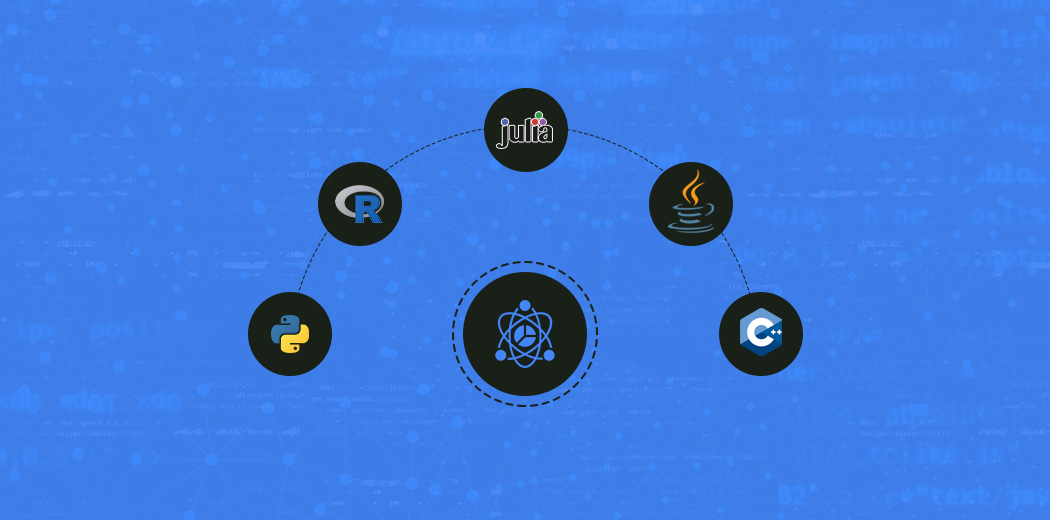
With the world of data science progressing faster and faster, myriad programming languages have been developed. Let’s have a look at the most prominent ones. Some of the most prominent languages include-
I recommend Python as the language to begin with. It is the most popular programming language in the data science community. From courses to data science competitions, a majority of activities in the data science domain happens around Python.
Python is a general-purpose, high-level interpreted language that has been growing rapidly in the applications of data science, web development, rapid application development. Its ease of use and learning has certainly made it very easy to adapt for beginners.
To learn about other languages and choose the right programming language for you, I recommend you go through the following article-
5 Popular Data Science Languages – Which One Should you Choose for your Career?
I hope you understand how paramount the concept of programming is for a data scientist to be efficient in his tasks. Better programming skills will definitely provide the necessary edge that multi-disciplinary fields like data science requires.
Do check out our Certified AI & ML BlackBelt Plus Program to not only excel in programming but also learn data science and be industry-ready.
Reach out to us in the comments below and let us know if you have any doubts.
A. Programming is fundamental in data science, enabling tasks like data manipulation, analysis, and model implementation, crucial for extracting insights and creating valuable solutions.
A. Coding empowers data scientists to automate tasks, handle complex analyses, and build machine learning models, fostering efficiency, reproducibility, and innovation in data-driven decision-making processes.
A. Coding is essential in data analytics for data cleaning, transformation, and statistical analysis. It allows analysts to derive meaningful insights, create visualizations, and automate repetitive tasks, enhancing analytical capabilities.
A. Using a programming language in data analysis provides flexibility, scalability, and control over data processing. It enables customization, facilitates collaboration, and supports the integration of advanced statistical and machine learning techniques for comprehensive analysis.
My name is Abhiraj. I am currently a manager for the Instruction Design team at Analytics Vidhya. My interests include badminton, voracious reading, and meeting new people. On a daily basis I love learning new things and spreading my knowledge.
GPT-4 vs. Llama 3.1 – Which Model is Better?
Llama-3.1-Storm-8B: The 8B LLM Powerhouse Surpa...
A Comprehensive Guide to Building Agentic RAG S...
Top 10 Machine Learning Algorithms in 2026
45 Questions to Test a Data Scientist on Basics...
90+ Python Interview Questions and Answers (202...
8 Easy Ways to Access ChatGPT for Free
Prompt Engineering: Definition, Examples, Tips ...
What is LangChain?
What is Retrieval-Augmented Generation (RAG)?
Edit
Resend OTP
Resend OTP in 45s