VOOZH about

URL: https://www.analyticsvidhya.com/blog/2022/04/data-engineering-sql-vs-nosql-databases/

⇱ Data Engineering: SQL vs. NoSQL Databases - Analytics Vidhya


India's Most Futuristic AI Conference Is Back – Bigger, Sharper, Bolder

  • d
  • :
  • h
  • :
  • m
  • :
  • s

Data Engineering: SQL vs. NoSQL Databases

Debasish Kalita Last Updated : 08 May, 2022
6 min read

This article was published as a part of the Data Science Blogathon.

Introduction

Application developers must consider various factors when selecting a database to purchase. There are numerous commercial databases available, each with its client benefits. SQL (relational database) and NoSQL (non-relational database) are the two main types of databases. This article will look at the differences between them and how they assist developers.

Many people are familiar with Relational Database Management Systems (RDBMS), and the Structured Query Language (SQL) used to communicate with them, from analysts and engineers to IT decision-makers. While these names refer to a decades-old paradigm still widely used, the sheer range and depth of database systems available today might be overwhelming.

πŸ‘ Image
Source: Medium.com

Furthermore, growing volumes of unstructured data, storage and processing power availability, and changing analytic requirements have sparked interest in fundamentally diverse technologies. These popular alternatives to traditional RDBMSs, collectively known as NoSQL, show promise for a range of modern use cases.

Practitioners should be aware of the distinctions between SQL, NoSQL, individual Database Management Systems (DBMS), and languages, as well as the contexts in which each is best suited and how the landscape is changing, to make informed decisions about which to utilize.

What is a SQL Database?

Structured query language (SQL) is a domain-specific programming language for querying and manipulating data in a relational database supported by SQL databases. The core of the relational model is abstracting data as a set of tuples grouped into relations, which allows for abstraction over the actual representation of data and access paths.

πŸ‘ SQL database?
Source: Weired.com

The most widely used language for implementing queries in relational architecture is SQL. SQL Programming includes inserting, searching, updating, and deleting database records. SQL is used in relational databases such as MySQL Database, Oracle, MS SQL Server, Sybase, etc.

Pros of SQL databases:

  1. Flexible queries
  2. Reduced data storage footprint
  3. Data integrity semantics that is strong and well-understood

Cons of SQL databases:

  1. Rigid data models
  2. Single point of failure
  3. Limited Horizontal scalability

What is a NoSQL Database?

NoSQL is a non-relational database management system (DBMS) that does not require a set schema, avoids joins, and is scalable. For dispersed data repositories with large data storage requirements, a NoSQL database is employed. Companies like Twitter, Facebook, and Google, for example, acquire gigabytes of user data every day.

πŸ‘ NoSQL Database
Source: Medium.com

The acronym NoSQL stands for β€œNot Only SQL” or β€œNot SQL.” In 1998, Carl Strozz coined the term β€œNoSQL.” Traditional RDBMS uses SQL syntax to store and retrieve data for further analysis. On the other hand, a NoSQL database system is a group of databases that may hold structured, semi-structured, unstructured, and polymorphic data.

Pros of NoSQL databases:

  1. High performance
  2. Flexible data models
  3. High-level data abstractions
  4. Dynamic schema for unstructured data

Cons of SQL databases:

  1. Distributed systems problems
  2. Lack of flexibility in access patterns
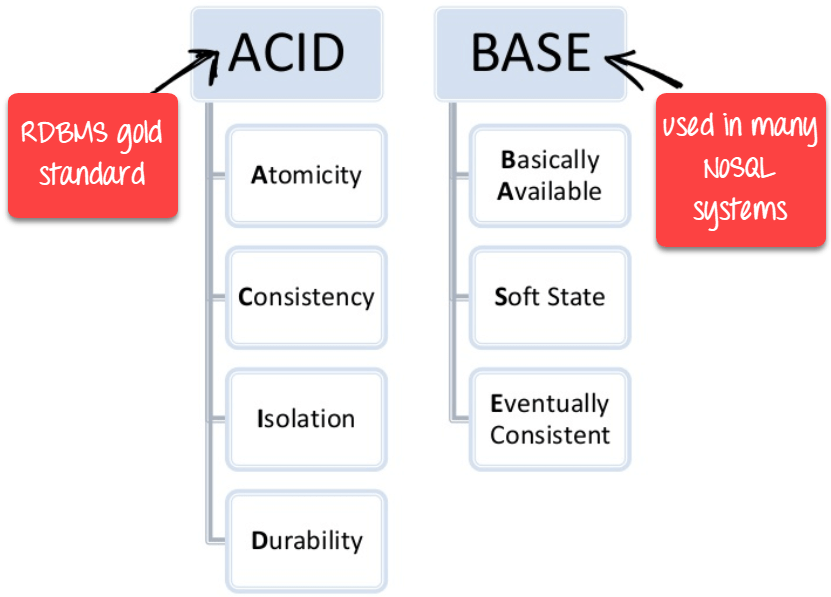
  3. Vague interpretations of ACID constraints

SQL vs NoSQL

When choosing a modern database, one of the essential factors to consider is utilizing a relational (SQL) or non-relational (NoSQL) data structure. While both are attractive options, there are several key differences that clients should examine before deciding.

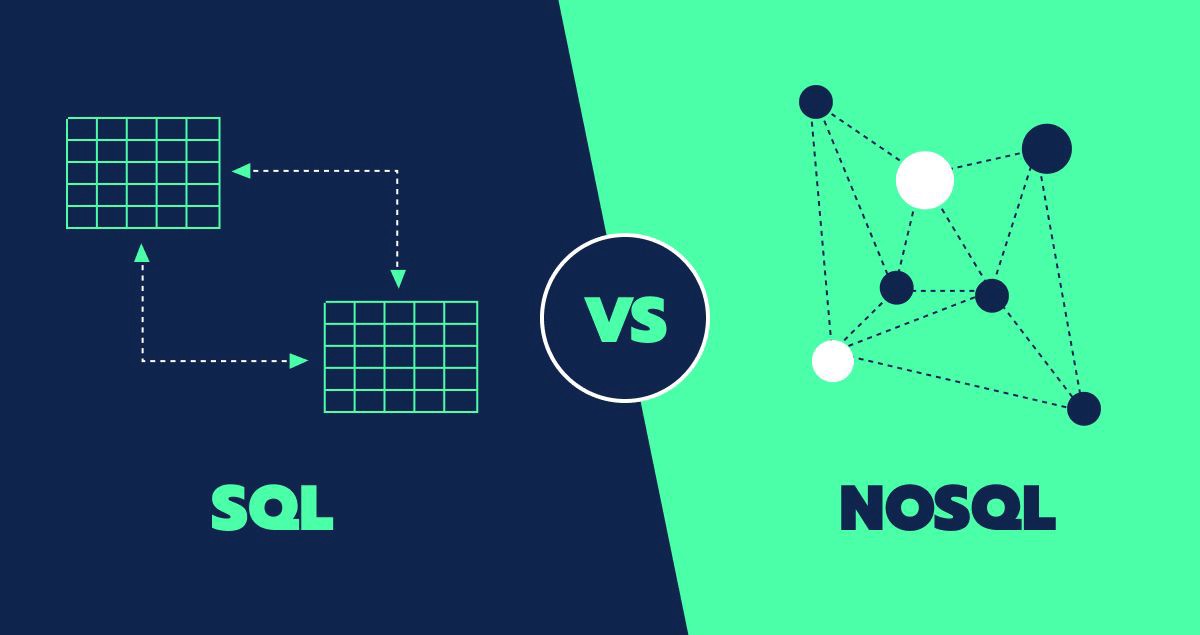
πŸ‘ SQL vs NoSQL
Source: Towardsdatascience.com

The following are the five critical distinctions between SQL and NoSQL:

  1. SQL refers to relational databases, whereas NoSQL refers to non-relational databases.
  2. SQL databases use a structured query language and have a defined schema. NoSQL databases use dynamic schemas for unstructured data.
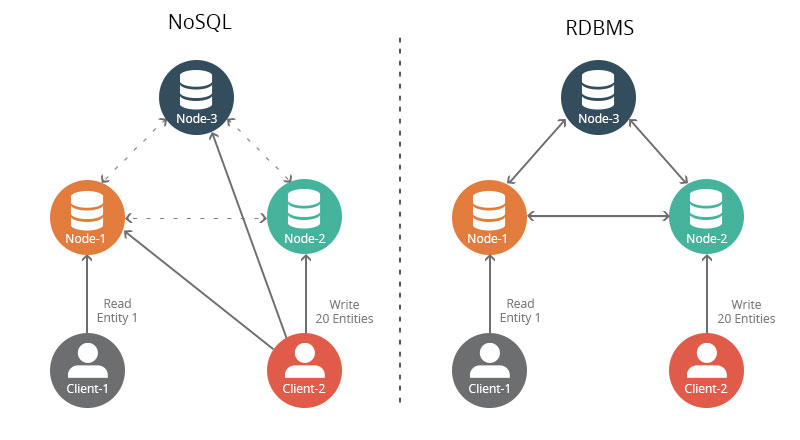
  3. NoSQL databases scale horizontally, whereas SQL databases scale vertically.
  4. Whereas SQL databases are table-based, NoSQL databases are document, key-value, graph, or wide-column stores.
  5. Multi-row transactions are a strength of SQL databases, whereas unstructured data like documents and JSON is a strength of NoSQL databases.
πŸ‘ SQL and NoSQL Image 2
Source: WordPress.com

Database Architecture

The primary distinction between these two systems is that SQL databases are relational, whereas NoSQL databases are non-relational.

Database Schemas and Query Languages

SQL databases contain a pre-defined schema for defining and manipulating data and employ structured query language. SQL is one of the most versatile and extensively used query languages, making it a safe bet for many applications. It’s ideal for queries with a lot of variables. SQL, on the other hand, can be overly restrictive. Before dealing with your data, you must first determine its structure using specified schemas. Your data must all be organized in the same way. It would be difficult and disruptive to your entire system if you ever wanted to change your data structure.

In NoSQL databases with dynamic schemas, unstructured data is stored in several ways. You can use a column-oriented, document-oriented, graph-based, or KeyValue store to store your data.

Scalability

The processing capability of existing hardware can be used to scale most SQL databases vertically. NoSQL databases employ a master-slave architecture that allows them to extend horizontally by adding more servers or nodes. These are good generalizations; however, keep in mind the following:

  1. SQL databases may also be scaled horizontally, though sharding or partitioning logic is frequently left to the user and is not well supported.
  2. While many NoSQL systems rely on a master-slave architecture, there are additional possibilities for scaling vertically.
  3. Savings from more efficient data structures can easily outweigh scalability disadvantages; the essential thing is to understand the use case and design accordingly.

Structure

SQL database schemata usually reflect relational, tabular data, consistent, and integrity standards in place. They have tables with columns (attributes) and rows (records), and keys have limited logical associations.

NoSQL databases do not have to follow this format, although they usually fall into one of four categories:

  1. Column-oriented databases convert row-oriented RDBMSs into column-oriented databases, enabling efficient storing of high-dimensional data and individual records with several properties.
  2. Key-Value Stores are dictionaries that allow you to access various objects using a unique key to each one.
  3. Semi-structured data is stored in document stores: objects that include their essential information and can be completely different from one another.
  4. Relationships are added to documents in graph databases, allowing for efficient traversal of highly connected data sets.

SQL vs NoSQL: When to Use Each?

When to use SQL?

  1. SQL is the most straightforward language for communicating with a relational database management system.
  2. Analyzing and customizing behavioural-related sessions
  3. Creating unique dashboards
  4. It allows you to store and retrieve data from a database swiftly.
  5. When you want to use joins and run sophisticated queries, this is the way.
πŸ‘ SQL Uses
Source: Specindia.com

When to use NoSQL?

  1. When ACID assistance isn’t required
  2. When the traditional RDBMS model is insufficient
  3. Data that necessitates a flexible schema
  4. Database constraints and validation logic are not necessary to be implemented.
  5. Data logging from a variety of sources
  6. It should be used to keep track of temporary data such as shopping carts, wish lists, and session information.

Sample Code

Here’s a document that describes one of the cars in the collection:

{
"_id" : ObjectId("600c626932e0e"),
"year" : "2018",
"make" : "ford",
"color" : "white",
"km" : 2200,
"price" : 42000
}

A row in SQL identifies a data point (in this case, one car).

 year make colour km price 
 2018 ford white 2200 42000

Query: Find cars made by Ford.

NoSQL (MongoDB):

> db.car.find( {make: "ford"} ).limit(1).pretty()
{
"_id" : ObjectId("600c63cf32e0e"),
"year" : "2018",
"make" : "ford",
"colour" : "white",
"km" : 2200,
"price" : 42000
}

SQL (MySQL):

mysql> select * from car
 -> where make = "ford"
 -> limit 1;
 year make colour km price 
 2018 ford white 2200 42000

Conclusion

  • The traditional database is a SQL database system that represents data and relationships using a tabular relational paradigm.
  • The schema in SQL databases is stable, static, or predetermined, whereas the schema in NoSQL databases is dynamic.
  • SQL databases are not well suited for hierarchical data storage. However, NoSQL databases are.
  • The decision between SQL and NoSQL databases depends on the project requirements rather than their differences.

The media shown in this article is not owned by Analytics Vidhya and is used at the Author’s discretion.

A graduate in Computer Science and Engineering from Tezpur Central University. Currently, I am pursuing my M.Tech in Computer Science and Engineering in the Department of CSE at NIT Durgapur. I expect to Postgraduate in the spring, 2022. A Grounded and Solution-oriented Computer Engineer with a wide variety of experiences. Adept at motivating self and others. Passionate about programming and educating the next generation of technology users and innovators.

Login to continue reading and enjoy expert-curated content.

Free Courses

Generative AI - A Way of Life

Explore Generative AI for beginners: create text and images, use top AI tools, learn practical skills, and ethics.

Getting Started with Large Language Models

Master Large Language Models (LLMs) with this course, offering clear guidance in NLP and model training made simple.

Building LLM Applications using Prompt Engineering

This free course guides you on building LLM apps, mastering prompt engineering, and developing chatbots with enterprise data.

Improving Real World RAG Systems: Key Challenges & Practical Solutions

Explore practical solutions, advanced retrieval strategies, and agentic RAG systems to improve context, relevance, and accuracy in AI-driven applications.

Microsoft Excel: Formulas & Functions

Master MS Excel for data analysis with key formulas, functions, and LookUp tools in this comprehensive course.

Responses From Readers

Flagship Programs

GenAI Pinnacle Program| GenAI Pinnacle Plus Program| AI/ML BlackBelt Program| Agentic AI Pioneer Program

Free Courses

Generative AI| DeepSeek| OpenAI Agent SDK| LLM Applications using Prompt Engineering| DeepSeek from Scratch| Stability.AI| SSM & MAMBA| RAG Systems using LlamaIndex| Building LLMs for Code| Python| Microsoft Excel| Machine Learning| Deep Learning| Mastering Multimodal RAG| Introduction to Transformer Model| Bagging & Boosting| Loan Prediction| Time Series Forecasting| Tableau| Business Analytics| Vibe Coding in Windsurf| Model Deployment using FastAPI| Building Data Analyst AI Agent| Getting started with OpenAI o3-mini| Introduction to Transformers and Attention Mechanisms

Popular Categories

AI Agents| Generative AI| Prompt Engineering| Generative AI Application| News| Technical Guides| AI Tools| Interview Preparation| Research Papers| Success Stories| Quiz| Use Cases| Listicles

Generative AI Tools and Techniques

GANs| VAEs| Transformers| StyleGAN| Pix2Pix| Autoencoders| GPT| BERT| Word2Vec| LSTM| Attention Mechanisms| Diffusion Models| LLMs| SLMs| Encoder Decoder Models| Prompt Engineering| LangChain| LlamaIndex| RAG| Fine-tuning| LangChain AI Agent| Multimodal Models| RNNs| DCGAN| ProGAN| Text-to-Image Models| DDPM| Document Question Answering| Imagen| T5 (Text-to-Text Transfer Transformer)| Seq2seq Models| WaveNet| Attention Is All You Need (Transformer Architecture) | WindSurf| Cursor

Popular GenAI Models

Llama 4| Llama 3.1| GPT 4.5| GPT 4.1| GPT 4o| o3-mini| Sora| DeepSeek R1| DeepSeek V3| Janus Pro| Veo 2| Gemini 2.5 Pro| Gemini 2.0| Gemma 3| Claude Sonnet 3.7| Claude 3.5 Sonnet| Phi 4| Phi 3.5| Mistral Small 3.1| Mistral NeMo| Mistral-7b| Bedrock| Vertex AI| Qwen QwQ 32B| Qwen 2| Qwen 2.5 VL| Qwen Chat| Grok 3

AI Development Frameworks

n8n| LangChain| Agent SDK| A2A by Google| SmolAgents| LangGraph| CrewAI| Agno| LangFlow| AutoGen| LlamaIndex| Swarm| AutoGPT

Data Science Tools and Techniques

Python| R| SQL| Jupyter Notebooks| TensorFlow| Scikit-learn| PyTorch| Tableau| Apache Spark| Matplotlib| Seaborn| Pandas| Hadoop| Docker| Git| Keras| Apache Kafka| AWS| NLP| Random Forest| Computer Vision| Data Visualization| Data Exploration| Big Data| Common Machine Learning Algorithms| Machine Learning| Google Data Science Agent
πŸ‘ Av Logo White

Continue your learning for FREE

Forgot your password?
πŸ‘ Av Logo White

Enter OTP sent to

Edit

Wrong OTP.

Enter the OTP

Resend OTP

Resend OTP in 45s

πŸ‘ Popup Banner
πŸ‘ AI Popup Banner