|
VOOZH | about |
|
VOOZH | about |
THE ASAHI SHIMBUN
June 11, 2026 at 16:39 JST
👁 Photo/Illutration
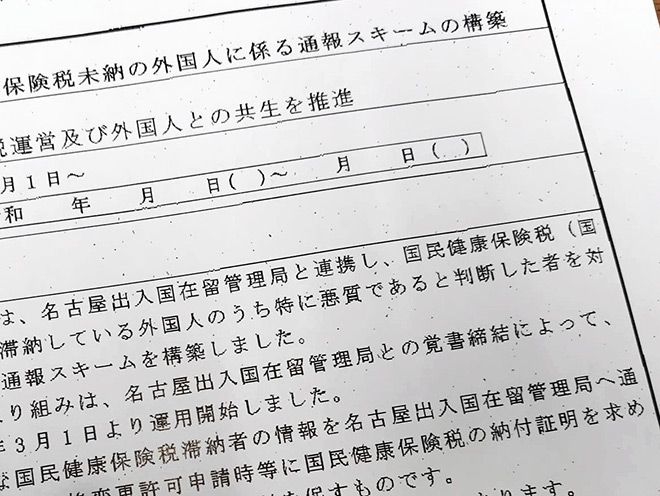
An announcement by the city of Hashima in Gifu Prefecture that it began sharing information on National Health Insurance premium delinquents with immigration authorities (The Asahi Shimbun)
In line with tightened residency status screenings, more than 100 municipalities are notifying immigration authorities of foreign residents who are deemed egregiously delinquent in paying National Health Insurance premiums.
Nonpayers can be denied residency status based on information provided by municipalities.
When screening applications for changes or renewals of residency status, authorities consider whether the applicants have fulfilled public obligations, such as paying taxes and NHI premiums.
At the end of 2020, the Immigration Services Agency started a program to collect the names, residence card numbers and other details of individuals in arrears based on the Local Tax Law from municipalities that conclude memorandums of understanding.
As of May 25, 115 municipalities were supplying such information, according to the ISA.
By last spring, 27 individuals reported under this system were denied permission to remain.
The ISA has not disclosed the names of municipalities that have signed memorandums, citing requests from the municipalities involved.
Consequently, it remains unclear to foreign residents whether the municipalities where they reside are sharing their information with immigration authorities.
Each municipality determines what constitutes egregious nonpayment and whether to provide information based on its own criteria.
Some municipalities have declined to make their criteria public, saying there is a risk they could be exploited.
Among them is Yokohama, which has supplied information on about 1,000 individuals.
The city said it factors in case-by-case judgments by staff members.
“We do not share (with immigration authorities) everyone who exceeds the threshold,” an official said.
Nagoya, which began providing information in August 2021, considers cases to be egregious if premiums from at least a year ago remain unpaid and the nonpayer fails to respond to payment reminders.
For municipalities with large foreign populations, clearing premium arrears is a common challenge that takes up labor and budget resources.
According to health ministry data, the collection rate of NHI premiums for foreign residents stood at about 63 percent among about 150 municipalities that track such data, lower than the overall rate of 93 percent that includes Japanese citizens.
Municipalities hope to use the potential negative impact on residency status screenings as leverage to encourage payment of NHI premiums.
In Tokyo’s Toshima Ward, where foreign residents account for more than 32 percent of NHI enrollees, officials were struggling to resolve arrears despite efforts to encourage nonpayers to read payment reminders, such as printing the ISA logo on the envelopes.
After the ward began sharing information with immigration authorities in fiscal 2023, “the effect has been tremendous,” an official said. “Foreign residents are now coming to the ward office of their own accord.”
The city of Hashima in Gifu Prefecture, which began providing information in March, said it is grateful for the program because it requires no additional budget outlays.
The neighboring town of Kasamatsu said it would be helpful if the arrangement could be applied to municipal and prefectural resident taxes and fixed assets taxes.
When NHI premiums go unpaid, municipalities typically send reminders, call or visit to urge payment. If these measures fail, they investigate assets and seize properties, which are standard procedures for Japanese and foreign nationals alike.
Koichi Kodama, a lawyer familiar with issues affecting foreign residents, warned that the information-sharing system risks breeding distrust of Japan.
“It is terrifying for foreign residents to have their personal information shared without their knowledge, only to be used as a factor in determining whether they are allowed to continue living in Japan,” he said.
Kodama added: “While it goes without saying that nonpayment is unacceptable, driving foreign residents out of the country for falling into arrears seems like an excessively harsh penalty compared with what Japanese citizens face.”
(This article was written by Kento Matsushima and Keiichiro Shimada.)
Japan to punish longer-term foreign residents in arrears
June 10, 2025Japan to clarify rules for foreign kids who want to stay and work
July 2, 2024Permanent residency visa revocation law gets guidelines
September 29, 2025Foreigners with permanent residency could face stricter rules
February 5, 2024Japan to double required period in the country for citizenship
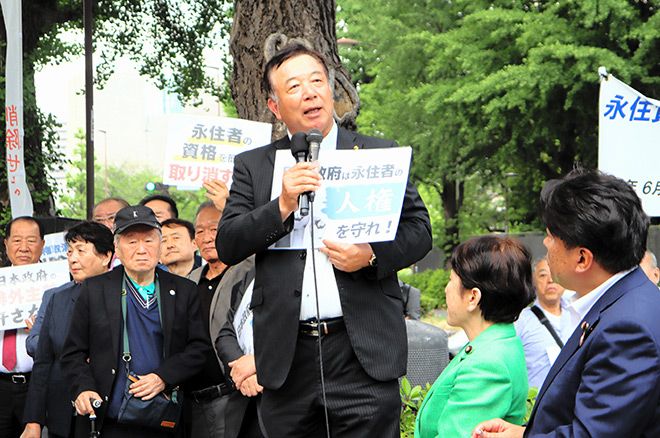
December 22, 2025Protesters attack bill on revoking permanent residency status
June 7, 2024A peek through the music industry’s curtain at the producers who harnessed social media to help their idols go global.
A series based on diplomatic documents declassified by Japan’s Foreign Ministry
Here is a collection of first-hand accounts by “hibakusha” atomic bomb survivors.
Cooking experts, chefs and others involved in the field of food introduce their special recipes intertwined with their paths in life.
A series about Japanese-Americans and their memories of World War II
Some articles on this website may contain content generated by artificial intelligence programs.
Copyright © The Asahi Shimbun Company. All rights reserved. No reproduction or republication without written permission.