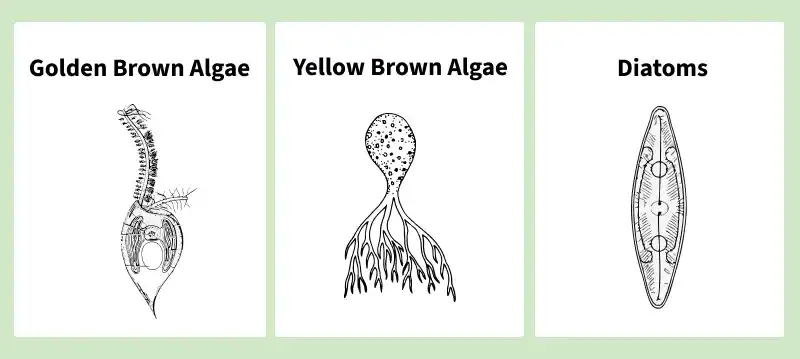
Chrysophytes are a group of microscopic, photosynthetic organisms mainly found in freshwater and marine environments. They belong to the kingdom Protista and are commonly known as golden algae because of their characteristic golden-yellow colour. This colour is due to the presence of pigments like chlorophyll a, chlorophyll c, and xanthophylls (especially fucoxanthin).
👁 alage Classification of Chrysophytes It has been classified into three groups: diatoms (Bacillariophyceae), golden-brown algae (Chrysophyceae), and yellow-green algae (Xanthophyceae).
1. Bacillariophyceae (Diatoms) Diatoms are members of the division Bacillariophyta. They are unicellular eukaryotic organisms found mainly in aquatic environments. The cell wall of diatoms is made of silica and consists of two overlapping halves, called a frustule. The two-part cell wall of diatoms is the inspiration for the name of these organisms. Examples: Dinoflagellates, diatoms, euglenoids , slime moulds, and protozoans .
2. Chrysophyceae (Golden brown algae) Golden algae, also called golden-brown algae, include about 33 genera and nearly 1,200 species of algae. They are found in both freshwater and marine (saltwater) environments. Golden algae belong to the class Chrysophyceae. Most species are unicellular and biflagellate, meaning each cell has two different flagella. They contain the pigment fucoxanthin, which gives them their golden-brown color. Their food reserve is mainly stored as oil droplets. Many species are protected by a silica cyst called a statocyst (or statospore). The surface ornamentation of the statocyst helps in distinguishing between different species. They reproduce asexually by producing motile and non-motile spores. Examples: Chrysococcus, Dinobryon, Synura .
3. Xanthophyceae (Yellow Brown Algae) Their yellow-green colour is due to the absence of the pigment fucoxanthin. The cell wall is mainly made of cellulose. They are found mostly in freshwater, but some species occur in terrestrial and marine environments. They may occur in different forms such as unicellular, filamentous, or colonial forms. Examples: Vaucheria , Tribonema
Characteristics of Chrysophytes Mostly consist of Unicellular Organisms Free-floating (Planktonic) in water Two unequal flagella . The colour of golden yellow is caused by an auxiliary pigment(Fucoxanthin). Silica and cellulose are used to make cell walls . Found in both freshwater and marine environments. Chrysophytes are photosynthetic. Cell Structure and Metabolism No uniform cell structure among all chrysophytes Some species are amoeboid and lack a cell wall Others have cell walls composed of cellulose and silica One or two flagella may be present; if two, they are usually unequal Mainly photosynthetic (autotrophic) Some golden algae become heterotrophic or mixotrophic in low light or nutrient-rich conditions Reproduction of Chrysophytes In chrysophytes, reproduction happens by cell division. Chrysophytes generate spores and reproduce asexually. The spores move around, have flagella, and are known as zoospores. Flagella are only present during reproductive stages Only diatoms exhibit sexual reproduction. Significance of Chrysophytes Chrysophytes are autotrophs that produce a large amount of oxygen by photosynthesis. Chrysophytes are also useful. Diatomaceous earth is used to filter and polish oils. As a biofuel. They are particularly important in lakes, where they may serve as the zooplankton's main food source. It decomposes dead stuff and distributes these nutrients to another part of the water body. It supports the maintenance of biodiversity. Chrysophytes produce oils or the polysaccharide laminarin as a food storage product. Related Articles: