|
VOOZH | about |
|
VOOZH | about |
Notes for NCERT Class 11 Chapter 2 Biological Classification: Biological classification is the process by which biologists group living organisms which, are classified on the basis of their similarity. Classification is essential for the convenient study of living organisms. It is required to identify different varieties of organisms. It helps in the correct identification of many organisms. It leads to the evolution of organisms. It also establishes phylogenetic relationships among organisms. Carolus Linneuas was one of the scientists to classify organisms.
NCERT Class 11 Biology Chapter 02 Biological Classification: The practice of classifying organisms based on shared characteristics is known as biological classification. Linnaeus proposed two areas of classification. He divided organisms into two kingdoms: the animal kingdom (Animalia) and the plant kingdom (Plantae). The classification of the two kingdoms had some disadvantages, such as the impossibility of distinguishing between eukaryotes and prokaryotes, unicellular and multicellular species, and photosynthetic and non-photosynthetic organisms. As a result, the field continued to grow and served as a primary example of R.H. Whittaker's classification of the five domains or kingdoms.
Two kingdom classification was given by a biologist, Carolus Linnaeus. He classified organisms into two kingdoms, i.e. Plantae (included all plants) and Animalia (included all animals).
This system didn't distinguish between the following types of organisms-
In 1969, R.H. Whittaker proposed the five-kingdom classification. He classified those five kingdoms as Monera, Protista, Fungi, Plantae, and Animalia. He primarily used the following criteria for classification:
Bacteria are the main members of this kingdom. Kingdom Monera is further divided into:
They are special bacteria as they can withstand extreme environmental conditions because of their different cell wall structure. They can be:
They have rigid cell walls and flagellum (locomotion), if motile. They can be photosynthetic autotrophs, chemosynthetic autotrophs and heterotrophs.
They reproduce by asexual mode- binary fission, sexual mode- transfer of DNA and spore formation in unfavourable conditions.
They are the smallest organisms which lack cell walls. They can survive in the absence of oxygen (anaerobic). They cause diseases (pathogens).
They are single-celled eukaryotes. They include:
| Classification of Protista | Characteristic Features | Examples |
| Chrysophytes (chief producers in oceans) | Their cell walls form two overlapping shells, which are fit together and embedded with silica which, makes them indestructible. So, cell wall deposits and their accumulation leads to ‘diatomaceous earth’. This soil can be used to polish things, and filter oils and syrups. | Diatoms and golden algae (desmids) |
| Dinoflagellates | They show rapid multiplication and make the appearance of sea red (bioluminescence). Toxins released by them can kill other aquatic animals. | Red dinoflagellates (Example: Gonyaulax) |
| Euglenoids | They have a pellicle protein-rich layer) which keeps them flexible | Euglena |
| Slime Moulds | During suitable conditions, they form plasmodium and during unfavourable conditions, plasmodium differentiates and forms fruiting bodies (spores inside) | Acrasia, Plasmodiophorina |
| Protozoans | They are heterotrophs and live as predators or parasites. They are classified into four types | Plasmodium |
| Protozoans | Features/Diseases Caused | Examples |
| Amoeboid Protozoans | They form pseudopodia to capture their prey. Some of them are parasites | Amoeba, Entamoeba |
| Flagellated Protozoans | Sleeping sickness, a disease caused by the parasitic forms | Trypanosoma |
| Ciliated Protozoans | Cilia (locomotion) and gullet, a cavity is present on the body | Paramoecium |
| Sporozoans | Some species cause malaria | Plasmodium |
Fungi are multicellular and the how heterotrophic mode of nutrition (saprophytes/parasites/symbiotic- mycorrhiza). Some fungi are unicellular, e.g. yeast.
Mushrooms and yeast are the most valuable fungi. Mushrooms are edible and are a good source of proteins. Yeast is used to make bread and cheese. Penicillium fungi are used to produce antibiotics.
Some fungi cause diseases in both plants and animals, e.g. wheat rust disease is caused by Puccinia fungus.
There are three modes of reproduction in fungi, i.e. vegetative, asexual and sexual.
In ascomycetes and basidiomycetes, the dikaryotic stage (n + n, i.e., two nuclei per cell) is formed, known as dikaryon and the phase is dikaryophase.
| Classification of Fungi | Characteristic Features | Examples |
| Phycomycetes | They grow on decaying wood in moist sites and obligate parasites on plant bodies | Mucor, Rhizopus (bread mould fungi) and Albugo (parasitic fungi on mustard) |
| Ascomycetes (sac-fungi) | Neurospora is used in biochemical and genetic work. Some are edible, e.g. morels and truffles | Penicillium, yeast, Aspergillus, Claviceps and Neurospora |
| Basidiomycetes | Some are edible, e.g. mushrooms. Mushrooms are rich in protein | Agaricus (mushroom), Ustilago (smut) and Puccinia (rust fungus), Mushrooms, bracket fungi, puffballs |
| Deuteromycetes | They are known as 'Imperfect Fungi' because in this group, only asexual or vegetative phases are seen. Some fungi of this group are saprophytes or parasites while the majority are decomposers of litter, which aid in mineral cycling | Alternaria, Colletotrichum and Trichoderma |
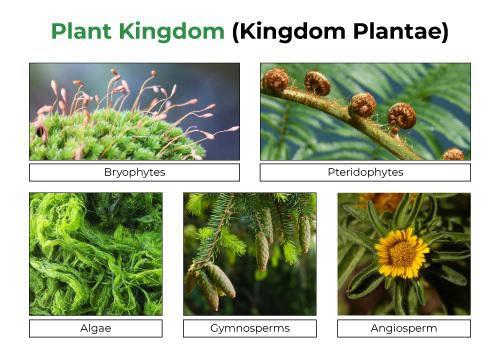
All eukaryotic organisms that contain chlorophyll, usually known as plants, are classified as Plantae. A few species, like parasites and plants that feed on insects, are partially heterotrophic. Insectivorous plants include bladderwort and Venus fly traps, and parasites like Cuscuta feed on them. The eukaryotic structure of plant cells has large chloroplasts and a cell wall comprised primarily of cellulose. Algae, bryophytes, pteridophytes, gymnosperms, and angiosperms are all part of the plant kingdom.
The haploid gametophytic and the diploid sporophytic phases of a plant's life cycle alternate with one another. Various plant families have different haploid and diploid phase lengths and whether they are independent or reliant on others.
They are multicellular and heterotrophic (show the holozoic mode of nutrition) eukaryotes. They lack cell walls. Almost, all the animals show locomotion. Sexual reproduction occurs by the fusion of male and female gametes which give rise to an embryo followed by repeated cell divisions.
The differences between viruses, viroids and prions are given below:
| Viruses | Viroids | Prions |
| They are oblique intracellular agents | They are oblique intracellular agents | They are the abnormal form of a cellular protein |
| They have either DNA or RNA which is surrounded by a protein coat | They consist of only RNA. The protein coat is absent | They don't possess DNA or RNA. Only protein coat is present |
Bacteriophages are also known as phages. These are the viruses which infect and replicate in the bacterial cells.
The tobacco mosaic virus (TMV) consists of single-stranded RNA. It infects tobacco plants and members of the family Solanaceae. The infection can cause some patterns like a mosaic, which shows mottling and discolouration on the surface of the leaves.
The close association of fungus and algae form lichens. They are found in a pollution-free environment. Lichens are used in deodorant, pH papers, insense-sticks, toothpaste and perfumes. The fungal component is known as mycobiont and the algal component is known as phycobiont.