|
VOOZH | about |
|
VOOZH | about |
Multi-cloud and hybrid cloud are two increasingly popular strategies in the booming IT sector. Despite cloud computing being over a decade old, businesses continue to reap new benefits as the technology matures. What began as private, on-premises infrastructures has evolved into public solutions controlled by major third-party corporations (like AWS, Google Cloud, and Microsoft), paving the way for advanced hybrid and multi-cloud environments.
While both approaches offer significant benefits such as enabling organizations to provide services more effectively and productively they require careful planning and management to ensure optimal performance and security.
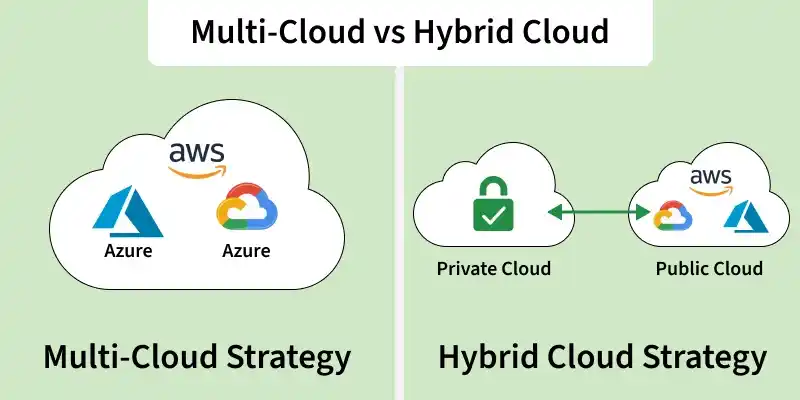
A multi-cloud strategy involves dispersing cloud-based assets, software, and applications across multiple cloud environments and providers.
Key Characteristics:
Practical Example: An organization might run certain applications exclusively on Microsoft Azure, while other separate applications rely entirely on AWS. Alternatively, an application might conduct all computational and networking operations on one cloud service while utilizing database services from a completely different provider.
A hybrid cloud is a combination of a private cloud (typically on-premises data centers) and public cloud services provided by third parties.
Key Characteristics:
Practical Example: An application running on a hybrid cloud platform might use a public cloud for web services and load balancing to handle traffic spikes, while keeping its sensitive databases and storage securely housed in a private, on-premises cloud structure.
| Parameters | Multi-Cloud | Hybrid Cloud |
|---|---|---|
| Philosophy | Multi-Cloud is a term that refers to the use of two or more public clouds, such as AWS, Azure, and Google multi-Cloud. | Hybrid clouds, such as an OpenStack private cloud and AWS, combine private and public clouds. |
| Multiple Public Cloud | Always required. | Based on requirements. |
| Concept | It is based on public clouds. | It is based on private cloud and public cloud. |
| Data Security | The data of users is kept safe by the public cloud provider. | The data of users is safe on the cloud, whether it is private or public. |
| Data Sharing | Cloud-to-cloud data transfer is possible. | Cloud data can be shared between them. |
| Unified Security | It is difficult to implement. | It is possible to implement. |
| Tool Support | Support for third-party operational tools should be prioritized. | Support for native ops tools should be prioritized. |
| Tools and security controls | Only public clouds have distinct security limits and tools. | Public and private clouds have various security limits and tools. |
| Analytics | Third-party performance analytics should be prioritized. | Concentrate on native performance statistics. |
| Cost management | Multi-Cloud will concentrate on third-party cloud utilization and cost control. | The emphasis in the Hybrid Cloud will be on native cloud usage and cost control. |