Google Cloud Platform - Introduction to Cloud Spanner
Last Updated : 13 Mar, 2026
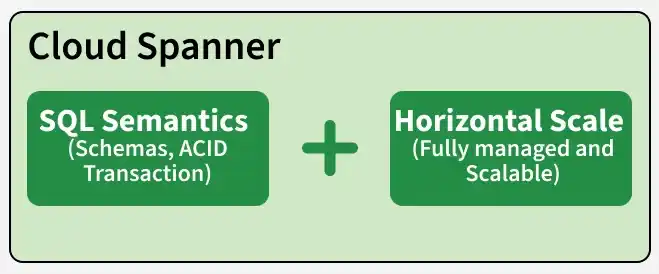
Google Cloud Spanner is a fully managed, globally distributed relational database service provided by Google Cloud. It combines the strong consistency and structured schema of traditional relational databases with the horizontal scalability of NoSQL systems. Cloud Spanner is designed for mission-critical applications that require high availability, global scale, and transactional consistency. It eliminates the trade off between consistency and scalability that exists in most database systems.
Google Cloud Spanner is a globally distributed SQL database that supports:
ACID compliant transactions.
Strong consistency across regions.
Automatic horizontal scaling.
High availability with minimal operational overhead.
Unlike traditional databases that scale vertically, Spanner scales horizontally across regions while maintaining relational semantics.
CPU and memory resources, Query processing power and Transaction execution.
Google Cloud Spanner Working
Google cloud Spanner working include following steps:
1. Client Request An application sends a SQL query or transaction request.
2. Query Routing The request is routed to the nearest healthy replica.
3. Transaction Coordination For write operations, the leader replica coordinates via Paxos.
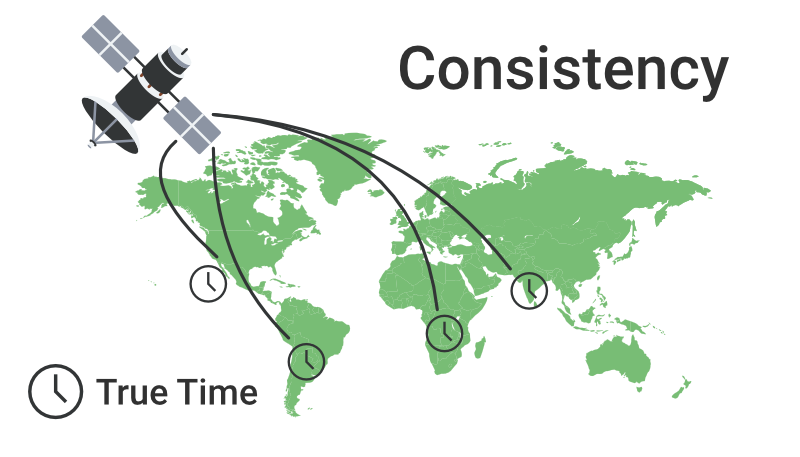
4. TrueTime Validation TrueTime ensures global transaction ordering and consistency.
5. Replication Data is synchronously replicated across replicas.
6. Response The result is returned to the client with strong consistency guarantees.
Consistency Model
Cloud Spanner provides:
External consistency (strict serializability): Ensures that transactions appear to execute in a globally consistent order that matches real-world time.
Read-write transactions: Allow applications to perform multiple reads and writes atomically while maintaining full ACID guarantees across regions.
Stale reads: Enable low-latency read operations by allowing reads from replicas that may not contain the most recent data, improving performance for global users.
This makes Spanner suitable for applications where correctness is critical.
Security in Cloud Spanner
Encryption at rest and in transit
IAM-based access control
Private IP connectivity
Audit logging and monitoring
Performance and Scalability
Automatic sharding of data
Linear scalability with node addition
No downtime during scaling operations
Optimized for high throughput and low latency
Common Use Cases
1. Global Financial Systems
Banking platforms
Payment processing systems
Fraud detection applications
2. Large-Scale SaaS Applications
Multi-tenant SaaS platforms
Enterprise business applications
3. E-commerce Platforms
Inventory management
Order processing
Global user traffic handling
4. Gaming and Media Platforms
Real-time multiplayer games
Global leaderboards
User session tracking
Key Features of Cloud Spanner
Key features of Google Cloud Spanner includes:
1. Global Distribution
Replicates data across multiple geographic regions to serve users with low latency.
Ensures data durability and fault tolerance even during regional failures.
Enables applications to operate seamlessly at a global scale.
2. Strong Consistency
Guarantees that all transactions are committed in a globally consistent order.
Ensures users always read the most recent committed data when required.
Maintains data correctness across distributed replicas.
3. Horizontal Scalability
Automatically distributes data across nodes as the workload increases.
Allows applications to scale without downtime or manual sharding.
Supports linear performance growth by adding compute capacity.
4. High Availability
Uses synchronous replication to maintain multiple data replicas.
Automatically detects failures and redirects traffic to healthy replicas.
Provides continuous application availability with minimal disruption.
5. SQL Support
Uses standard ANSI SQL for querying and managing data.
Supports joins, indexes, and transactions across distributed datasets.
Reduces learning curve for teams familiar with relational databases.
6. Fully Managed
Google handles infrastructure provisioning and scaling automatically.
Performs routine maintenance such as patching and upgrades transparently.
Eliminates operational overhead for database administration.
Advantages of Cloud Spanner
Combines SQL and NoSQL benefits
Globally consistent transactions
Minimal operational overhead
Enterprise-grade reliability
Limitations of Cloud Spanner
Higher cost compared to traditional databases
Overkill for small or low-traffic applications
Requires careful schema and query design
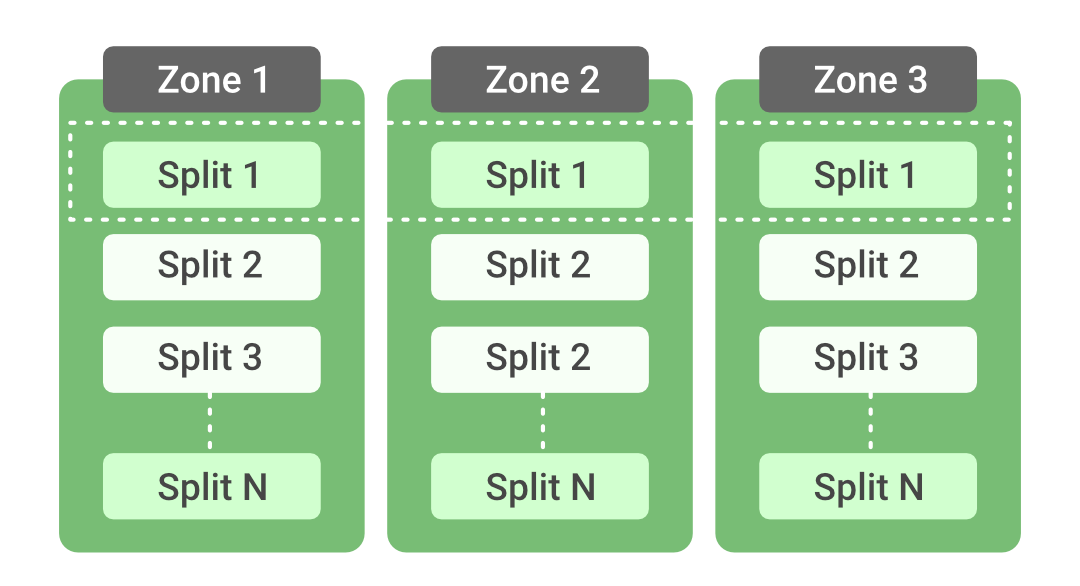
how data is horizontally partitioned and replicated across zones
Spanner offers up to an industry-leading 99.999% availability, so you're protected from failures. Spanner provides high availability via asynchronous replication between replicas in independent zones. It uses a Paxos base replication scheme in which rights are committed only when a majority quorum is achieved.