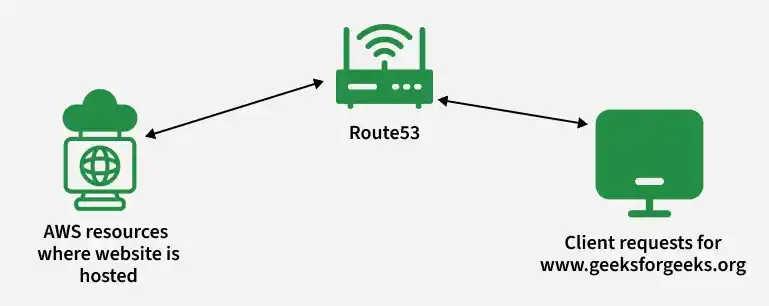
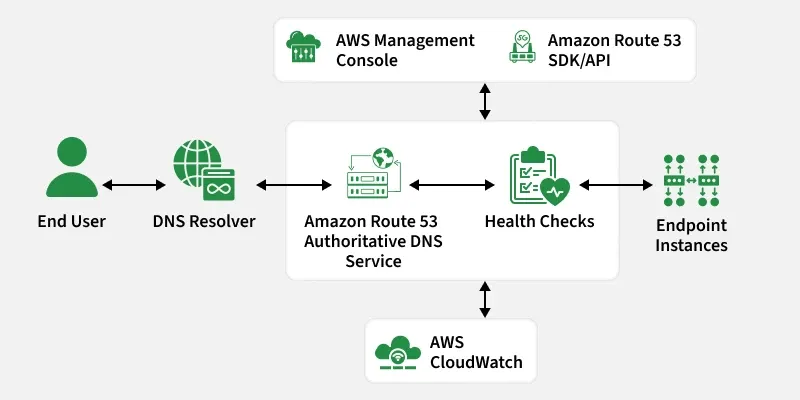
Amazon Route 53 is a highly available and scalable cloud Domain Name System (DNS) web service. In simplest terms, it acts as the phone book of the internet, translating human-readable domain names, such as www.google.com, into the numeric IP addresses (like 192.0.2.1) that computers use to connect to each other.
Records: Records are created to route internet traffic to resources. They are stored inside a hosted zone and define how traffic for a domain or subdomain should be directed.
Hosted zone: A hosted zone is a collection of DNS records for a domain and its subdomains. When a domain is registered in Amazon Route 53, a hosted zone is created to manage traffic routing.
DNS query: It is a request for information sent from DNS client to the DNS server.
Alias records: Alias records route traffic to AWS resources such as S3 buckets, CloudFront distributions, or Load Balancers. They provide better integration with AWS services.
Name servers: They are the servers in the DNS that translates the domain name into IP address so that internet traffic can be routed to the resources.
DNS failover: DNS failover automatically redirects traffic from unhealthy resources to healthy resources when a failure occurs.
Routing policy: Routing policy determines how Amazon Route53 responds to queries.
Route 53 Routing Policies and Traffic Management
Route 53's power lies in its routing policies. You can choose how Route 53 answers DNS queries.
Simple Routing
Meaning: One domain → one resource.
Use Case: Best for small applications or when only one resource handles all traffic.
Example: A company website hosted on a single EC2 instance.
Weighted Routing
Meaning: Split traffic between multiple resources based on percentages.
Use Case: Ideal for A/B testing, gradual deployments, or testing new application versions.
Example:
80% traffic → Version 1
20% traffic → Version 2
Latency Routing
Meaning: Sends users to the AWS Region with the lowest network latency.
Use Case: Improves performance for global applications.
Example:
Users in India → Mumbai Region
Users in Germany → Frankfurt Region
Failover Routing
Meaning: Switches traffic from a primary resource to a backup resource if the primary fails.
Use Case: Disaster recovery and high availability.
Example:
Primary server → US-East
Backup server → US-West
Geolocation Routing
Meaning: Routes users based on their geographic location.
Use Case: Deliver localized content or meet regional requirements.
Example:
France users → French-language servers
Japan users → Japanese-language servers
Geoproximity Routing
Meaning: Routes traffic based on the physical distance between users and AWS resources, with optional traffic bias.
Use Case: Balance traffic across regions or shift traffic to preferred locations.
Example: Even if users are closer to Region A, traffic can be shifted toward Region B when Region A is overloaded.
Multivalue Answer Routing
Meaning: Returns multiple healthy IP addresses randomly.
Use Case: Basic load balancing and redundancy without a load balancer.
Example: A DNS query returns several healthy server IPs, and the client connects to one of them.
Amazon Route53 supported DNS Record Types
The following are the DNS record types that are supported in Amazon Route53:
A Record ( Address Record ): Maps a domain or subdomain to an IPv4 address.
AAAA Record ( IPv6 Address Record ): Maps a domain or subdomain to an IPv6 address.
CNAME Record ( Canonical Name Record ): Creates an alias from one domain name to another domain name. Commonly used for subdomains.
MX Record (Mail Exchange Record ): Specifies the mail servers responsible for receiving emails for a domain and defines their priority order.
Advanced Features
1. Health Checks
Route 53 can monitor the health of your application endpoints.
HTTP/HTTPS Checks: Route 53 pings your endpoint. If it gets a non-200 response or times out, it marks the endpoint as unhealthy.
CloudWatch Alarms: Trigger health status changes based on metrics (e.g., CPU > 90%).
Failover: When an endpoint is unhealthy, Route 53 stops sending traffic to it (if configured in the routing policy).
2. Route 53 Resolver
Route 53 Resolver enables hybrid cloud DNS between on-premises networks and AWS VPCs.
Inbound Endpoints: Allow on-premises systems to resolve DNS records in AWS.
Outbound Endpoints: Allow AWS resources to resolve DNS records from on-premises environments.
Use Cases
The following are the use cases of Amazon Route 53:
High Availability And Reliability: Amazon Route 53 uses a global network of DNS servers to provide fast, reliable, and highly available DNS resolution.
Scalability: Route 53 can handle millions of DNS queries per second and automatically scales during high traffic periods.
Traffic Management: It routes users to the most appropriate resources based on factors such as latency, geographic location, health checks, and routing policies.
Health Checks And Failures: Route 53 monitors application endpoints and automatically redirects traffic to healthy resources if failures occur.
Integration With Other AWS Services: Route 53 integrates seamlessly with AWS services like Amazon S3, Elastic Load Balancing, and Amazon CloudFront for scalable cloud architectures.
Limitations
Amazon Route53 is an AWS service that offers scalable and highly available DNS web service. It has many limitations aside of benefits. The following are some of the limitation of Amazon Route53:
Geographical Load Balancing Limitations: Route 53 supports geographic routing, but it is not as advanced as dedicated global server load balancing solutions.
Complex Configuration for Advanced Routing: Configuring routing policies such as latency-based or weighted routing can be difficult for beginners unfamiliar with DNS and AWS services.
DDoS Protection Constraints: Route 53 can handle some DDoS attacks, but organizations with strict security requirements may need additional protection services.
Basic Domain Registration Features: Route 53 provides basic domain registration features and lacks some advanced options like extensive TLD choices and enhanced privacy features.
Pricing
Route 53 uses a pay-as-you-go model:
Hosted Zone: ~$0.50 per zone / month.
Standard Queries: ~$0.40 per million queries.
Latency/Geo Queries: ~$0.60 - $0.70 per million queries.
Health Checks: ~$0.50 - $0.75 per check / month.
Domain Registration: Varies (e.g., ~$12/year for .com).
Alternatives Of Amazon Route53
Feature
Amazon Route 53
GoDaddy / Namecheap
Cloudflare DNS
AWS Integration
Native. (Alias records to ELB, S3, CloudFront).
Manual CNAME/IP entry.
Manual setup (though often good).
Routing Policies
Advanced. (Latency, Geolocation, Failover).
Basic DNS routing
Advanced routing and load balancing
Health Checks
Integrated with AWS resources.
Limited or paid add-on.
Yes, often paid.
Latency
Ultra-low (Global Anycast network).
Varies.
Ultra-low (Global Anycast).
Cost
Pay-per-use pricing
Often flat fee/free with domain.
Free tier available.
To Know How to Configure Amazon Route 53 In AWS refer this - Article