|
VOOZH | about |
|
VOOZH | about |
Virtualization in cloud computing helps create virtual versions of hardware, such as desktop computers, with a virtual ecosystem of operating systems, storage, memory, and networking services. The virtualization architecture uses the same hardware to run multiple operating systems on the same machine and optimize their performance.
Virtualization plays an important role and function in cloud computing. It helps in reducing the space or costs associated with the investment. This technology allows end users to run multiple desktop operating systems and applications simultaneously on the same hardware and software.
Virtualization in cloud computing simplifies the creation of virtual machines and makes it easier to run multiple machines. It also helps create a virtual ecosystem of server operating systems, multiple storage facilities, and multiple operating systems.
Cloud computing is an application or service associated with a virtual ecosystem. Such ecosystems can be public or private. Due to virtualization, the need for physical infrastructure can be reduced. The terms cloud computing and virtualization are now used interchangeably and are rapidly converging.
There are some technologies in virtualization defined as follows:
Virtualization Architecture is defined as a model that describes the concept of virtualization. The use of virtualization is important in cloud computing. In cloud computing, end users share data through an application called the cloud. However, end users can share their entire IT infrastructure with virtualization itself.
In the diagram above, virtualization includes virtual applications and virtual infrastructure services.
Virtualization in cloud computing helps create virtual versions of hardware such as desktop computers with a virtual ecosystem of operating systems, storage, memory, and networking services. Virtualization architecture uses the same hardware to run multiple operating systems on the same machine and optimize their performance.
Virtualization and virtualization architecture are important concepts in cloud computing. In fact, since the definition of cloud computing also includes virtual ecosystems, these terms are often used interchangeably. Whether the ecosystem is private (i.e., cloud) or public (public cloud), virtualization reduces the need for organizations to maintain physical (on-premises) infrastructure for their computing needs. With cloud computing and virtualization architecture, applications can be shared with many active users. With a public cloud like Amazon Web Services (AWS) or Microsoft Azure, these can be shared with multiple businesses.
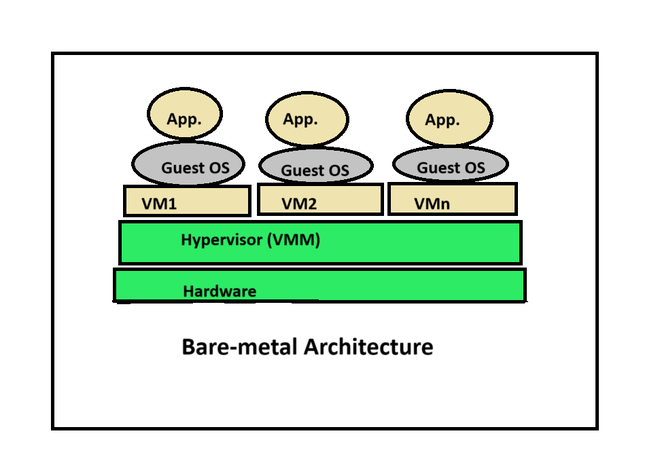
There are two main types of virtualization architectures: hosted and bare metal.
In this type of configuration, first, the host operating system is installed on the hardware, then the software is installed. The software is a hypervisor or virtual machine (VM) that requires many guest operating systems or VMs to be installed on the hardware to set up the virtualization architecture. Once the hypervisor is in place, applications can be installed and run on the virtual machine as if they were installed on the physical machine.
In this architecture, the hypervisor is installed directly on the hardware, not on top of the operating system. Hypervisors and virtual machines are configured the same way as infrastructure. Bare metal virtualization architecture is designed for applications that provide real-time access or perform some form of data processing.
Virtualization is hypervisor based. A hypervisor separates the operating system and applications from the underlying computer hardware so that the host computer can run multiple virtual machines as guests and share physical resources such as network processor, memory space, and network bandwidth. A hypervisor allocates memory or storage services and distributes some of these services to each virtual machine according to the needs of the virtualization architecture.
The alternative to hypervisor-based virtualization in cloud computing is containerization. For example, operating system virtualization is an important volume-based virtualization approach. In this architecture, the operating system is set up to act as multiple separate systems, allowing distributed applications to be deployed and run without having to turn on the entire virtual machine for each system. Instead, multiple isolated machines (called volumes) run on a single host, each accessing a single key.
Like virtual machines, container is a way to create virtual packages. Essentially, a container is a lightweight virtual machine that is part of the same operating system instance or hypervisor. But virtualization is a way to run multiple operating systems on a single physical server. Containerization, on the other hand, is a way of running multiple applications on the same machine in a virtual machine. VMs are best suited for applications that require full-scale performance. Containers are a better choice for short-term projects that need to reduce the number of servers used by multiple applications.
Virtualization and virtualization architecture are important concepts in cloud computing. Virtualization and cloud computing work together to ensure you have the highest level of computing intelligence. It enables applications to be shared across multiple network threads between different companies and active users.