|
VOOZH | about |
|
VOOZH | about |
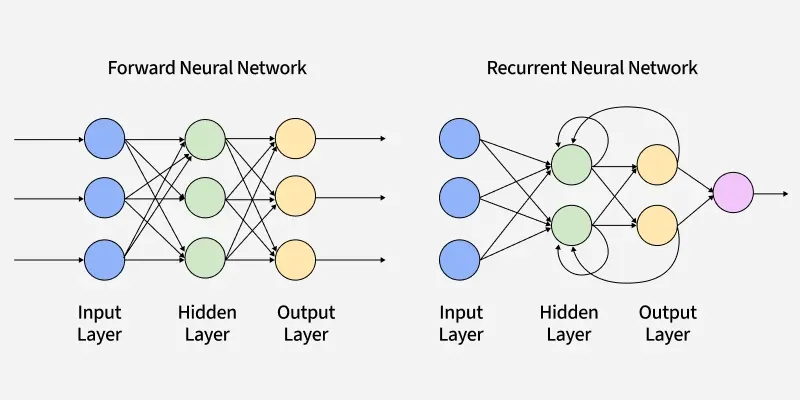
Neural networks have become essential tools in solving complex machine learning tasks. Among them most widely used architectures are Feed-Forward Neural Networks (FNNs) and Recurrent Neural Networks (RNNs). While both are capable of learning patterns from data, they are structurally and functionally different.
Feed-forward neural networks is a type of neural network where the connections between nodes do not form cycles. It processes input data in one direction i.e from input to output, without any feedback loops.
Used in classification tasks like identifying handwritten digits using the MNIST dataset.
Recurrent neural networks add a missing element from feed-forward networks i.e memory. They can remember information from previous steps, making them ideal for sequential data where context matters.
Used in language modeling such as predicting the next word in a sentence.
| Feature | Feed-Forward Neural Network (FNN) | Recurrent Neural Network (RNN) |
|---|---|---|
| Data Flow | One-way (input → output) | Cyclic (can loop over previous states) |
| Memory | No memory | Has memory via hidden states |
| Best For | Static input (images, tabular data) | Sequential input (text, audio, time series) |
| Complexity | Lower | Higher |
| Training Time | Faster | Slower due to time dependencies |
| Gradient Issues | Less prone | Can suffer from vanishing/exploding gradients |
| Example Use Cases | Image classification, object detection | Sentiment analysis, speech recognition |
| Limitation | Feed-Forward Neural Network | Recurrent Neural Network (RNN) |
|---|---|---|
| Input Handling | Cannot handle variable-length input sequences | Supports sequences but struggles with long ones |
| Memory | No memory of previous inputs | Limited memory; forgets long-term context |
| Temporal Modeling | Ineffective at capturing time-based patterns | Can model temporal patterns but with difficulty |
| Performance Issues | Good parallelism, but lacks temporal context | Sequential nature slows training and inference |
| Training Challenges | Relatively stable | Prone to vanishing gradient and unstable training |
Both architectures are fundamental building blocks in modern deep learning, often combined in approaches to use their respective strengths. Using these basics provides a solid foundation for exploring more advanced neural network architectures translation, speech-to-text conversion and robotic control.