|
VOOZH | about |
|
VOOZH | about |
In recent times, a new set of models called Diffusion Models has gained popularity, especially for generating high-quality images. Among these, Denoising Diffusion Probabilistic Models (DDPMs) stand out due to their simplicity and ability to produce excellent results.
A diffusion model is a type of generative model. That means it can generate new data, like images, that look similar to real ones.
The key idea is:
This is possible as it learns to reverse a noising process step by step.
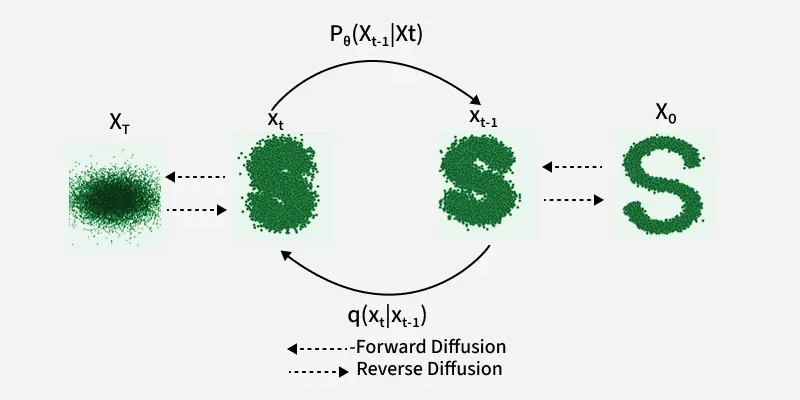
The diffusion process is a way of adding noise to an image over time. In DDPMs, this happens in two phases:
1. Forward Process (Adding Noise): We slowly add small amounts of noise to an image step-by-step, over many steps (say, 1000). By the end, the image becomes pure noise.
Let’s say:
This process is predefined, and we know how the noise is added.
2. Reverse Process (Removing Noise): Now, we want to go backward: from pure noise to a clear image . But we don’t know exactly how to do that. So we train a neural network to predict and remove noise at each step, and this is where the model learns.
Denoising Diffusion Probabilistic Models (DDPMs) are a type of diffusion model which learn to remove noise from an image at each step. Once trained, they can start from random noise and generate a new image step-by-step.
The training objective is to minimize the difference between the actual noise added and the noise the model predicts.
Once the model is trained:
This step-by-step denoising is slow but accurate.
Many improvements have been proposed, such as: