|
VOOZH | about |
|
VOOZH | about |
Data Science and Artificial Intelligence are two most exciting areas in tech today, but they often get mixed up. Both use large amounts of data to find insights and make decisions, but they do it in different ways and for different purposes.
In this article, we’ll break down the key differences between Data Science and Artificial Intelligence, looking at what each field does, the tools and techniques they use, and how they’re shaping different industries.
Table of Content
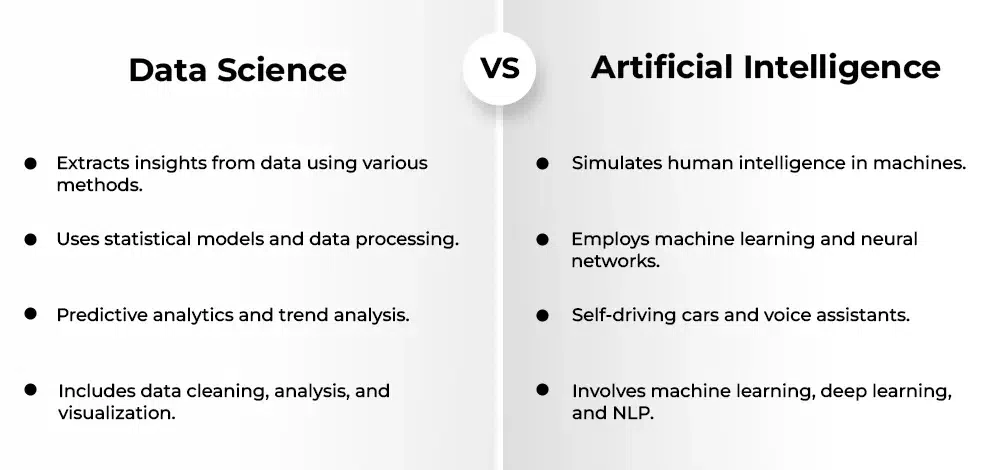
As we know Data Science is a subset of Artificial Intelligence. Simply, data science is a collection of data to analyze, and we decide on behalf of it. It uses scientific methods, processes, algorithms, and insights from many structural and unstructured data. Data Science is about finding answers to complex questions using data, making it a key area for businesses, researchers, and governments looking to turn raw information into meaningful insights.
Artificial Intelligence (AI) refers to the simulation of human intelligence in machines. They solve problems faster than human beings. Speech recognition, translation tools, etc. are the building areas of AI. AI is all about machine learning deep learning etc. We can emulate cognition and human understanding to a certain level. AI can be found in many everyday applications, from personal assistants like Siri and Alexa to recommendation systems on Netflix and Spotify.
| Aspects | Data science | Artificial Intelligence |
|---|---|---|
| Basics | Data Science is a detailed process that mainly involves pre- processing analysis, visualization and prediction. | AI(short) is the implementation of a predictive model to forecast future events and trends. |
| Goals | Identifying the patterns that are concealed in the data is the main objective of data science. | Automation of the process and the granting of autonomy to the data model are the main goals of artificial intelligence. |
| Types of data | Data Science will have a variety of different types of data, including structured, semi-structured, and unstructured type of data. | AI uses standardized data in the form of vectors and embeddings. |
| Scientific Processing | It has a high degree of scientific processing. | It has a lot of high levels of complex processing. |
| Tools used | The tools utilized in Data Science are far more extensive than those used in AI. This is due to the fact that Data Science entails a number of procedures for analyzing data and developing insights from it. | The tools used in AI are less extensive compared to Data Science. |
| Build | By using the concept of data science, we can build complex models about statistics and facts about data. | By using this we emulate cognition and human understanding to a certain level. |
| Technique used | It uses the technique of data analysis and data analytics. | It uses a lot of machine learning techniques. |
| Use | Data science makes use of graphical representation. | Artificial intelligence makes use of algorithms and network node representation. |
| Knowledge | Its knowledge was established to find hidden patterns and trends in the data. | Its knowledge is all about imparting some autonomy to a data model. |
| Examples of Tools | R,Python, etc. are the tools used in data science. | Tensor flow, sci-kit-learn, Kaffee, etc are the tools used in AI. |
| Models | Models are built in Data Science to generate statistical insights for decision-making. | Models are created in Artificial Intelligence that is believed to be analogous to human understanding and cognition. |
| Applications | Its applications are advertising, marketing, Healthcare, etc. | Its application is robotics, automation, etc. |
While Data Science focuses on extracting insights from data, Artificial Intelligence focuses on building intelligent systems that can perform tasks that normally require human intelligence. Data Science is an interdisciplinary field that uses a variety of techniques to analyze data, while Artificial Intelligence is mainly a computer science field that heavily relies on machine learning.