|
VOOZH | about |
|
VOOZH | about |
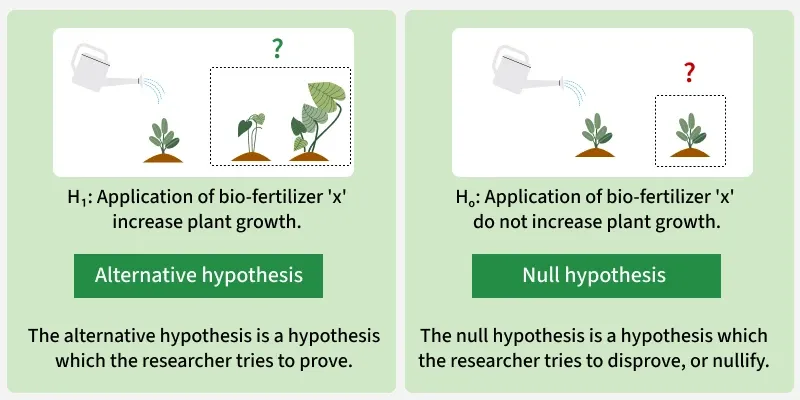
In statistics and data science, hypothesis testing is a core method used to make decisions based on data. This process are two competing statements: the Null Hypothesis and the Alternative Hypothesis. Understanding the difference between them is essential for correct analysis and interpretation.
The Null Hypothesis is the starting assumption in hypothesis testing. It states that there is no effect, no difference or no relationship between variables.
Example:
H₀: The average salary of data scientists is ₹10 LPA.
H₀: There is no difference between Model A and Model B accuracy.
The Alternative Hypothesis is the statement that challenges the null hypothesis. It suggests that an effect, a difference or a relationship does exist.
Example:
H₁: The average salary of data scientists is not ₹10 LPA.
H₁: Model A performs better than Model B.
| Null Hypothesis (H₀) | Alternative Hypothesis (H₁ / Hₐ) |
|---|---|
| States that no relationship exists between variables | States that a relationship exists between variables |
| Assumes no effect or no change | Assumes an effect or change is present |
| Considered the default assumption | Represents the research claim |
| Researchers try to reject this hypothesis | Researchers aim to support/accept this hypothesis |
| If accepted (not rejected), researchers may need to reconsider their assumptions | If accepted, researchers support their original claim |
| No observable impact on the output | Observable impact on the output |
| Tested directly using statistical tests | Supported indirectly by rejecting H₀ |
| Denoted by H₀ | Denoted by H₁ or Hₐ |
| Accepted when p-value > significance level (α) | Accepted when p-value < significance level (α) |
| Maintained when there is insufficient evidence | Accepted when there is strong evidence |