|
VOOZH | about |
|
VOOZH | about |
Skewness and kurtosis are statistical measures that describe the shape of a distribution beyond basic central tendency. Skewness explains how symmetric or asymmetric the data is around its mean, while kurtosis explains how peaked the distribution is and how heavy or light its tails are.
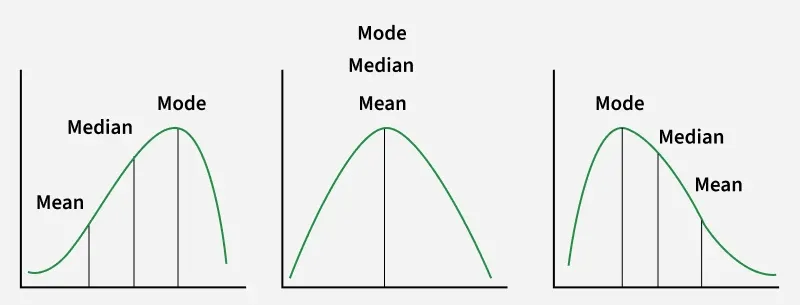
Skewness measures the asymmetry of a probability distribution around its mean. It indicates whether data values are stretched more toward the left or the right side, affecting the distribution’s overall balance.
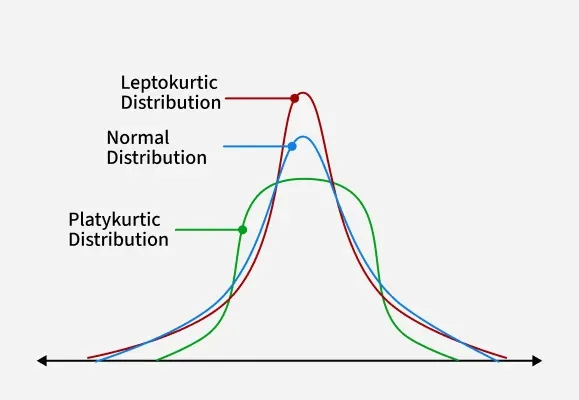
Kurtosis measures how sharp the peak of a distribution is and how heavy or light its tails are compared to a normal distribution. It shows how much of the data lies close to the center and how much appears in the extreme ends.
Let's compare skewness and kurtosis,
| Aspect | Skewness | Kurtosis |
|---|---|---|
| Core Purpose | Quantifies the asymmetry of a distribution | Quantifies the peakedness and tail weight of a distribution |
| Primary Focus | Direction and degree of horizontal asymmetry | Vertical structure and extremity of tail behaviour |
| Positive Values | Reflect a distribution with a longer or heavier right tail | Reflect a sharper peak with heavier tails and more extreme values |
| Negative Values | Reflect a distribution with a longer or heavier left tail | Reflect a flatter peak with lighter tails and fewer extreme values |
| Effect on Summary Statistics | Alters the relationship among mean, median and mode | Influences tail probability, variance concentration and outlier impact |
| Sensitivity | Sensitive to directional deviations and skewed clusters | Highly sensitive to occurrence and magnitude of extreme observations |
| Analytical Implication | Used to identify directional bias and underlying imbalance | Used to assess risk, extremity and departure from normal tail behaviour |
| Role in Distribution Shape | Describes shape horizontally | Describes shape vertically and in the tails |