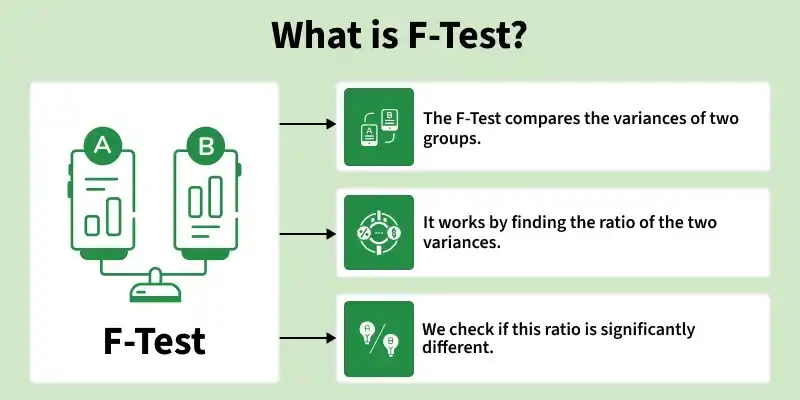
The F-test is a statistical hypothesis testing used to compare the variances of two independent samples. It helps determine whether the variability in two populations is significantly different. The F-test is widely used in hypothesis testing, ANOVA (Analysis of Variance) and statistical model comparison in data science and analytics.
To properly understand the F-test, it is important to first understand the F-distribution, since the test statistic follows this distribution.
F-distribution
The F-distribution is a continuous probability distribution that arises as the ratio of two independent chi-square distributed random variables divided by their respective degrees of freedom.
It is defined by two parameters:
df1: degrees of freedom of the numerator
df2: degrees of freedom of the denominator
Formula:
where:
X1 and X2 follow chi-square distributions
df1 and df2 are their respective degrees of freedom
The F-statistic is always greater than or equal to 0 because it is a ratio of variances, and variance cannot be negative.
How the F-Test Works
The F-test compares two variances by forming their ratio. Depending on the research question, the test can be:
Left-tailed
Right-tailed
Two-tailed
The F-test is applicable when:
The populations are normally distributed
Samples are random and independent
Hypothesis Testing Framework for F-test
For various hypothesis tests the F test formula is provided as follows:
1. Left Tailed Test
Null Hypothesis:
Alternate Hypothesis:
Decision-Making Standard: Reject if the F statistic is less than the critical value.
2. Right Tailed Test
Null Hypothesis:
Alternate Hypothesis:
Decision-Making Standard: Reject H0 if the F statistic is greater than the critical value.
3. Two Tailed Test
Null Hypothesis:
Alternate Hypothesis:
Decision-Making Standard: Reject H0 if the F statistic falls in the rejection region.
F Test Statistics
The F test statistic or simply the F statistic is a value that is compared with the critical value to check if the null hypothesis should be rejected or not. The F test statistic formula is given below:
For large samples:
For small samples:
where:
is the variance of the first population and is the variance of the second population.
is the variance of the first sample and is the variance of the second sample.
Steps to Perform an F-Test
Compute variances of both samples
Define null and alternative hypotheses
Calculate the F statistic
Determine degrees of freedom
Find the critical F value using significance level α
Compare F statistic with critical value
Decision Rule
If : Do not reject H0
If : Reject H0
Example
Consider the following example In this we conduct a two-tailed F-Test on the following samples:
Statistic
Sample 1
Sample 2
Standard Deviation
10.47
8.12
Sample Size
41
21
Step 1: Hypotheses
Step 2: Compute Variances
Step 3: Degrees of Freedom
Step 4: Critical Value
Two-tailed test with α = 0.05:
From the F-table:
Step 5: Decision
1.66 < 2.287
Do not reject the null hypothesis. The variances of the two populations are statistically similar.
Python Implementation of F-Test
Two samples are generated assuming normal distributions.
Sample variances are computed using unbiased estimation (ddof=1).
The F-statistic is calculated as the ratio of variances.
Degrees of freedom are derived from sample sizes.
The p-value is obtained using the F-distribution.
Results are printed in a readable format.
Output:
F-statistic: 1.2978 P-value: 0.2697
Interpretation: Since the p-value > 0.05, we fail to reject the null hypothesis, indicating that the variances are statistically similar.