|
VOOZH | about |
|
VOOZH | about |
The Generalized Method of Moments (GMM) is a method used to estimate the parameters such as slope or intercept in models when traditional methods do not work well. It is useful when the data does not follow the usual assumptions, when there are issues with the data or when the independent variable is related to the error term. It is an extension of the Method of Moments (MM).
1. Moment Conditions: Moment conditions are rules that describe the relationships between the variables in the model. For example, in a simple linear regression model:
We assume that:
Which mean the error term is uncorrelated with the independent variable . We use this condition to estimate the model parameters and .
2. Objective Function: The objective function is used to measure how close our model is to the actual data. It helps minimize the differences between the theoretical moments and the sample moments. This is done by minimizing a sum of squared differences.
Where is the vector of sample moments and is the weighting matrix. The weighting matrix helps adjust the importance of each moment condition.
3. Weighting matrix: The weighting matrix helps in deciding how much importance should be given to each moment condition. The choice of the weighting matrix affects the efficiency of GMM estimation.
To understand how GMM is used to estimate parameters in a model, let's take help of an example of estimating the parameters of a simple linear model. We will use this equation to define the Moment Condition:
Where:
We assume that the error term ϵ\epsilonϵ is not related to the independent variable . This gives us a moment condition:
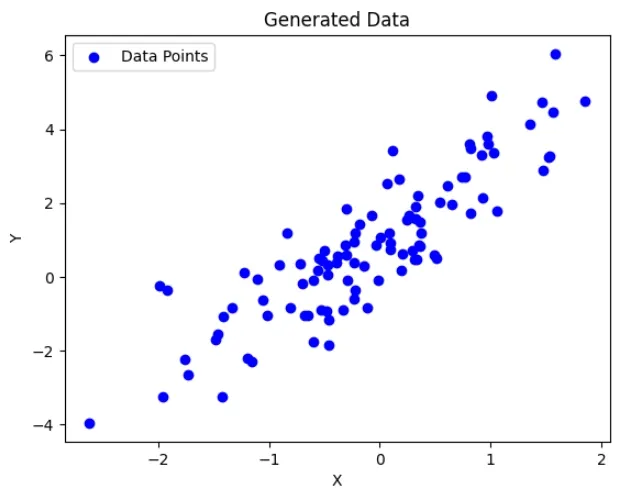
We will use the below graph and its data to understand the process,
Next we need to define an objective function. This function helps measure how well the estimated parameters fit the data. The objective function looks at the difference between the theoretical moments and the sample moments. The objective function looks like this:
By minimizing this function, we can find the values of and that make the model fit the data as well as possible.
In the weighting matrix , the optimal weight matrix is defined by,
Where
Once the moment conditions and the objective function are defined, the next step is to estimate the parameters. This is done by minimizing the objective function with respect to the parameters and . The process typically involves using optimization algorithms such as Nelder-Mead or BFGS to find the values of and that minimize the objective function.
After the parameters are estimated, it is important to check how well the GMM model fits the data.
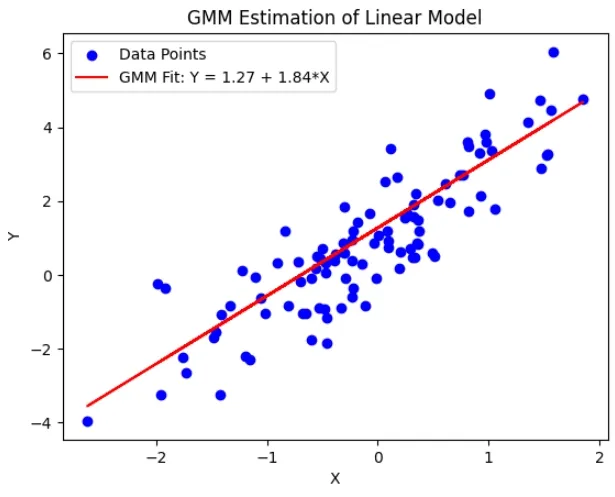
The plot shows the data points in blue and the red line represents the estimated relationship based on the GMM method. The closer the red line is to the data, the better the estimation.