Hazard function estimates the probability that an item will fail during a specific time interval, based on its survival until the previous moment.
In simple terms, it reflects the risk of failure as time progresses, assuming that the item has survived up to the current time, and hazard function is denoted as ℎ(𝑡).
Hazard rate is an important concept in reliability analysis and survival statistics, representing the rate at which an item or system fails at a given point in time, given that it has survived up to that point.
It provides insight into the likelihood of failure for an item of a particular age and is an essential component of the hazard function.
1. The Cumulative Distribution Function (CDF), 𝐹(𝑡), is related to 𝑆(𝑡) as:
2. The PDF, 𝑓(𝑡), is derived by differentiating 𝐹(𝑡):
3. The hazard function, in terms of 𝑓(𝑡) and 𝑆(𝑡), becomes:
Interpretation
𝑆(𝑡) decreases monotonically from 1 to 0 as time progresses.
ℎ(𝑡) reflects the rate of change in risk over time.
Hazard function that increases over time suggests that the risk of failure becomes greater as time progresses, while a decreasing hazard function suggests that the risk of failure reduces over time.
Different Types of Hazard Functions
The shape of a hazard function reveals crucial information about the process:
Constant Hazard: Exhibited by exponential distributions, where risk remains uniform over time. Example: Radioactive decay.
Increasing Hazard: Observed in aging systems where risk grows over time. Example: Mechanical wear and tear.
Decreasing Hazard: Seen in populations where risk diminishes as time progresses. Example: Infant mortality.
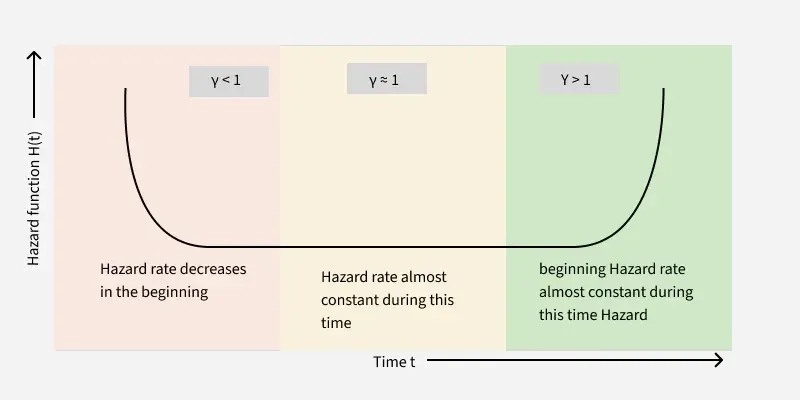
Non-Monotonic Hazard: Characterized by early failures followed by stable and increasing risk (e.g., the "bathtub curve").
Weibull Distribution
A flexible model that encompasses increasing, constant, and decreasing hazards:
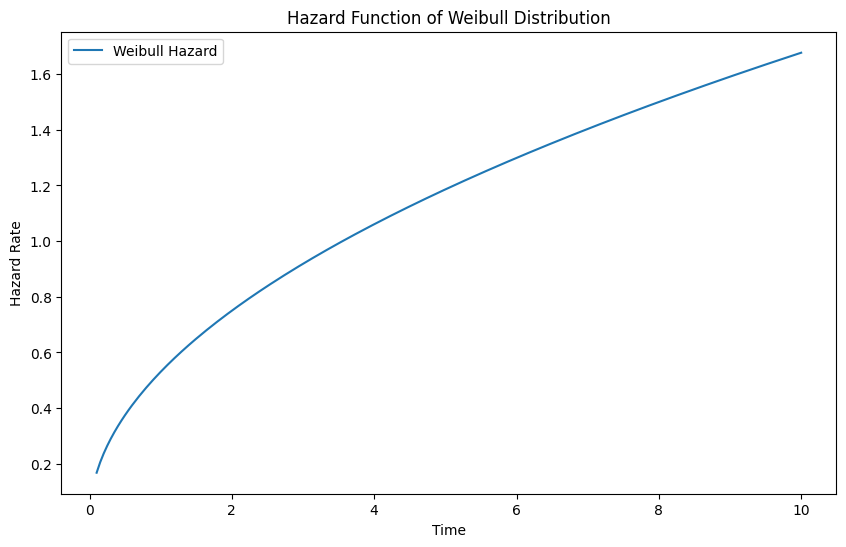
The output represents hazard function of Weibull distribution, the shape of the curve is influenced by shape parameter and scale parameter of the Weibull distribution.
Initial hazard rate is relatively low but increases steadily as time advances.
As the time progresses, the risk of failure becomes more pronounced, indicating that the system's failure becomes more likely as it "ages."
Practical Implementation: Case Study
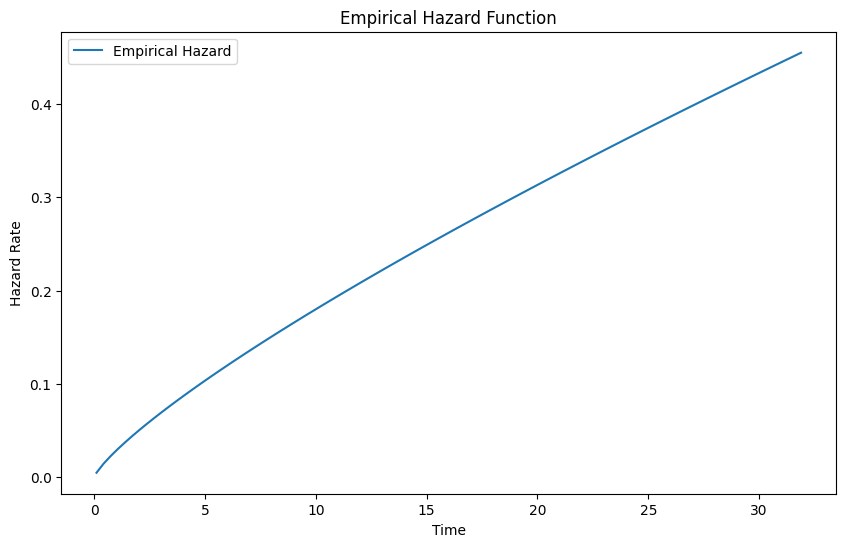
Scenario: Analyzing survival rates of machinery in a factory. Using empirical data, we fit a Weibull distribution and estimate the hazard function.