|
VOOZH | about |
|
VOOZH | about |
Normal Distribution is defined as the probability distribution that tends to be symmetric about the mean; i.e., data near the mean occurs more as compared to the data far away from the mean. The two parameters of normal distribution are mean (μ) and standard deviation (σ). Hence, the notation of the normal distribution is
X ~ N (μ,σ2)
Table of Content
The Probability Density Function (PDF) of a normal distribution, often denoted as f(x), describes the likelihood of a random variable taking on a specific value within the distribution. In simpler terms, it tells the probability of getting a particular result. For a normal distribution, the PDF is represented by the well-known bell-shaped curve. This curve is centered at the mean (average) value, and its shape is determined by the standard deviation, which measures how spread out the data is. The PDF shows that values near the mean are more probable, while values farther from the mean are less likely.
The PDF of a normal distribution is defined by:
, -∞ < x < ∞
Where,
As different combinations of μ and σ lead to different normal distributions. The Standard normal distribution is defined as the value of normal distribution at μ = 0 and σ = 1. This is known as z-transformation.
Since Z is symmetrical about zero,
Example:
If X ~ (49, 64), calculate:
(i) P (X < 52)
(ii) P (X > 60)
(iii) P (X < 45)
(iv) P (|X - 49| < 5)
Solution:
(i) P (X < 52) = = P(Z < 0.375) = 0.6443
P (X < 52) = 0.6443
(ii) P (X > 60) = = P(Z > 1.375) = 1 - P(Z < 1.375) = 0.91466
P (X > 60) = 0.91466
(iii) P(X < 45) = = P(Z < -0.5) = 1 - P(Z < 0.5) = 0.69146
P(X < 45) = 0.69146
(iv) P (|X - 49| < 5) = P ( -5 < (X - 49) < 5)
= P (44 < X < 54)
= P (X < 54) - P (X < 44)
=
= P (Z < 0.625) - P(Z < -0.625)
= P(Z < 0.625) - [ 1 - P(Z < 0.625)]
= 0.73401 - (1 - 0.73401)
P (|X - 49| < 5) = 0.46802
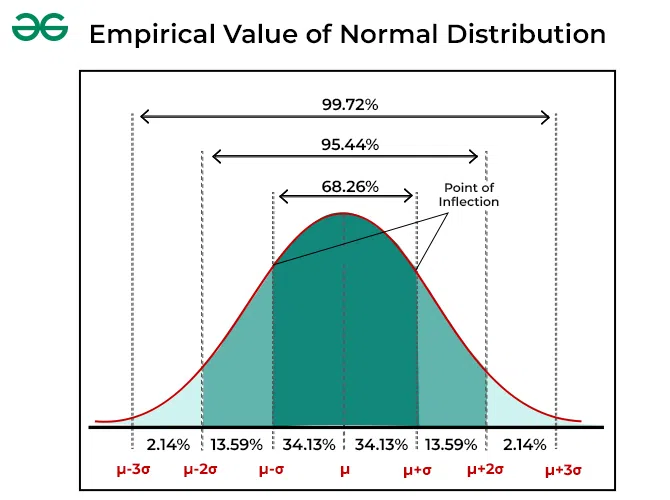
In most cases with normal distributions, about 68.27% of the data will be found within one standard deviation above or below the average. Approximately 95.45% of the data falls within two times the standard deviation range, and around 99.73% falls within three times the standard deviation range. This is often called the "Empirical Rule," which helps us understand where the majority of data in a normal distribution is located.
In other words, μ ± 1σ covers 68.27% of the area, μ ± 2σ covers 95.45% of the area, and μ ± 3σ represents 99.73% of the area.
👁 Empirical-Value-of-Normal-Distribution-copy
The parameters of the Normal Distribution, also known as the Gaussian Distribution, are the mean and the standard deviation. The mean represents the average or central value of the data, while the standard deviation measures the spread or variability of the data points. Together, these parameters describe the shape and characteristics of the bell-shaped curve that is typical of the Normal Distribution. The mean determines the center of the curve, and the standard deviation controls how wide or narrow it is. These parameters are essential for understanding and analysing data in various fields, including statistics, science, and finance.
In a normal distribution, the mean represents the central value where most data clusters. It determines the peak of the bell-shaped curve on a graph. If you change the mean, the whole curve shifts left or right on the horizontal axis. Essentially, the mean is the average value in the dataset, indicating where the data tends to center around, and it is a key factor for understanding the central tendency of the data. The mean in a normal distribution is denoted by the symbol μ (mu).
The normal distribution typically has a positive standard deviation. The mean indicates where the graph is balanced, while the standard deviation shows how much the data is spread out. A smaller standard deviation means the data is closer together, resulting in a narrower graph. Conversely, a larger standard deviation means the data is more spread out, resulting in a wider graph. Standard deviations help divide the area under the normal curve, with each division representing a percentage of data within a particular part of the graph. The formula for the standard deviation (σ) in a normal distribution is given as follows:
σ = √Variance = √σ²
Where,
The curve of a normal distribution, often referred to as a bell curve, is a symmetrical, smooth, and continuous graph that depicts the distribution of data. It has the following characteristics:
1. Symmetry: The curve is perfectly symmetrical around its center, which is the mean (average) value. This means that if you were to fold the curve in half at the mean, both sides would match like a mirror image.
2. Bell Shape: The curve takes the form of a bell, with a single peak at the mean. It rises to the peak, gradually descends on both sides and extends infinitely in both directions.
3. Mean as the Peak: The highest point of the curve is precisely at the mean value. This signifies that the mean is the most likely outcome in the distribution.
4. Standard Deviation Controls Spread: The spread or width of the curve is determined by the standard deviation. A smaller standard deviation results in a narrower, taller curve, while a larger standard deviation leads to a wider, shorter curve.
5. Tail Ends: As the curve moves away from the mean, it gets closer to the horizontal axis but never touches it. This means that there is always some probability of extreme values, although they become increasingly rare as you move further from the mean.
If the value of a random variable is 8, the mean is 10, and the standard deviation is 3, then find the probability density function (PDF) of the normal distribution at this value.
To find the PDF at the value of the random variable (8), use the formula for the normal distribution.
According to the given information, we have, Mean (μ) = 10, Standard Deviation (σ) = 3, and e is the base of the natural logarithm (approximately 2.71828)
Now, putting the values in the formula, we get:
f(8) = 0.10648
If the value of a random variable is 12, the mean is 15, and the standard deviation is 2, then find the probability density function (PDF) of the Gaussian distribution at this value.
To find the PDF at the value of the random variable (12), use the formula for the normal distribution,
According to the given information, we have, Mean (μ) = 15, Standard Deviation (σ) = 2, and e is the base of the natural logarithm (approximately 2.71828)
Now, putting the values in the formula, we get,
f(12) = 0.06475
Normal Distribution is used in business statistics in the following ways:
1. Quality Control: Companies use the normal distribution to monitor and maintain the quality of their products. By analysing measurements and defects, they can assess if the production process is within acceptable limits.
2. Market Research: In market research, the normal distribution helps analyse customer preferences, buying patterns, and survey data. This aids in making informed marketing and product development decisions.
3. Financial Analysis: Financial analysts use the normal distribution to model and predict stock prices, asset returns, and investment risks. It's the foundation for tools like the Black-Scholes model for options pricing.
4. Performance Evaluation: HR departments use the normal distribution to evaluate employee performance. It can help determine salary structures and performance bonuses, and identify underperforming or exceptional employees.
5. Supply Chain Management: Normal distribution assists in optimising inventory levels, demand forecasting, and managing production processes to ensure products are available when needed.
6. Risk Assessment: Businesses assess various risks, including credit risk, market risk, and operational risk, using the normal distribution to quantify and manage these risks effectively.
7. Credit Scoring: Financial institutions use the normal distribution to build credit scoring models, determining an individual's creditworthiness and loan approval.