|
VOOZH | about |
|
VOOZH | about |
In this article, we will delve into the Orthogonal Matching Pursuit (OMP), exploring its features and advantages.
The Orthogonal Matching Pursuit (OMP) algorithm in Python efficiently reconstructs signals using a limited set of measurements. OMP intelligently selects elements from a "dictionary" to match the signal, operating in a stepwise manner. The process continues until a specified sparsity level is reached or the signal is adequately reconstructed. OMP's versatility is evident in applications like compressive sensing, excelling in pinpointing sparse signal representations. Its implementation in Python, through sklearn.linear_model.OrthogonalMatchingPursuit, proves valuable in image processing and feature selection.
In this analogy, Python's Orthogonal Matching Pursuit (OMP) is likened to a detective's toolkit for reconstructing missing elements in a signal, resembling solving a puzzle with absent pieces. OMP identifies the most significant signal elements, starting with an empty guess and iteratively selecting the best-fitting pieces from measurements. This iterative process refines the approximation until the essential components of the signal are revealed. Implemented in Python using sklearn.linear_model.OrthogonalMatchingPursuit`, OMP acts as a detective guiding the uncovering of crucial elements and completing the signal puzzle.
Steps Needed
r as the original signal.T as an empty set.T by adding the index of the selected atom.In this example below code uses scikit-learn to apply Orthogonal Matching Pursuit (OMP) for sparse signal recovery. It generates a random dictionary matrix and a sparse signal, then observes the signal. OMP is applied with a specified number of expected non-zero coefficients. The results include the estimated coefficients and the support set (indices of non-zero coefficients), providing information about the original and estimated sparse signals.
Output:
Original Sparse Signal:
 [ 0. 0. -0.60035931 0. 0. 0.06069191
 0. 0. -0.65530325 0. 0. 0.
 0. 0. 0. 0. 0. 0.
 0. 0. ]

Estimated Sparse Signal:
 [-0.14809913 0. 0. 0. 0. 0.
 0. 0. -1.03167779 0. 0. -0.16831767
 0. 0. 0. 0. 0. 0.
 0. 0. ]

Indices of Non-Zero Coefficients (Support Set): [ 0 8 11]
In this example below code illustrates sparse signal recovery using Orthogonal Matching Pursuit (OMP). It generates a sparse signal with non-zero coefficients, creates an observed signal by multiplying it with a random matrix (dictionary), and applies OMP for signal recovery. The recovered and true sparse signals are then plotted for visual comparison.
Output:
👁 Screenshot-from-2023-12-11-13-01-20-(1)
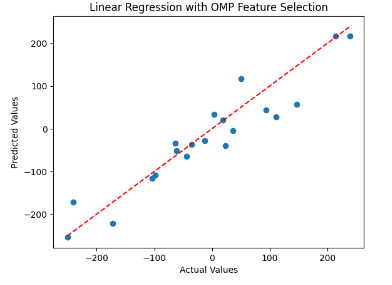
In this example below code showcases a regression workflow with scikit-learn. It generates synthetic data, splits it, applies Orthogonal Matching Pursuit for feature selection, trains a linear regression model, and evaluates its performance on a test set. The script concludes with a scatter plot visualizing the accuracy of the regression model.
Output:
There are numerous advantages to OMP, and we will highlight some key examples.
In summary, Orthogonal Matching Pursuit (OMP) emerges as a powerful and efficient algorithm for sparse signal recovery. Its simplicity, coupled with the ability to select relevant atoms while maintaining orthogonality, makes it a popular choice in compressive sensing and image processing. Despite some challenges, OMP remains a valuable tool in signal processing, providing a computationally feasible approach for extracting meaningful information from sparse data representations.

.webp)