A PDF summarizer automatically processes the text content inside PDF files and produces concise summaries or responses to queries, saving users time and effort required to read lengthy documents. This can be useful for research papers, reports, manuals or any long-form content. We can use RAG which integrates two AI concepts:
Retrieval: Searching a large collection of documents or text chunks to find the most relevant pieces of information for a specific query.
Generation: Using a language model to generate answers or summaries based on the retrieved relevant content.
This combination allows the system to provide more accurate, context-driven and up-to-date responses by grounding them in real document data rather than only relying on pre-trained model knowledge.
Workflow of PDF Summarizer
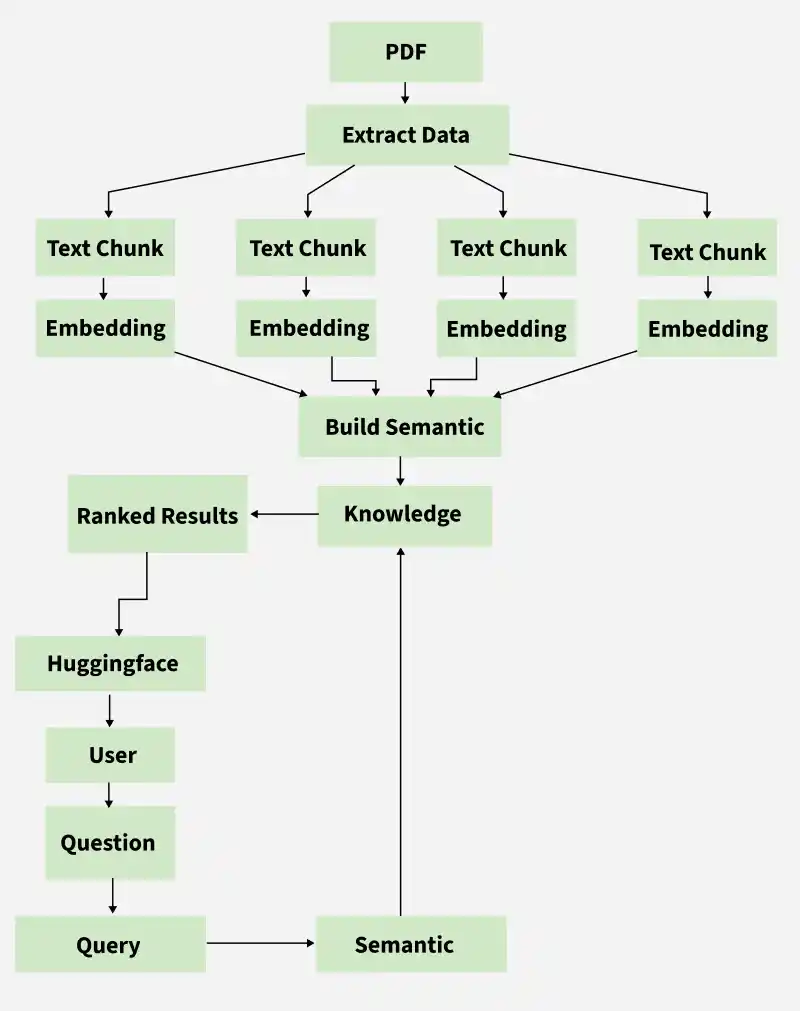
Let's build a PDF Summarizer using RAG but before that lets see its workflow:
Extract Data: The text content is extracted from the PDF.
Text Chunk & Embedding: The extracted text is split into smaller chunks and each chunk is converted into an embedding (vector) representing its semantic meaning.
Build Semantic & Knowledge: All embeddings form a semantic index (vector database), creating a searchable knowledge base.
Query & Semantic: When the user asks a question, it is converted into an embedding and used to perform semantic search in the knowledge base for relevant chunks.
Ranked Results: The system retrieves and ranks the most relevant chunks related to the user's question.
Huggingface: These chunks are provided to a Huggingface language model, which generates a specific answer or summary.
User: The generated answer is presented to the user.
Implementation
Step 1: Install the Dependencies
We install the required packages for our model,
langchain: Langchain is used for chaining language model calls and managing document-based workflows.
langchain-community: Community components extending LangChain functionality.
pypdf: For reading and extracting text from PDF files.
sentence-transformers: To convert text into vector embeddings.
faiss-cpu: A fast library for vector similarity search (vector storage).
transformers: Hugging Face library for pre-trained language models.
Step 2: Import Required Libraries and Configure Logging
We import all the library components needed for file uploads, document loading, text splitting, embedding generation, vector-based search, language model interaction and logging.
files.upload(): lets users upload PDFs dynamically in Colab.
RecursiveCharacterTextSplitter: splits long text documents into manageable chunks.
PyPDFLoader: helps parse PDF text page by page.
HuggingFaceEmbeddings: generates semantic vectors from text chunks.
FAISS: wraps efficient vector search.
RetrievalQA: builds a retrieval-based question answering pipeline.
HuggingFacePipeline: integrates local transformer models for generation.
Logging helps track the process and issues during runtime.
Step 3: Define the RAG System Class
We define a class to keep all components i.e documents, embeddings, vector stores, language models and QA chains organized and accessible.
documents: Loaded PDF pages
vector_store: FAISS index for embeddings
embeddings: Model for converting text to vectors
llm: Local language model
qa_chain: RetrievalQA pipeline
Step 4: Upload the PDFs
We upload the PDF that is to be summarized.
Uses files.upload() to dynamically upload PDF files in Colab.
Returns paths of uploaded files for further processing.