|
VOOZH | about |
|
VOOZH | about |
Probability sampling is a statistical sampling method used in research and data analysis to draw reliable and unbiased conclusions from a population. In this method, every individual or element in the population has an equal and known chance of being selected in the sample.
Probability sampling works by selecting samples from a population using random selection methods based on probability theory. Each individual in the population has a known and non-zero chance of being selected, which helps create unbiased and representative samples.
1. Define the Population: Identify the complete group or population for the study.
2. Create a Sampling Frame: Prepare a list of all individuals or elements in the population.
3. Select Samples Randomly: Use random sampling techniques so every member has an equal chance of selection.
4. Collect Data from the Sample: Gather information from the selected individuals or elements.
5. Analyze and Generalize Results: Use the sample data to make conclusions about the entire population.
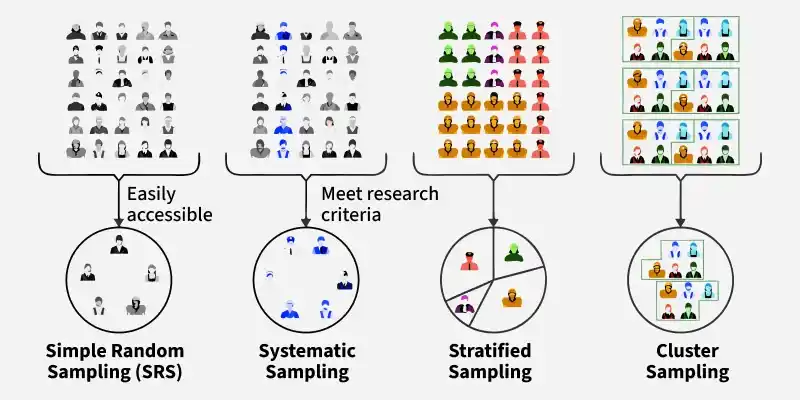
Probability sampling includes different techniques used to select representative samples from a population.
In simple random sampling, every individual in the population has an equal chance of being selected. Selection is completely random and independent.
Formula
Where:
Systematic sampling selects every element from a population after choosing a random starting point.
Formula
Where:
Stratified sampling divides the population into subgroups (strata) based on specific characteristics, and random samples are selected from each group.
Formula
Where:
Cluster sampling divides the population into clusters, randomly selects some clusters and includes all individuals within selected clusters.
Formula
Where:
Aspect | Probability Sampling | Non-Probability Sampling |
|---|---|---|
Selection Chance | Every element has a known and equal chance of selection | Selection chance is unknown or unequal |
Randomness | Uses random selection methods | Does not use random selection |
Generalizability | Results can be generalized to the entire population | Results may not represent the whole population |
Bias | Minimizes sampling bias | More prone to selection bias |
Precision | Provides more accurate estimation of population parameters | Less precise due to non-random selection |
Sampling Error | Sampling error can be measured | Sampling error cannot be measured accurately |
When to Use | Used when accurate, reliable and statistically valid results are required | Used when quick, low-cost or exploratory research is needed |