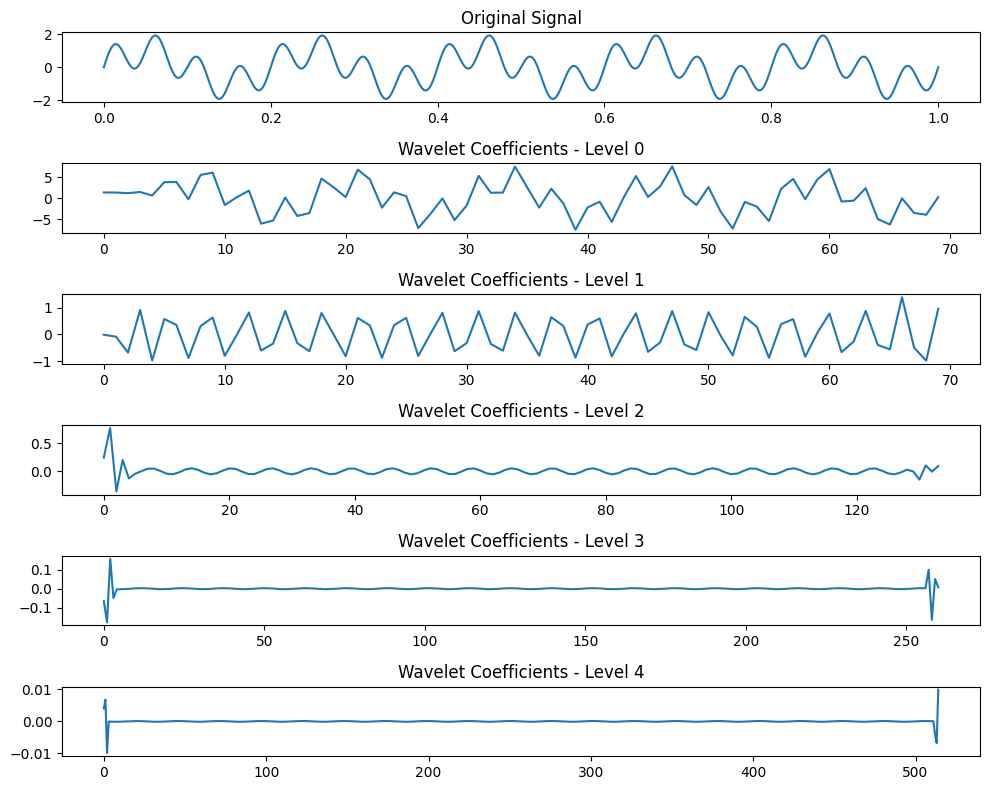
A Wavelet Transform (WT) is a mathematical technique that transforms a signal into different frequency components, each analyzed with a resolution that matches its scale. Wavelets are small waves with limited duration and they possess both time and frequency localization, which means they can capture both high-frequency and low-frequency information simultaneously.
The basic idea of wavelet analysis is to represent a function or signal in terms of a set of basis functions known as wavelets, which are derived from a single mother wavelet by translation and scaling.
Types of Wavelet Transforms
1. Continuous Wavelet Transform (CWT)
Provides a continuous mapping of the signal in time and frequency.
Suitable for detailed analysis and visualization of signals.
2. Discrete Wavelet Transform (DWT)
Provides a compact representation of signals using wavelet coefficients.
Used extensively in image and signal compression.
3. Stationary Wavelet Transform (SWT)
A variant of DWT that is shift-invariant.
Ideal for feature extraction and denoising applications.
4. Multiresolution Analysis (MRA)
Decomposes signals into different resolution levels.
Provides a hierarchical view of signal components.
Continuous Wavelet Transform (CWT)
The Continuous Wavelet Transform (CWT) of a signal x(t) is defined as:
Where:
W(a,b) is the wavelet coefficient.
a is the scale parameter that dilates or compresses the wavelet.
b is the translation parameter that shifts the wavelet.
ψa,b∗(t) is the conjugate of the mother wavelet ψ(t).
Discrete Wavelet Transform (DWT)
The Discrete Wavelet Transform (DWT) is a sampled version of the CWT where the scale and translation parameters are discretized. It is defined as:
Where:
j represents the scale index.
k is the translation index.
ψj,k[n] is the discrete wavelet obtained by scaling and shifting the mother wavelet.
The DWT decomposes a signal into approximation and detail coefficients, which represent low and high-frequency components, respectively.
Commonly Used Wavelets
1. Haar Wavelet:
Simplest and most intuitive wavelet.
Suitable for step-like signals.
2. Daubechies Wavelets (db):
Provides smooth and compactly supported wavelets.
Widely used in data compression and denoising.
3. Symlets:
A modified version of Daubechies wavelets.
Exhibits better symmetry properties.
4. Coiflets:
Designed to have better approximation properties.
5. Morlet Wavelet:
Combines a sinusoidal wave with a Gaussian window.