|
VOOZH | about |
|
VOOZH | about |
AWS Backup provides a centralized, managed solution to automate and safeguard critical organizational data across the AWS ecosystem. Despite its robust features, data protection strategies often fail due to architectural oversights, inadequate testing, and a lack of clarity regarding the shared responsibility model. To ensure business continuity and prevent financial loss, organizations must move beyond simple automation toward a validated and well-designed backup strategy.
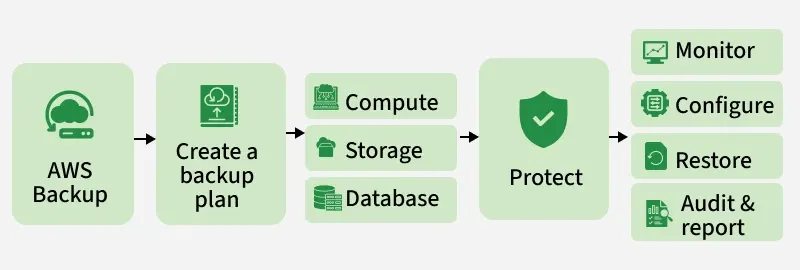
AWS Backup provides a unified control plane for scheduling, retention, monitoring, and compliance. AWS Backup supports data protection for services such as:
Using AWS Backup, organizations can define backup policies, enforce governance rules, and monitor backup activity from a single console or API.
AWS Backup operates using a few core building blocks:
A policy-based framework that automates the backup lifecycle. Backup plan defines:
The "glue" between your data and your policy. While you can use specific Resource IDs, using Tags is the industry standard for automated, scalable protection across dynamic environments.
A backup vault is a logical container that stores recovery points. Vaults provide:
AWS Backup operates via the AWSBackupDefaultServiceRole, ensuring the service has the scoped-down permissions necessary to interact with S3, EBS, RDS, and other supported resources securely.
One of the primary reasons for test plan failures is the inadequate testing of backup procedures. Organizations may overlook the importance of regularly testing their backup and recovery processes, leading to gaps in their resilience strategy. Without thorough testing, potential issues such as incomplete backups, data corruption, or failed recovery procedures may go undetected until a real disaster occurs, putting critical data at risk.
Resource constraints, including limited personnel, time, and budget, can hinder the implementation of comprehensive test plans. In some cases, organizations may prioritize other operational tasks over testing backup procedures, assuming that their backup systems are functioning adequately. However, without sufficient resources dedicated to testing, organizations may fail to identify vulnerabilities or inefficiencies in their backup infrastructure, leaving them vulnerable to data loss or downtime.
Another common pitfall is relying on outdated backup plans that do not align with the evolving needs and technologies of the organization. As IT environments grow more complex and dynamic, backup strategies must adapt accordingly to ensure optimal protection of data assets. Failure to update backup plans regularly can result in outdated configurations, incompatible backup policies, or inadequate coverage of new data sources, diminishing the effectiveness of the backup solution.
To mitigate the risk of test plan failures and enhance data resilience, organizations can leverage the capabilities of AWS Backup in conjunction with best practices for backup and recovery. Here are some key considerations:
AWS Backup supports cross-region backup copy, allowing recovery points to be copied to another AWS region. This protects data against regional failures and strengthens disaster recovery readiness.
Regularly perform restore tests to validate:
Automated restore testing should be part of operational readiness.
AWS Backup Vault Lock provides WORM (Write Once, Read Many) protection, preventing backups from being deleted or modified—even by administrators. This is critical for:
Backups ensure recoverability; replicas ensure uptime.
Tag-based assignment ensures that new resources are automatically protected without manual intervention, reducing human error and configuration drift.