|
VOOZH | about |
|
VOOZH | about |
Graph Theory is a branch of mathematics concerned with the study of objects (called vertices or nodes) and the connections between them (called edges). A graph is a collection of various vertices, also known as nodes, and these nodes are connected via edges.
Graphs are widely used in computer science, network analysis, operations research, and real-world problem solving.
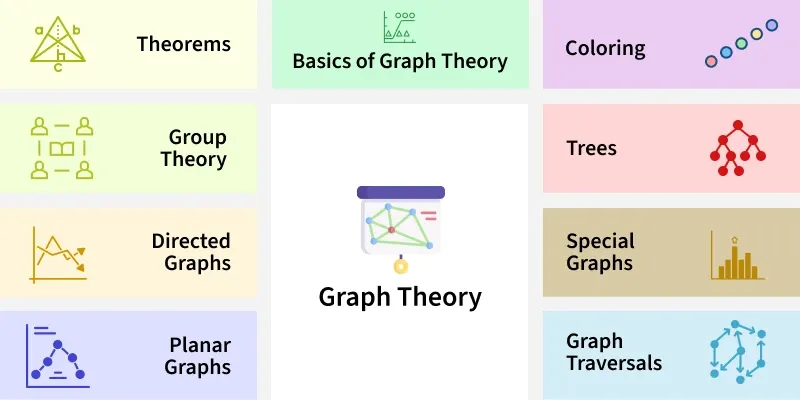
Covers the foundations of graphs, their representations, key terminology, and basic algorithms like Dijkstra’s.
Learn how to explore graphs systematically using DFS, BFS, and topological sorting.
Focuses on hierarchical graph structures, spanning trees, traversals, and coding applications.
Introduces important classes of graphs like bipartite, complete, regular, and random graphs.
Study Eulerian paths and cycles, along with algorithms and real-world applications.
Learn about matching problems, including perfect and bipartite matchings, with approximation methods.
Understand graph coloring, chromatic numbers, and their applications in scheduling and optimization.
Explores planar graphs, planarity testing, and Kuratowski’s characterization.
Covers properties of digraphs, connectivity, shortest paths, and strong components.
Links algebraic structures with graph theory through groups, isomorphisms, and fields.