|
VOOZH | about |
|
VOOZH | about |
Capacitive reactance is the opposition presented by a capacitor to the flow of alternating current (AC) in a circuit. Unlike resistance, which remains constant regardless of frequency, capacitive reactance varies with the frequency of the AC signal. It is denoted by the symbol XC and is measured in ohms (Ω).
The Formula for Capacitance Reactance(XC) can be given as
- f is the frequency of the AC signal,
- c is the capacitance of the capacitor.
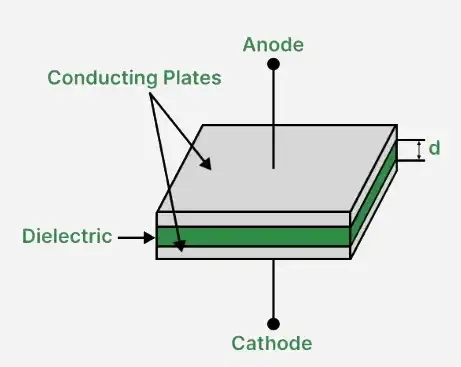
A capacitor is a passive device used to store electric energy in the form of an electric field between two parallel plates of conductors which are separated by a dielectric material. Dielectric materials are those materials that have the capacity to store electric charges. A capacitor behaves differently if it is placed in a circuit having a DC source or AC source.
The capacitor has the property to oppose sudden changes in voltage. When such abrupt change occurs, it tries to maintain the voltage by supplying the required voltage to the circuit. This voltage is generated by the electric field which was present when the capacitor was charged. The electric field gets reduced after supplying the voltage. This behaviour of the capacitor is useful and is used in power supplies to regulate the output DC voltage. Capacitance is measured in Farads named after Michael Faraday.
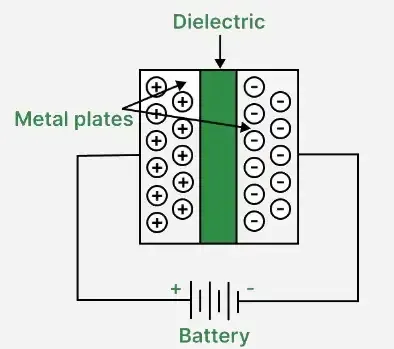
A capacitor consists of two metal plates separated by some dielectric material such as air or paper. It is possible to store charges on these metal plates with the help of external power source. When a battery is connected to a capacitor as shown in the above figure, electrons are pumped out of the battery and reaches the right side metal plate and accumulates there since it is attracted by the holes (positive) which is provided by positive terminal of the battery. The electrons stored in the metal plate cannot reach the other plate since it is separated by the dielectric. This electric field is still maintained even after disconnecting the battery.
The ability to hold charges is called capacitance and it depends on the area of the metal plate, since higher area means more electrons can be accumulated. It also depends on distance between the plates, since electrostatic forces are weak and to attract more electrons to the plate, there must be strong positive force at the other side of the metal plate and this force reduces as the distance increases. It also depends on the dielectric constant of the material placed between the metal plates.
The formula to calculate Capacitance is
C = ε A/d
Where C is capacitance, ε is permittivity of the dielectric and d is the distance between the two electrodes.
When AC supply is connected, the charges are still stored in the capacitor but the polarity of the voltage changes with time. Current does not flow through the capacitor once it is charged to the source voltage like in the case of DC supply. However the changing polarity causes the current to flow through the capacitor since the capacitor charges and discharges continuously.
Reactance can be defined as opposition to the flow of alternating current inside passive components such as capacitor and inductor. Reactance is similar to resistance however resistance is not related to frequency of voltage or current in a circuit. Reactance changes with respect to frequency of voltage and current.
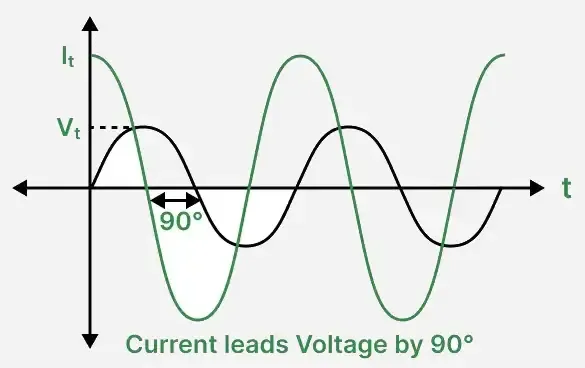
Unlike resistance, reactance does not dissipate heat when it opposes the current. It opposes the current in different way. A capacitor has both resistance and reactance, therefore requiring complex numbers to denote their values. Reactance in capacitor is created due to current leading the voltage by 90°.
Normally the current and voltage follows Ohm's law and are in phase with each other and vary linearly. This phase difference cause decrease in current through capacitor when voltage across the capacitor increases. This can be proved easily as follows:
We know, charge present in the capacitor is equal to capacitance times voltage across the capacitor. i.e.
Q = CV
We also know, current is defined as flow of charges per unit time. i.e.
It = dQ/dt
Substituting Q = CV,
It = CdVt/dt
Let Vt = Vsin(ωt)
It = C dVsin(ωt)/dt
∴ It = CVωcos(ωt) [ ∵ dsin(ωt)/dt = ωcos(ωt) ]
There is a phase difference of 90° between sine and cosine function. Hence current i(t) leads voltage V by 90°.
I0 = CV0ωcos(ω0)
I0 = CV0ω [ ∵ cos(0) = 1 ]
∴ V0/I0 = Xc = 1/2πfC [ ∵ ω = 2πf ]
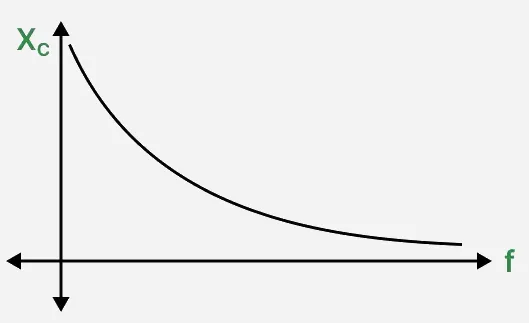
Therefore Capacitive reactance is equal to 1/2πfC where, reactance is inversely proportional to frequency of signal. This is the reason why capacitor acts as open switch in DC circuit since frequency of DC is 0 and 1/0 becomes infinite. Hence in DC voltage, capacitive reactance is very high. As frequency increases, capacitive reactance decreases. This behaviour of capacitor is very useful to build filters to attenuate certain frequencies of signal. Capacitive reactance is also inversely proportional to capacitance.
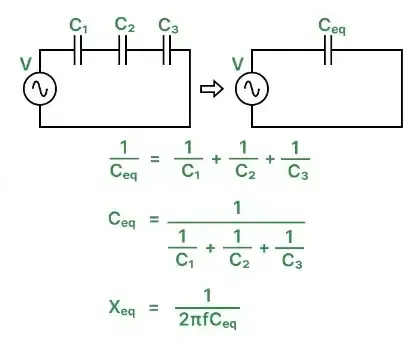
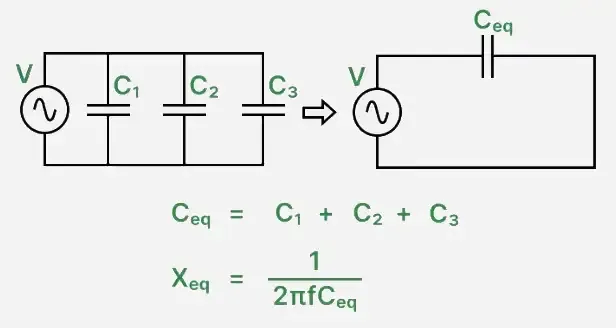
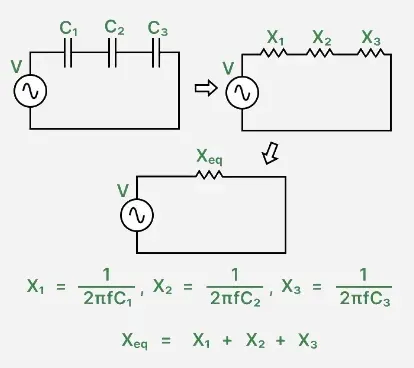
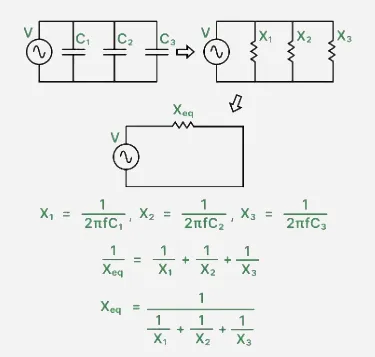
Capacitance and capacitive reactance both changes when multiple capacitors are introduced to the existing circuit. It changes based on how they are connected i.e. series or parallel. An equivalent capacitance can be calculated when multiple capacitors are connected in series or parallel to simplify the given circuit. The rules for combining the capacitances are as follows:
When n capacitors are connected in series, the total capacitance of the circuit reduces and is lower than the least capacitance provided by an individual capacitor. It is equal to:
1/Ceq = 1/C1 + 1/C2 + 1/C3 + . . . + 1/Cn
When n capacitors are connected in parallel, the total capacitance of the circuit increases and is higher than the largest capacitance provided by an individual capacitor. It is equal to:
Ceq = C1 + C2 + C3 + . . . + Cn
The equivalent capacitive reactance can be calculated as if we know the total capacitance of the circuit,
Xeq = 1/2πfCeq
We can also find reactance of each capacitor individually such as X1 = 1/2πfC1 , X2 = 1/2πfC2 , . . . , Xn = 1/2πfCn and add those reactance if they are series or add their reciprocals if they are in parallel. i.e.
For series, Xeq = X1 + X2 + X3 + . . . + Xn
For parallel, 1/Xeq = 1/X1 + 1/X2 + 1/X3 + . . . + 1/Xn
Since reactance is the resistance provided by energy storing components such as capacitors and inductors, when multiple reactance are connected in series they are added directly and is higher than the largest reactance present in the circuit. When multiple reactance are connected in parallel, their reciprocals are added such that the total reactance is lower than the least reactance present in the circuit. These rules are same as resistors connected in series or parallel.
From the above graph we can confirm that as the frequency increases, capacitive reactance decreases since capacitive reactance is inversely proportional to frequency.
Capacitive Reactance | Inductive Reactance |
|---|---|
In capacitive reactance, current leads voltage by 90°. | In inductive reactance, current lags voltage by 90°. |
Capacitive reactance can be given by the formula XC = 1/2πfC. | Inductive reactance can be given by the formula XL = 2π fL. |
Capacitive reactance decreases with increase in frequency. | Inductive reactance increases with increase in frequency. |
When capacitive reactance is represented as complex number, the imaginary part is negative. | When inductive reactance is represented as complex number, the imaginary part is positive. |
Due to capacitive reactance, capacitors are used in high pass filters since attenuation is less for high frequency signals. | Due to inductive reactance, inductors are used in low pass filters since attenuation is less for low frequency signals. |
Given Below is the Application of the Capacitive Reactance
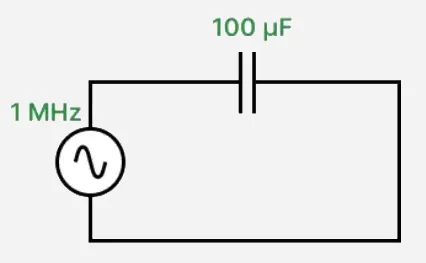
Example 1: A capacitor having capacitance 100εF is connected to supply whose frequency is 1MHz. Find the capacitive reactance.
XC = 1/2πfC
f = 1 × 10⁶
C = 1 × 10⁻⁶
∴ XC = 1/2π f.c = 0.159 Ω
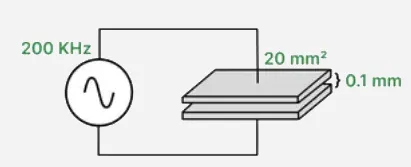
Example 2: A capacitor is built using two metal plates having area equal to 20mm2 separated by 0.1mm which contains air. This capacitor is connected to a frequency generator generating a sine wave of frequency 200KHz. Find the capacitive reactance which will be provided by the capacitor.
C = ε₀A/d
ε₀= 8.85418782 × 10⁻¹²
A = 20mm2 = 20 × 10-6
d = 0.1mm = 0.1 × 10⁻³
∴C = 1.77 × 10⁻¹² F
XC = 1/2πfC
XC = 449.59 KΩ
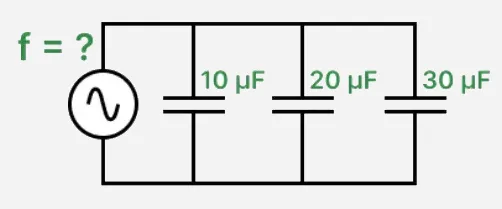
Example 3: Three capacitors having capacitances 10μF, 20μF and 30μF are connected in parallel such that their equivalent capacitive reactance is equal to 145 KΩ. Find the frequency of the signal which was passed through this circuit.
Ceq = C1 + C2 + C3
Ceq = 10 + 20 + 30 = 60 × 10-6 F
Xeq = 1/2πfCeq
Xeq = 145000 Ω
∴ f = 2πXeqCeq
f = 54.66 Hz