|
VOOZH | about |
|
VOOZH | about |
In this article, we will discuss about delta to star conversion. Firstly, we will try to understand the two types of connections i.e. star and delta connections. The understanding will be developed by learning about their characteristics through current and voltage equations in these circuits. We will proceed to see the differences between the star and delta connections based on different parameters. Results will be derived from the beginning to ensure clarity of formulas.
In addition to this, we will look into some solved examples that will help us understand the concept better. Later in the article, we will discuss the applications, advantages, and disadvantages of this conversion. The article will conclude with some frequently asked questions that readers can refer to.
Table of Content
In electronics and communication, we often need to analyze the circuit to simplify certain tasks. For this purpose, certain types of complex circuits have been introduced which simplify the task of circuit solving. These complex arrangements are usually connected in the zig-zag, series, and parallel, and sometimes they can include both types in a single circuit. Among these connections, star, and delta are some common types of connection. Let us study the characteristics of these circuits individually to develop a better understanding.
Formally,
Star and Delta Connection are two types of connections used in the 3-phase circuit to simplify the task of solving resistance in the circuit.
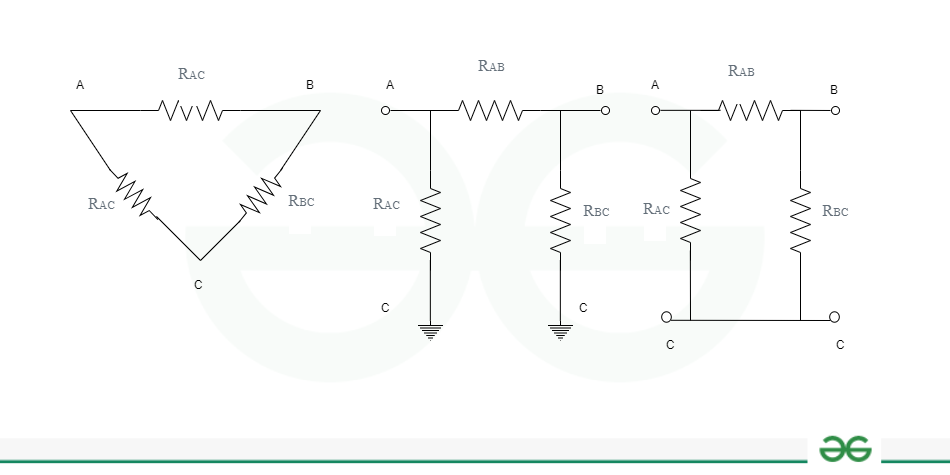
Delta connection is the type of connection where ending terminal of one winding joins to the starting terminal of other winding resulting in a closed circuit. Therefore, this type of network is called a mesh network. It is sometimes also in the shape of pi and mostly in the shape of a triangle or can be referred to as a delta.
The circuit diagram has been provided for better understanding about delta circuits. Note that in this type of connection, three lines run from the 3 common points formed by any two terminals. These lines are called Line Conductors.
Formally, A Delta Connection Circuit is a circuit that has no common or neutral point in the system due to which line voltage is equal to the phase voltage
A star connection circuit is the circuit where the three resistors in the circuit have a common point this point is called star or the neutral point. These circuits usually have a shape like the alphabet 'Y' which resembles a star and therefore these circuits get the name Star Connection Circuit .
The common point is grounded in most cases. Note that in this type of connection, all the windings terminal have one common junction and other terminal of each winding is joined to a separate junction.
Formally, Star Connection Circuit are a types of connection that have a neutral wire and the voltage developed across line is root three times the phase voltage.
Some of the important electrical properties of star and delta connection are current and voltage so let us study them individually.
Let us take a look at the circuit and the phasor diagram.
The figure clearly shows us the arrangement in a delta connection. We have assumed that the current flowing in each of the three windings in IR, IY, IB. We will use the phasor diagram to find the relationship between the quantities.
Mathematical Equations
From the phasor diagram
IR = IBR - IRY
and IY = IRY - IYB
and IB = IYB - IBR
Now we will use vector parallelogram law to calculate the equivalent
∴ IR= √(IBR2 +IRY2+ 2IBRIRYcos(60)
We know that for a balanced load, IRY =IBR =IYB =Iph. (Iph is the phase current)
IR= √(Iph2+Iph2+2Iph2 cos(60))
∴ IL= √3 Iph
Also as VRY= VYB= VBR= VL
∴ VL=Vph
Let us take a look at the circuit diagram of star connection
The figure shows the arrangement in a delta circuit. We have assumed that there are three phase voltages VR, VY, VB and the corresponding line voltages are VRY, VYB, VBR. We will use the phasor diagram to find the relationship between the quantities.
Mathematical Equations
From the phasor diagram
VR=V Y=VB=Vph
Also VRY =VR +(−V Y)=VR−VY
Now we will use vector parallelogram law to calculate the equivalent
∴ VRY = √(VR2+VY2+2VRVY cos60)
∴ VRY=√(Vph2+ Vph2+2Vph2cos60)
Therefore VL=√3 Vph
From the above calculation, we can say that line voltage is √3 times phase voltage in a star connection. Also from the figure, we can say that load is balanced hence current must be equal
IR=IY=IB=Iph
Let us look at the difference between delta and star connection
Parameter | Star Connection | Delta Connection |
|---|---|---|
Presence of Node | In this type of circuit the all the three branches have a common node and branches initiate form this node. | In this type of circuit the three are connected in way that they form a loop and no common node is present. |
Common Terminal | One terminal is common for all the branches in the circuit. | For every two branches one terminal remains common. |
Relation between line and phase current | IL=Iph | IL=√3 Iph |
Relation between line and phase voltage | VL=√3 Vph | VL=Vph |
Presence of neutral point | There is a neutral point present in the circuit | No neutral point is present in this type of circuit |
Power Supply | It receives less power than the supply. | It receives the full power. |
Used in | Used in power transmission networks | Used in power distribution networks |
Load Type | It can have both balanced and unbalanced load | It can only have balanced load. |
Delta to Star Conversion allows to convert Delta circuit connection into Star circuit connection by formation of resistances in both the side.
Let us consider three resistances RAB, RBC, RAC are connected in delta to three terminals A, B and C
If this circuit is converted to star connection by three resistances RA, RB, RC as shown here.
We are calculating equivalent circuit therefore, the resistance measured between any two of the terminals A, B, and C must be the same in two cases.
Resistance between A and B for star = Resistance between A and B for delta connection
Mathematically, we can write
RA+RB=(RBC+RAC)RAB/(RAB+RBC+RAC) →1
RB+RC=(RAB+RAC)RBC/(RAB+RBC+RAC) →2
RC+RA=(RAB+RBC)RAC/(RAB+RBC+RAC) →3
Adding the above three equations
2(RA+RB+RC)=2(RABRBC+RACRBC+RABRAC)/(RAB+RBC+RAC)
∴ RA+RB+RC= (RABRBC+RACRBC+RABRAC)/(RAB+RBC+RAC) →4
Subtract Equation 2 from Equation 4
RA+RB+RC−(RB+RC)=
equals (RABRBC+RACRBC+RABRAC)/(RAB+RBC+RAC) -(RAB+RAC)RBC/(RAB+RBC+RAC)
∴ RA=RACRAB/( RAB+RBC+RAC)
Similarly, Subtract Equation 3 from Equation 4
RB=RBCRAB/( RAB+RBC+RAC)
Similarly, Subtract Equation 1 from Equation 4
Rc=RACRBC/(RAB+RBC+RAC)
We can use these relations to calculate the resistances of star network from the resistances of delta network
Let us summarize the steps to be followed for delta to star conversion :
Find the equivalent star connection of the circuit in star with resistances Rac=4 ohms ,Rbc=8 ,Rab=12 ohms respectively.
From our previous derivations, we can say that
Rc=RacRbc/ (Rac+Rab+Rbc)
Ra=RabRac/ (Rac+Rab+Rbc)
Rb=RbcRab/ (Rac+Rab+Rbc)
we have Rac=4 ,Rbc=8 and Rab=12
On putting these values in above equation
Rc= 4*8/24 = 4/3 ohms
Ra= 4*12/24= 2 ohms
Rb= 8*12/24 = 4 ohms
The resistor value in a Y network that is equivalent to a Δ containing 3 resistors of R ohm.
A Y network means a star network. We are given that the three resistances in star connection are R ohms and we have to find the equivalent resistance in star connection. Consider the diagram
Given RA=RB=RC=R ohms
R1=RARB/RA+RB+RC
R2=RARC/RA+RB+RC
R3=RCRB/RA+RB+RC
From symmetry of the question we can say
R1=R2=R3
On putting the value R ohm ,we get
∴ R1=R2=R3=R/3 ohms
Let us see some applications of delta to star conversion
Let us see some advantages of delta to star conversion
Let us see some disadvantages of delta to star conversion
We have studied two important types of circuit connections in this article. We have also seen the relationship between the different parameters of the Star and Delta circuits. In addition to this, we have seen how the two types of connection are different from each other and therefore, we devised the necessary equations that can be used to convert the delta circuit to a Star circuit. Although, this method is helpful but there are some limitations to it. Some solved examples have been provided for better understanding of the concept. Readers are requested to refer to FAQs in case any doubt still exists.