|
VOOZH | about |
|
VOOZH | about |
A goroutine is a lightweight, concurrent execution unit in Go, managed by the Go runtime. It is much lighter than a thread, allowing thousands or even millions to run efficiently. Goroutines execute concurrently and are scheduled automatically, making concurrent programming in Go simple and efficient.
To create a goroutine, you use the go keyword followed by a function call. Here’s a simple example:
In the above example:
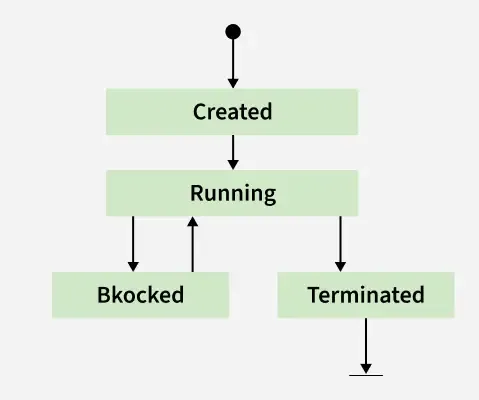
go keyword, allowing printMessage to run concurrently with the main function.time.Sleep(time.Second) allows the main function to wait for the goroutine to complete before the program exits.Managing the lifecycle of goroutines is vital to prevent issues like goroutine leaks and inefficient resource consumption. Let's explore how goroutines are managed from creation to termination.
A goroutine can be in one of the following states:
Effective resource management ensures that goroutines run efficiently without overwhelming system resources or causing memory leaks.
Using a context allows you to gracefully cancel a goroutine. This is particularly useful for background workers that might need to be stopped after a certain condition is met.
Example: Explicit Termination with Context
Explanation:
context package is used to propagate cancellation signals across goroutines. We create a cancellable context with context.WithCancel().background Worker goroutine listens for the Done() channel to gracefully exit when cancel() is called.Channels can also be used to signal a goroutine to stop. A worker listens for a signal on a channel, and when it receives the signal, it terminates.
Example: Channel-Based Termination
Explanation:
done channel is used to signal the worker goroutine to stop. This approach is simple and effective for controlled goroutine shutdowns.Effective resource management also involves employing concurrency patterns that help in distributing workloads, preventing resource exhaustion, and ensuring smooth operation across multiple goroutines.
The worker pool pattern is used to limit the number of concurrent goroutines performing a specific task. This is essential in cases where tasks are CPU-bound or resource-intensive.
Example: Worker Pool Pattern
Explanation:
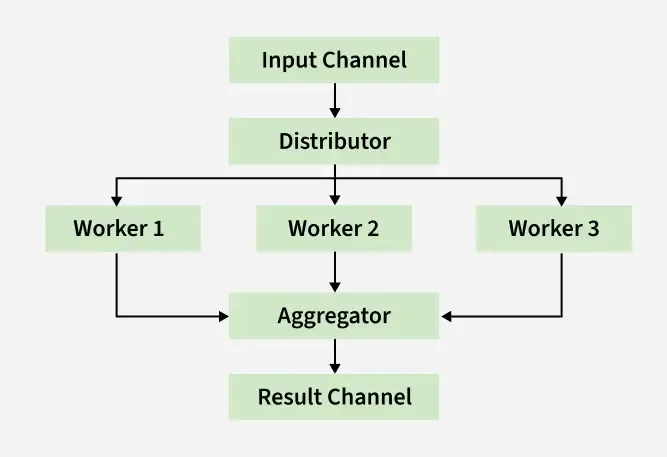
This pattern involves distributing tasks to multiple workers and then collecting their results. It's often used when you have a large number of independent tasks that need to be processed concurrently.
Example: Fan-Out/Fan-In Pattern
Explanation:
The semaphore pattern is used to limit the number of concurrent goroutines that can access a shared resource. This is helpful when dealing with rate-limiting or resource restrictions.
Example: Semaphore Pattern
Explanation:
context to manage cancellation and timeouts for long-running goroutines.Efficient goroutine management is key to building fast and reliable Go applications. By using lifecycle management, concurrency patterns, and resource optimization, developers can fully leverage Go’s concurrency while ensuring scalability. Techniques like context-based termination, worker pools, and semaphores help control concurrency and optimize resource usage, making Go programs efficient and scalable.