|
VOOZH | about |
|
VOOZH | about |
In the past, we only had one character set, and that was known as ASCII (American Standard Code for Information Interchange). There, we used 7 bits to represent 128 characters, including upper and lowercase English letters, digits, and a variety of punctuations and device-control characters. Due to this character limitation, the majority of the population is not able to use their custom writing systems. To solve this problem, Unicode was invented. Unicode is a superset of ASCII that contains all the characters present in today's world writing system. It includes accents, diacritical marks, control codes like tab and carriage return, and assigns each character a standard number called "Unicode Code Point", or in Go language, a "Rune". The Rune type is an alias of int32. Important Points:
Example:
♄
It is a Rune with hexadecimal value ♄.
It represents a Rune constant, where an integer value recognizes a Unicode code point. In Go language, a Rune Literal is expressed as one or more characters enclosed in single quotes like 'g', '\t', etc. In between single quotes, you are allowed to place any character except a newline and an unescaped single quote. Here, these single-quoted characters themselves represent the Unicode value of the given character and multi-character sequences with a backslash (at the beginning of the multi-character sequence) encode values in a different format. In Rune Literals, all the sequences that start with a backslash are illegal, only the following single-character escapes represent special values when you use them with a backslash:
| Character | Unicode | Description |
|---|---|---|
| \a | U+0007 | Alert or Bell |
| \b | U+0008 | backspace |
| \f | U+000C | form feed |
| \n | U+000A | line feed or newline |
| \r | U+000D | carriage return |
| \t | U+0009 | horizontal tab |
| \v | U+000b | vertical tab |
| \\ | U+005c | backslash |
| \' | U+0027 | single-quote |
| \" | U+0022 | double quote(legal only in string literals) |
Example 1:
Output:
Rune 1: B; Unicode: U+0042; Type: int32
Rune 2: g; Unicode: U+0067; Type: int32
Rune 3: Unicode: U+0007; Type: int32
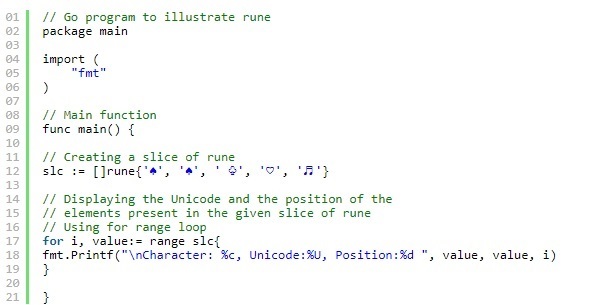
Example 2: 👁 Image
Output:
Character: ♛, Unicode:U+265B, Position:0
Character: ♠, Unicode:U+2660, Position:1
Character: ♧, Unicode:U+2667, Position:2
Character: ♡, Unicode:U+2661, Position:3
Character: ♬, Unicode:U+266C, Position:4