|
VOOZH | about |
|
VOOZH | about |
The GRE (Graduate Record Examinations) is a globally recognized test conducted by ETS (Educational Testing Service) for students aiming to pursue graduate programs in the USA, Canada, and other countries. The GRE exam syllabus for 2024 covers three major sections: Analytical Writing, Verbal Reasoning, and Quantitative Reasoning. Mastering the syllabus is crucial for students targeting high scores and admission to prestigious universities
Our GRE Preparation Guide and 4-Week Study Plan provide strategic resources to help you excel in each section of the GRE, whether preparing for the general test or specialized subject exams.
Table of Content
| Exam Details | Information |
|---|---|
| Exam Name | GRE |
| GRE Full Form | Graduate Record Examinations |
| Official Website | ETS GRE |
| Most Popular For | MS courses in the USA |
| Also Accepted For | MBA courses outside India |
| Conducted By | ETS (Educational Testing Service) |
| Mode of Exam | Computer-delivered test, Paper-delivered test, GRE at Home |
| GRE Exam Fees | GRE General Test: INR 22,550, GRE Subject Test: INR 14,500 |
| GRE Validity | 5 Years |
| Score Range | Verbal Reasoning: 130–170, Quantitative Reasoning: 130–170, Analytical Writing: 0–6 |
| GRE Contact | +91-1244517127 or 000-800-100-4072 (Monday–Friday, 9 a.m. to 5 p.m. IST) |
| GRESupport4India@ets.org |
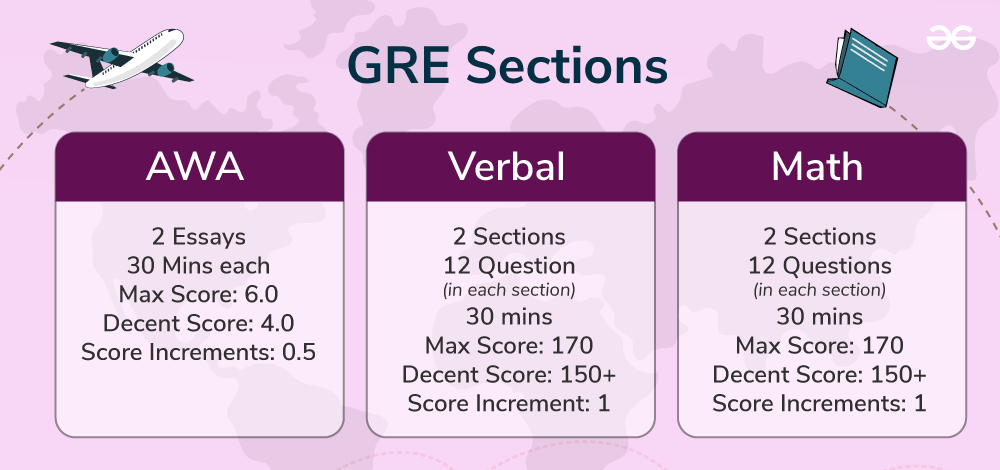
The GRE exam patterns differ between the computer-based and paper-based formats. The computer-based GRE exam is adaptive. The GRE General Test includes three sections: Analytical Writing, Verbal Reasoning, and Quantitative Reasoning. Each section is divided into two subsections. The total duration for the GRE General Test is 1 hour and 58 minutes. Here’s a breakdown of the sections:
| Sections | Number of Questions | Allotted Time |
|---|---|---|
| Analytical Writing | One "Analyze an Issue" task | 30 minutes |
| Verbal Reasoning | Section 1: 12 questions | Section 1: 18 minutes |
| Section 2: 15 questions | Section 2: 23 minutes | |
| Quantitative Reasoning | Section 1: 12 questions | Section 1: 21 minutes |
| Section 2: 15 questions | Section 2: 26 minutes |
This format provides a clear understanding of the GRE General Test structure, including the number of questions and the time allotted for each section.
Read More:GRE Exam Pattern
Looking for the latest GRE syllabus in PDF format? Our comprehensive GRE Syllabus PDF for 2024 provides all the essential details you need to excel in the exam. This document includes an in-depth overview of the GRE exam structure, covering critical sections like Analytical Writing, Verbal Reasoning, and Quantitative Reasoning. Whether you're aiming to understand the GRE exam syllabus, review key topics such as GRE Analytical Writing tasks, Verbal Reasoning question types, or Quantitative Reasoning concepts, our PDF is designed to offer valuable insights and preparation tips.
Stay ahead in your GRE preparation with a detailed guide to the GRE syllabus 2024, including scoring ranges, exam duration, and effective study strategies. Download our GRE Syllabus PDF to get a head start on your journey towards achieving a high score and securing admission to top graduate programs.
GRE Syllabus PDF- Free DOWNLOAD NOW!
The GRE General Test 2024 assesses critical academic skills in three key sections:
The Verbal Reasoning section evaluates your ability to analyze written English, focusing on complex sentence structures, vocabulary, and paragraph comprehension. While some may find this section straightforward, others might need extra preparation.
| Measure | Number of Questions | Allotted Time |
|---|---|---|
| Verbal Reasoning (Two sections) | Section 1: 12 questions | Section 1: 18 minutes |
| Section 2: 15 questions | Section 2: 23 minutes |
Verbal Reasoning Syllabus
| Topics Covered | Types of Questions | Analyses |
|---|---|---|
| Basic sentence structure, idioms, subject-verb agreement, noun-pronoun agreement, verb tense, modifiers | Reading comprehension, text completion, sentence equivalence | Analyzing sentence relationships, wordplay, understanding text structure, author’s assumptions and perspectives |
The Quantitative Reasoning section assesses your proficiency in basic mathematical skills and your ability to understand and interpret quantitative information. It includes:
| Measure | Number of Questions | Allotted Time |
|---|---|---|
| Quantitative Reasoning (Two sections) | Section 1: 12 questions | Section 1: 21 minutes |
| Section 2: 15 questions | Section 2: 26 minutes |
Quantitative Reasoning Syllabus
| Topics Covered | Types of Questions | Analyses |
|---|---|---|
| Arithmetic: Percentage, ratio, decimal representation | Quantitative comparison questions, numeric entry, MCQs | Analyzing quantitative situations, mathematical aptitude |
| Algebra: Intercepts, slopes, coordinate geometry, equations | ||
| Geometry: Parallel/perpendicular lines, polygons, triangles, circles | ||
| Data analysis: Line/bar graphs, scatter plots, permutations & combinations, Venn diagrams |
The Analytical Writing Assessment (AWA) is a crucial part of the GRE, often overlooked but significant in determining your overall score. It evaluates your ability to think critically and communicate effectively.
| Measure | Number of Questions | Allotted Time |
|---|---|---|
| Analytical Writing (One section) | One “Analyze an Issue” task | 30 minutes |
Analytical Writing Syllabus:
| Topics Covered | Types of Questions | Analyses |
|---|---|---|
| Argument analysis, sustaining coherent discussions, general topics, grammar | Analyze an issue and an argument | Constructing and evaluating arguments, critical thinking |
This section assesses your ability to:
Developing strong AWA skills requires practice and dedication. Investing time in this section can significantly enhance your overall GRE score and boost your chances of admission to your desired graduate program.
Starting September 2023, the GRE Subject Tests will be exclusively administered in a computer-delivered format, including Mathematics, Physics, and Psychology.
Note: There are no separately timed sections within any of the GRE Subject Tests.
| Subject | Syllabus | Number of Questions |
|---|---|---|
| Physics | Classical Mechanics: 20%, Electromagnetism: 18%, Optics and Wave Phenomena: 8%, Thermodynamics and Statistical Mechanics: 10%, Quantum Mechanics: 13%, Atomic Physics: 10%, Special Relativity: 6%, Laboratory Methods: 6%, Specialized Topics: 9% | Approximately 70 5-choice questions |
| Mathematics | Calculus: 50%, Algebra: 25%, Additional Topics: 25% | Approximately 66 MCQs |
| Psychology | Biological (30 questions), Cognitive (29 questions), Social (19 questions), Developmental (18 questions), Clinical (23 questions), Measurement/Methodology/Other (25 questions) | Approximately 144 MCQs |
| Section | Objective | Topics Covered | Score Range |
|---|---|---|---|
| Verbal Reasoning | Measures comprehension and analysis of written material. | - Reading Comprehension - Text Completion - Sentence Equivalence | 130–170 |
| Quantitative Reasoning | Assesses interpretation and analysis of quantitative data. | - Arithmetic: Percentages, Ratios, Proportions - Algebra: Equations, Functions, Inequalities - Geometry: Lines, Angles, Triangles, Circles - Data Analysis: Graphs, Tables, Statistics | 130–170 |
| Analytical Writing | Evaluates critical thinking and analytical writing skills. | - Analyze an Issue - Analyze an Argument | 0–6 |
| Detail | Information |
|---|---|
| Test Duration | Approximately 3 hours and 45 minutes |
| Format | Computer-delivered test |
| Fees | General Test: INR 22,550 Subject Test: INR 14,500 |
| Validity | 5 years |
Preparing for the GRE with a focus on Computer Science Engineering (CSE)? Understanding the GRE syllabus for CSE is crucial for optimal preparation. The GRE General Test assesses your skills across three main sections: Analytical Writing, Verbal Reasoning, and Quantitative Reasoning. For CSE aspirants, mastering these areas is essential for scoring high and gaining admission to top graduate programs.
1. Analytical Writing: This section tests your ability to articulate complex ideas clearly and coherently. The GRE Analytical Writing section includes two tasks: Analyze an Issue and Analyze an Argument. Focus on structuring arguments, supporting your position with evidence, and critiquing arguments effectively.
2. Verbal Reasoning: This part evaluates your ability to understand and analyze written material. Key areas include Reading Comprehension, Text Completion, and Sentence Equivalence. Enhancing your vocabulary and reading strategies will benefit your performance in this section.
3. Quantitative Reasoning: For CSE students, this section is particularly important as it includes Arithmetic, Algebra, Geometry, and Data Analysis. Key topics are:
For a detailed and effective study plan, review the GRE syllabus for CSE and practice relevant problems to boost your confidence and improve your score. Download our comprehensive guide to the GRE exam syllabus for CSE and start preparing with targeted resources and strategies.
The GRE 2024 exam has no specific eligibility criteria, allowing anyone planning to pursue graduate studies to take the test. However, consider the following:
By understanding the GRE Subject Test format and syllabus, you can better prepare for the exam and meet the eligibility criteria set by your target programs.
Read More: GRE Eligibility 2024
To truly stand out and achieve top-tier scores on the GRE, it’s crucial to excel and position yourself in the highest percentiles. This distinction can set you apart in the competitive job market, attracting offers from prestigious companies like Citigroup, Morgan Stanley, and Goldman Sachs.
Maximize Your GRE Preparation:
By adopting a strategic approach and dedicating time to thorough preparation, you can significantly boost your chances of achieving an outstanding GRE score and advancing your career prospects with leading financial institutions.
Read More: GRE Preparation Tips
Read More:
GRE Cut Off |