As we know that a set is a
well-defined collection of distinct objects. Each member of a set is called an element of the set. So in other words, we can say that a
set will never contain duplicate elements. But how in java
Set interface implemented classes like
HashSet,
LinkedHashSet,
TreeSet etc. achieve this uniqueness. In this post, we will discuss the hidden truth behind this uniqueness.
How HashSet works internally in Java?
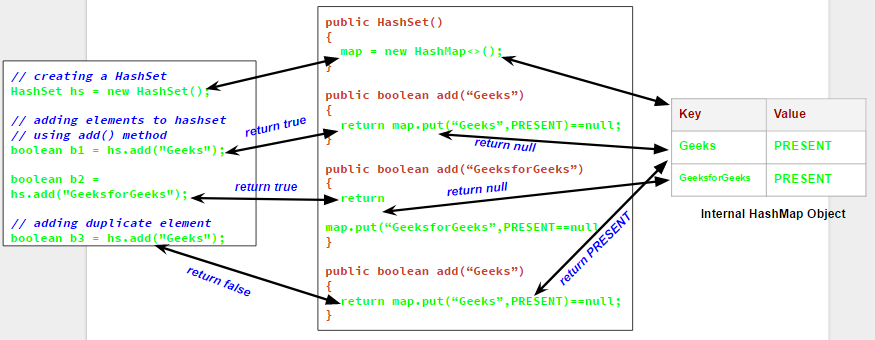
👁 How Set/HashSet works internally in Java
We will understand this with an example.Let us see the output of the following program which try to add duplicate elements in a HashSet.
Output:
b1 = true
b2 = true
b3 = false
[GeeksforGeeks, Geeks]
Now from the output, it is clear that when we try to add a duplicate element to a set using
add() method, it returns
false, and element is not added to hashset, as it is already present. Now the question comes, how
add() method checks whether the set already contains the specified element or not. It will be more clear if we have a closer look on the
add() method and default constructor in HashSet class.
// predefined HashSet class
public class HashSet
{
 // A HashMap object
 private transient HashMap
Now as you can see that whenever we create a HashSet, it internally creates a
HashMap and if we insert an element into this HashSet using
add() method, it actually call
put() method on internally created HashMap object with element you have specified as it’s key and constant Object called
"PRESENT" as it’s value. So we can say that
a Set achieves uniqueness internally through HashMap. Now the whole story comes around
how a HashMap and put() method internally works.
As we know in a
HashMap each key is unique and when we call
put(Key, Value) method, it returns the previous value associated with key, or
null if there was no mapping for key. So in
add() method we check the return value of map.put(key, value) method with
null value.
- If map.put(key, value) returns null, then the statement "map.put(e, PRESENT) == null" will return true and element is added to the HashSet(internally HashMap).
- If map.put(key, value) returns old value of the key, then the statement "map.put(e, PRESENT) == null" will return false and element is not added to the HashSet(internally HashMap).
As LinkedHashSet extends HashSet, so it internally calls constructors of HashSet using
super(). Similarly creating an object of
TreeSet class internally creates object of
Navigable Map as backing map.
Related Article : How HashMap internally works in Java.