|
VOOZH | about |
|
VOOZH | about |
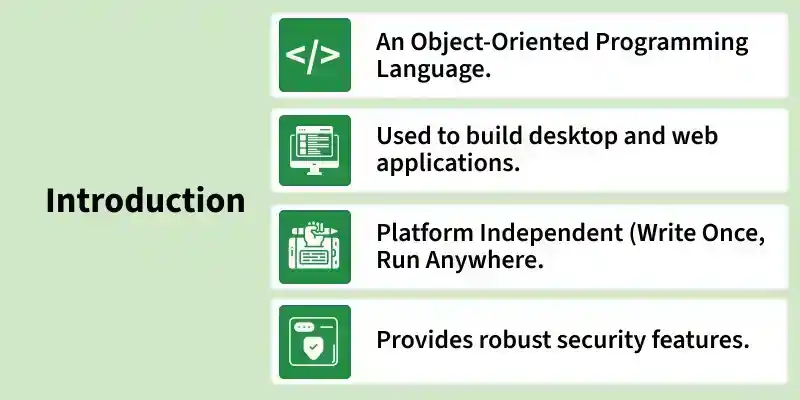
Core Java is the fundamental part of Java used to build general-purpose applications. It covers core concepts like OOPs, exception handling, collections, multithreading, and JDBC, forming the base for advanced technologies such as Spring and Hibernate.
Java provides different editions for different types of application development. Each edition contains specific libraries and APIs according to the application requirements.
Java SE is the basic edition of Java used for creating desktop and standalone applications. It contains core Java libraries and fundamental concepts.
Java EE is used for developing large-scale enterprise and web applications. It extends Java SE with additional APIs for web services, servlets, and enterprise applications.
Java ME is designed for mobile devices and embedded systems with limited memory and processing power.
Core Java is important because it forms the base of all Java technologies and frameworks. A strong understanding of Core Java helps developers build efficient, secure, and platform-independent applications.
Object-Oriented Programming helps organize programs using classes and objects.
Exception handling manages runtime errors and prevents program crashes.
Collections are used to store and manipulate groups of objects dynamically.
Multithreading allows multiple tasks to run simultaneously.
JDBC (Java Database Connectivity) connects Java applications with databases.
Let us understand the difference between Java and Core Java from the below table.
Core Java vs Advanced Java | Core Java | Advanced Java |
|---|---|---|
Definition | Covers fundamental concepts of Java | Encompasses all advanced concepts of Java |
Scope | General application development | Enterprise application development |
Version or Edition of Java | Java Standard Edition (J2SE) | Java Enterprise Edition (J2EE) |
Topics covered | Threading, Swing, OOP, Data types, operators, exception handling, etc. | Web services, Servlets, JSP, Database connectivity, EJB, etc. |
Architecture | Single-tier architecture (Standalone) | Two-tier architecture (Client-side and Server-side) |
Expertise | Prerequisite for Advanced Java development | Specialised skills in areas like database, networking, etc. |