FCFS disk scheduling algorithm:
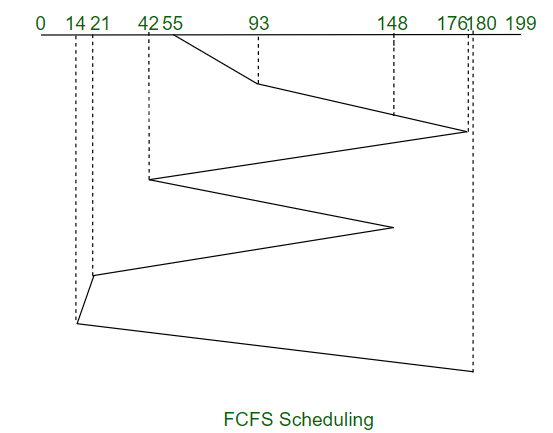
As the name suggests, the FCFS Scheduling Algorithm processes requests in the sequential order in which they arrive in the disk queue. Even if a higher priority request arrives in the schedule later, FCFS will process the request in the order that they have arrived and hence we can say that FCFS has a fair policy.
Example:
Consider a disk with 200 tracks (0-199) and the disk queue having I/O requests in the following order as follows: 93, 176, 42, 148, 21, 14, 180. The current head position of the Read\Write head is 55. Calculate the total number of track movements of Read/Write head using FCFS.
👁 Image
Total Seek Time,
= (93-55) + (176-93) + (176-42)
 + (148-42) + (148-21)
 + (21-14) + (180-14)
= 661
SCAN disk scheduling algorithm:
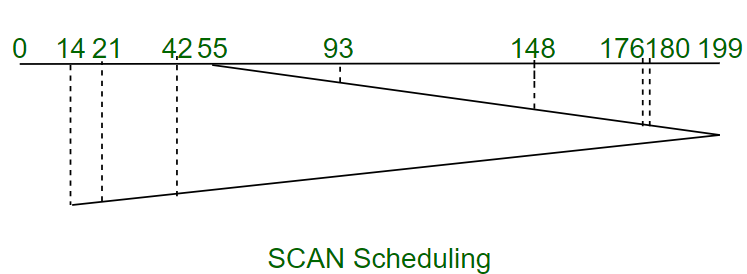
As the name suggests, the SCAN Algorithm scans all the tracks of the disk in a back and forth manner such that it will first process all the requests in one direction till it reaches the last track in that direction then it reverses the direction and starts servicing the requests in it comes across. This algorithm is also known as
Elevator Algorithm since it works like an elevator by continuously moving in one direction servicing requests and then reversing direction.
Example:
Consider a disk with 200 tracks (0-199) and the disk queue having I/O requests in the following order as follows: 93, 176, 42, 148, 21, 14, 180. The current head position of the Read\Write head is 55. Calculate the total number of track movements of Read/Write head using SCAN.
👁 Image
Total Seek Time,
= (199-55) + (199-14)
= 329
Now, let’s see the difference between FCFS and SCAN disk scheduling algorithms: