|
VOOZH | about |
|
VOOZH | about |
An operating system is software that acts as an intermediary between the user and computer hardware. It is a program with the help of which we are able to run various applications. It is the one program that is running all the time. Every computer must have an operating system to smoothly execute other programs.
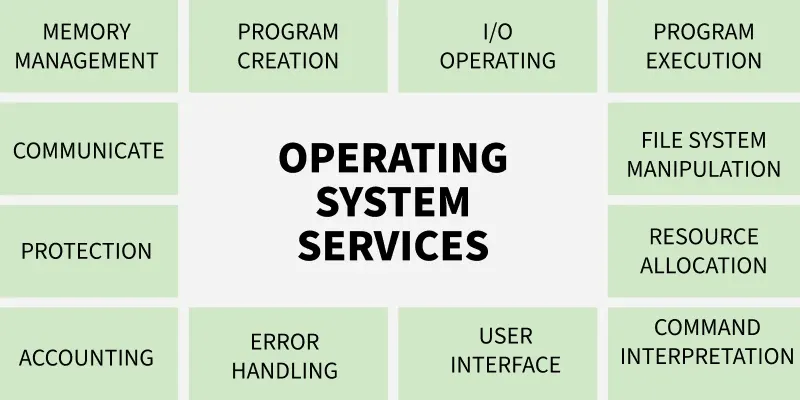
The Operating System manages program execution by loading programs into memory and scheduling them using algorithms like FCFS, SJF. It ensures smooth execution of user and system programs while preventing deadlocks where processes wait indefinitely. The OS also allocates system resources efficiently for proper functioning.
The Operating System manages all input-output operations and enables communication between users, programs, and device drivers. Device Device drivers act as the software interface for hardware, allowing the OS to control devices smoothly. The OS also provides programs with safe and timely access to input-output devices whenever required.
The Operating System manages communication between processes and enables smooth data transfer among them. It handles both local communication on the same computer and communication across networked systems. This ensures efficient and coordinated exchange of information.
The Operating System manages all file operations by granting programs the required access permissions such as read-only or read-write. It allows users to create, delete, store, and organize files across devices like, floppy disk or pen drives. The OS also decides how data should be stored and manipulated for efficient file management.
The OS manages memory like a cricket team manager choosing players. Just as the manager decides whether a player enters the playing 11 or 15 based on performance, the OS checks whether a new program meets the requirements for memory. If it does, the OS decides how much memory the program needs and loads it into an appropriate location, preventing unnecessary memory usage.
Process management can be understood by imagining the kitchen stove as the CPU and the chef as the Operating System. The chef must cook multiple dishes (programs) and ensures no single dish takes too much time so that every dish gets a fair chance to be cooked. In this way, the OS schedules and manages all programs efficiently to keep the system running smoothly.
The Operating System keeps the computer safe from unauthorized users by adding protective security layers. It defends the system from threats like viruses and hackers through tools such as firewalls and antivirus software. These measures ensure the safety of the computer and its data.
The Operating System helps keep personal information private, similar to locking a door that only you can open. It ensures that sensitive files and data remain hidden from others. In this way, the OS respects user confidentiality and protects important information.
The Operating System manages how system resources are shared among different processes. It allocates CPU time using CPU Scheduling Algorithms, handles memory management, and controls input-output devices. By deciding which process gets which resource, the OS ensures proper and efficient use of all available resources.
The Operating System provides a user interface that allows users to interact with the system either through a command-line interface(CLI) or a Graphical User Interface (GUI). In a CLI, the command interpreter executes user-typed commands. A GUI offers a mouse-based window and menu system that makes interaction easier and more visual.
This service enables communication between devices on a network by managing connections and controlling data exchange. It allows devices to connect to the internet, send and receive data packets, and maintain stable communication. Through proper network management, the system ensures smooth and reliable data transfer.
The Operating System detects and handles errors occurring in the CPU, memory, or input-output devices to keep the system stable. It prevents frequent errors, avoids deadlocks, and fixes issues that appear during program execution. A secure OS also acts as a protective layer against external threats or breaches.
Imagine a traffic light as the Operating System, guiding cars (programs) on when to stop, wait, or move. Red represents the simple queue, yellow is the ready queue, and green means the program is under execution. By switching lights at proper intervals, the OS ensures all programs move smoothly without traffic or delays.