|
VOOZH | about |
|
VOOZH | about |
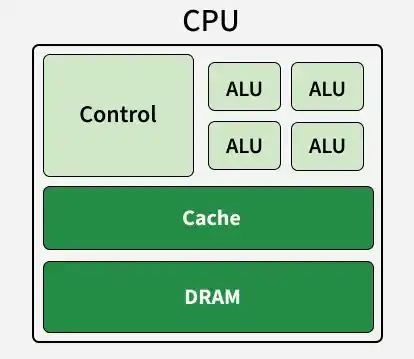
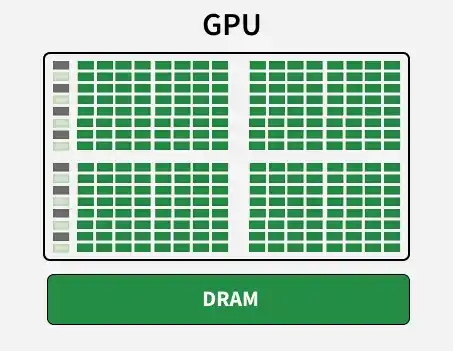
Modern computing systems use components like the CPU and GPU, each designed to handle different types of tasks based on how the computation is performed.
| Feature | CPU (Host) | GPU (Device) |
|---|---|---|
| Architecture | Latency-oriented: Designed to complete individual tasks with low delay. | Throughput-oriented: Designed to process a large amount of data in parallel. |
| Core Count | Small number of cores (typically 4 to 64). | Large number of cores (hundreds to thousands). |
| Processing Mode | Serial execution: Instructions are executed one after another. | Parallel execution: Multiple instructions are executed at the same time. |
| Control Logic | Complex control unit to manage branching, scheduling and instruction execution. | Reduced control unit, optimized for executing repeated parallel operations. |
| Cache Memory | Large cache (L1, L2, L3) to store frequently used data. | Smaller cache, uses high memory bandwidth for fast data transfer. |
| Ideal Workload | Operating system tasks, program control and sequential operations. | Vector operations, matrix computations, image processing and machine learning. |
A Central Processing Unit (CPU) is the main processor that executes program instructions and controls system operations. It is designed to handle tasks step-by-step and is used for general-purpose computing.
Advantages:
Disadvantages:
A Graphics Processing Unit (GPU) is a processor designed to perform many calculations at the same time. It is mainly used for parallel tasks such as graphics rendering and large-scale data processing.
Advantages:
Disadvantages: