|
VOOZH | about |
|
VOOZH | about |
Von Neumann architecture is a computer design where instructions and data are stored in the same memory space. This means the CPU fetches both instructions and data from the same memory, using the same pathways. Historically there have been 2 types of Computers:
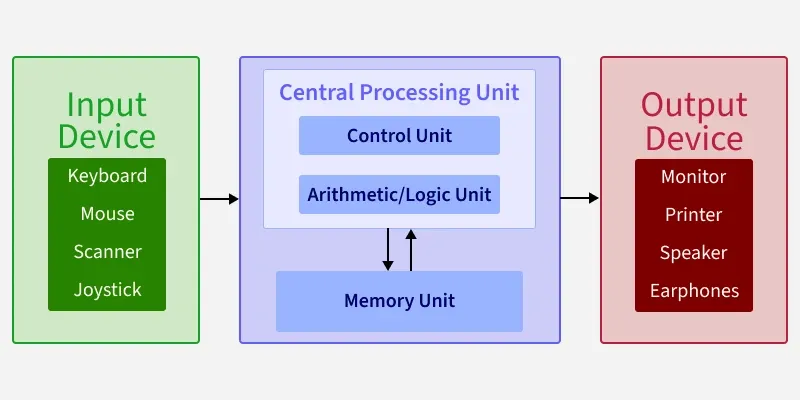
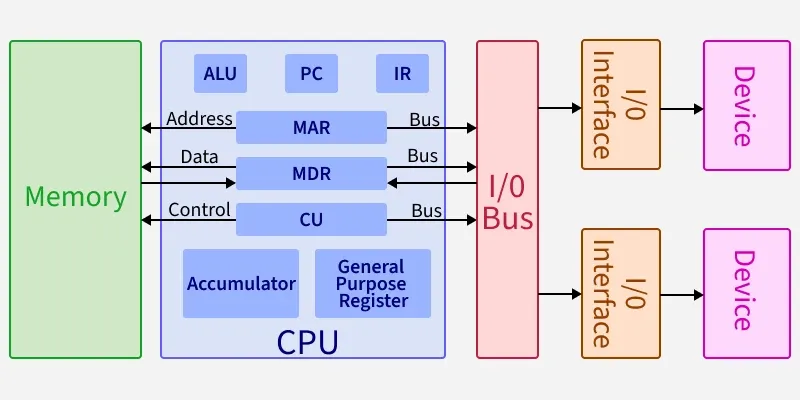
The structure described in the figure outlines the basic components of a computer system, particularly focusing on the memory and processor. It is made up with three main components:
We have these 3 components lets us see more about them in detail:
The central processing unit (CPU) is the main part of a computer that controls how it works. It is made up of the control unit, the arithmetic logic unit (ALU) and Registers (not RAM). The CPU handles instructions from programs, processes data, stores information, and produces results. Without the CPU, a computer cannot perform tasks or run any applications.
The control unit manages how the processor works by sending control signals. It decides how data should move inside the computer, controls input and output operations, and fetches the instructions from memory for execution.
The arithmetic and logic unit is the part of the CPU that handles the calculations and decision-making tasks. It performs arithmetic operations like addition and subtraction, logical operations such as comparisons, and tasks like shifting bits in data.
Registers are the fastest type of memory located inside the CPU. They temporarily store information that the processor is currently working on, making program execution and operations faster and more efficient. Register serve as the CPU's primary working memory.
The bus is a communication system that transfers data, addresses, and control signals between the CPU, memory, and I/O devices. In Von Neumann architecture, a single bus is shared for both data and instructions, which can create a bottleneck (known as the Von Neumann bottleneck).
Whatever we do to enhance performance, we cannot get away from the fact that instructions can only be done one at a time and can only be carried out sequentially. Both of these factors hold back the competence of the CPU. This is commonly referred to as the 'Von Neumann bottleneck'. We can provide a Von Neumann processor with more cache, more RAM, or faster components but if original gains are to be made in CPU performance then an influential inspection needs to take place of CPU configuration.
Von Neumann architecture is the foundation of most modern computing systems, where both instructions and data are stored in the same memory. Here are the some applications: