|
VOOZH | about |
|
VOOZH | about |
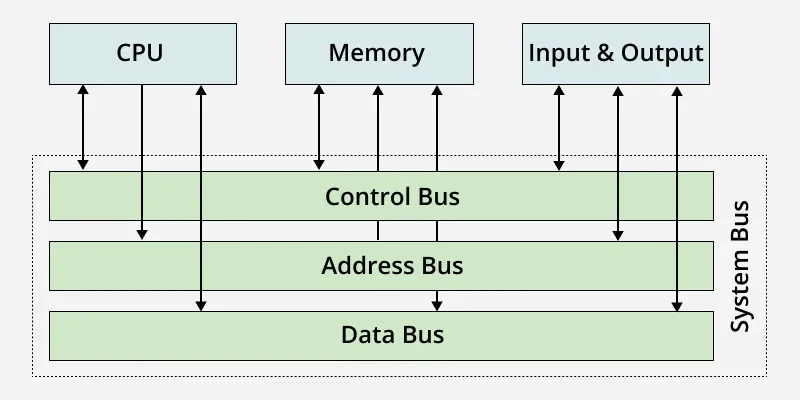
A computer bus is a communication system used to transfer data between components within a computer or between different computers. It is important for minimizing the number of connections needed by centralizing communication over shared pathways.
There are three main types of buses in a computer system, which are discussed below:
A collection of wires used to identify particular location in main memory is called Address Bus. Or in other words, the information used to describe the memory locations travels along the address bus.
Example:
- A system with 4-bit address bus can address 24 = 16 Bytes of memory.
- A system with 16-bit address bus can address 216 = 64 KB of memory
- A system with 20-bit address bus can address 220 = 1 MB of memory.
A collection of wires through which data is transmitted from one part of a computer to another is called Data Bus. It can be thought of as a highway on which data travels within a computer.
Example:
- A 16-bit bus can transmit 16 bits of data at a time.
- 32-bit bus can transmit 32 bits at a time.
Carries control and timing signals between the CPU and other devices in the computer. It is used to manage and coordinate operations such as read, write, and interrupt requests.
The below table shows the comparison between the three buses as below :
| Buses | Purpose & Key Role |
|---|---|
| Address Bus (Unidirectional) | Carries memory addresses; Identifies where data should go |
| Data Bus (Bidirectional) | Carries actual data, moves data between components |
Control Bus(Bidirectional) | Carries control and sync signals, coordinates CPU and device actions |