|
VOOZH | about |
|
VOOZH | about |
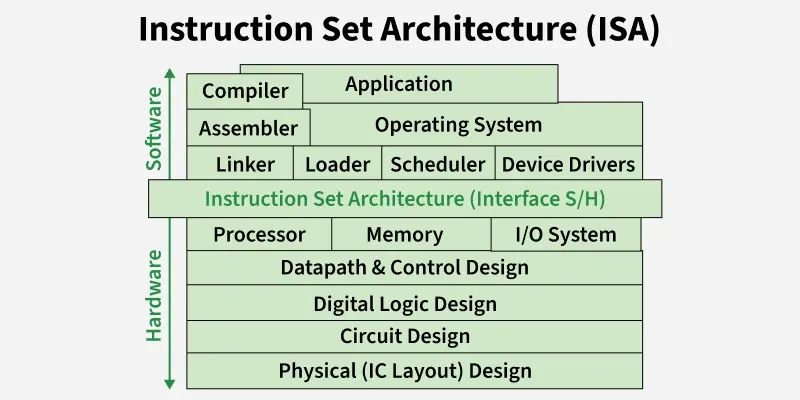
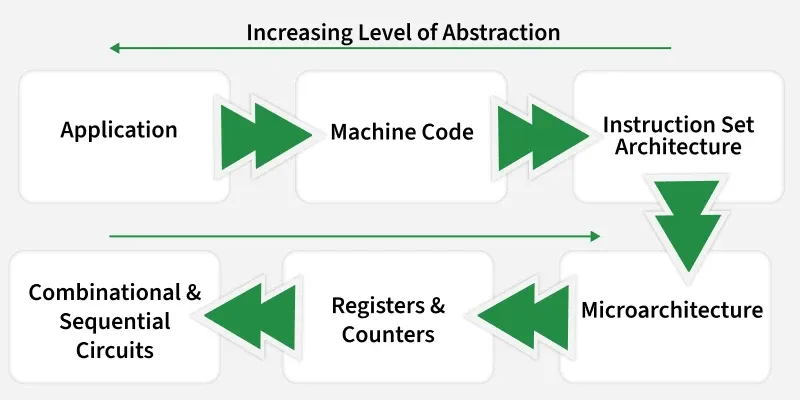
Microarchitecture and Instruction Set Architecture (ISA) are two fundamental concepts in computer organization. When we use a computer or smartphone, there's a lot going on behind the scenes in the processor (CPU). Two important parts that make everything work are:
ISA is the language of the CPU that tells it what operations it can perform, such as adding numbers, loading data, or jumping to another instruction.
It defines how software communicates with hardware through specific instruction rules and formats. It includes:
Some Popular ISAs are x86 (PCs), ARM (phones), MIPS (education), RISC-V (open source).
To understand what an ISA aims to do, let’s take MIPS ISA as an example. MIPS is popular in computer science courses because it’s simple and clean.
MIPS divides instructions into three main types:
MIPS is a 32-bit ISA, meaning every instruction must be exactly 32 bits (4 bytes) long. This fixed length simplifies the design and makes it more efficient for both hardware and compiler developers.
Since all MIPS instructions are 32 bits long, the ISA defines how those 32 bits are organized for different instruction types. MIPS uses three instruction formats:
| Format | Used For |
|---|---|
| R-type | Arithmetic and logic operations (eg; ADD, SUB) |
| I-type | Data transfer and conditional branches (eg; LW, BEQ) |
| J-type | Unconditional jumps (eg; J) |
Microarchitecture includes components like the ALU for calculations, pipelines for faster processing, cache for quick memory access, the control unit, and execution units.
ISA forms the core design element of any processor. Whether it’s RISC (Reduced Instruction Set Computing) or CISC (Complex Instruction Set Computing), the choice of ISA impacts all other design decisions.
Computer architecture often focus on instruction execution, pipelining, control unit design, and instruction formats — all of which are defined by the ISA.
Understanding ISA is critical for assembly-level programming. It helps in:
A well-designed ISA can lead to efficient hardware implementation and optimized software execution. ISA affects:
ISA determines software compatibility. If two processors implement the same ISA, they can run the same programs — even if their internal microarchitectures are different.
There are multiple types of ISA, each designed with different goals in mind, such as simplifying instruction sets for faster execution, supporting complex operations with fewer instructions, or enabling parallel processing to improve performance.
| Type | Description |
|---|---|
| RISC | Few, simple instructions for speed |
| CISC | Many complex instructions |
| VLIW | Runs multiple operations in one instruction |
| EPIC | Tries to run things in parallel |
| Stack-based | Uses a stack instead of registers |