|
VOOZH | about |
|
VOOZH | about |
Given an array of disk track numbers and initial head position, our task is to find the total number of seek operations done to access all the requested tracks if Shortest Seek Time First (SSTF) is a disk scheduling algorithm is used.
The basic idea is the tracks that are closer to the current disk head position should be serviced first in order to minimize the seek operations is basically known as Shortest Seek Time First (SSTF).
Step 1: Let the Request array represents an array storing indexes of tracks that have been requested. 'head' is the position of the disk head.
Step 2: Find the positive distance of all tracks in the request array from the head.
Step 3: Find a track from the requested array which has not been accessed/serviced yet and has a minimum distance from the head.
Step 4: Increment the total seek count with this distance.
Step 5: Currently serviced track position now becomes the new head position.
Step 6: Go to step 2 until all tracks in the request array have not been serviced.
Example:
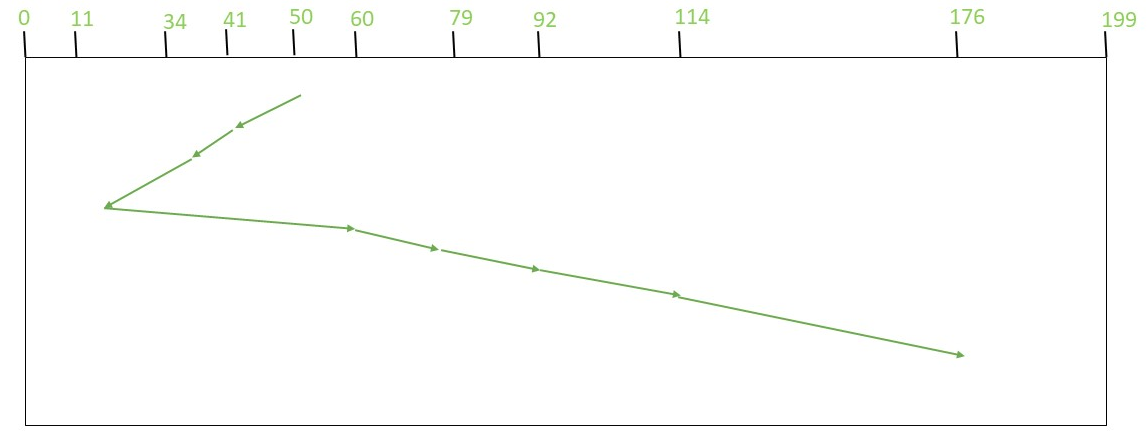
Request sequence = {176, 79, 34, 60, 92, 11, 41, 114}
Initial head position = 50
The following chart shows the sequence in which requested tracks are serviced using SSTF.
Therefore, the total seek count is calculated as:
= (50-41)+(41-34)+(34-11)+(60-11)+(79-60)+(92-79)+(114-92)+(176-114)
= 204
which can also be directly calculated as: (50-11) + (176-11)
The implementation of SSTF is given below. Note that we have made a node class having 2 members. ‘distance’ is used to store the distance between the head and the track position. ‘accessed’ is a boolean variable that tells whether the track has been accessed/serviced before by the disk head or not.
Total number of seek operations = 204
Seek Sequence: 50, 41, 34, 11, 60, 79, 92, 114, 176
Time Complexity: O(N^2)
Auxiliary Space: O(N)