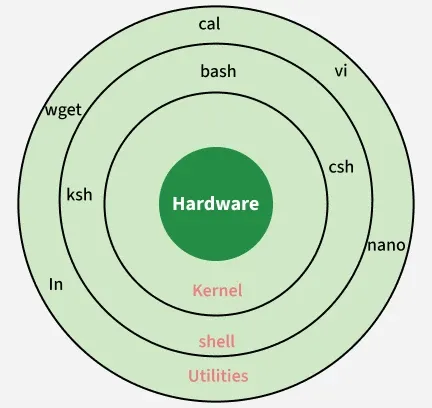
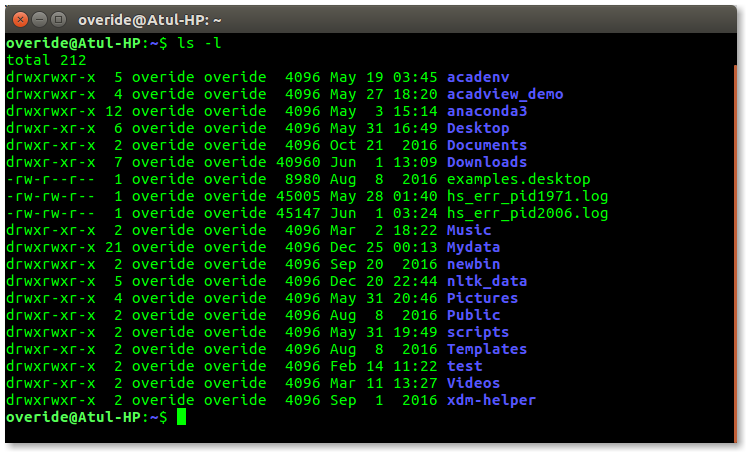
A shell in an operating system allows users to interact with the OS by entering commands. It acts as a bridge between the user and the kernel, translating user inputs into actions performed by the system. Shells can be command-line based (like Bash in Linux) or graphical. They support scripting to automate tasks and provide control over system operations.
Command Line shell provides a command-line interface where users type commands to perform specific tasks. It is lightweight, faster and preferred by developers and system administrators.
Examples:
Bash (Bourne Again Shell): Most commonly used in Linux.
sh (Bourne Shell): The original Unix shell.
csh (C Shell): Syntax similar to C programming.
zsh (Z Shell): An extended version of bash with advanced features.
2. Graphical Shell (GUI Shell)
Graphical shell provides a graphical interface to interact with the operating system using windows, icons and menus instead of typing commands.
Examples:
GNOME Shell in Linux.
Windows Explorer in Microsoft Windows.
Popular Shells Comparison
Comparison between some most popularly used shell in various operating systems are given below:
Shell
Features
Used In
Bash
Command history, scripting, job control
Linux, macOS
Zsh
Auto-completion, themes, plugins
Power users on Linux/macOS
Csh
C-like syntax
Older Unix systems
Fish
User-friendly, syntax highlighting
Linux
Components of a Shell
Prompt: A symbol or message indicating the shell is ready to accept input.
Input/Command Parser: Interprets the entered command.
Execution Environment: Interacts with the kernel to execute commands.
Scripting Capabilities: Allows users to write shell scripts for automation.
Functions of a Shell
Command Interpretation: Reads user input and interprets commands.
Program Execution: Initiates execution of programs or utilities.
Input/Output Redirection: Manages redirection of input/output using symbols like >, <, >>.
Pipe Communication: Passes output of one command as input to another using |.
Scripting Support: Allows creation of shell scripts for automating repetitive tasks.
Environment Customization: Users can configure aliases, environment variables, etc.
Shell Scripting
Shell scripting is a method of writing a series of commands in a text file to be executed by the shell. It enhances efficiency, automates routine tasks and allows conditional logic, loops and functions.