Meta(Facebook) system design interviews are a critical part of the hiring process for software engineers, especially for mid-to-senior level positions. These interviews assess a candidate's ability to design large-scale, distributed systems that can handle billions of users, enormous amounts of data, and real-time interactions. This article will explore some of the most frequently asked system design questions during Meta(Facebook) interviews.
How to Approach Meta(Facebook) System Design Questions?
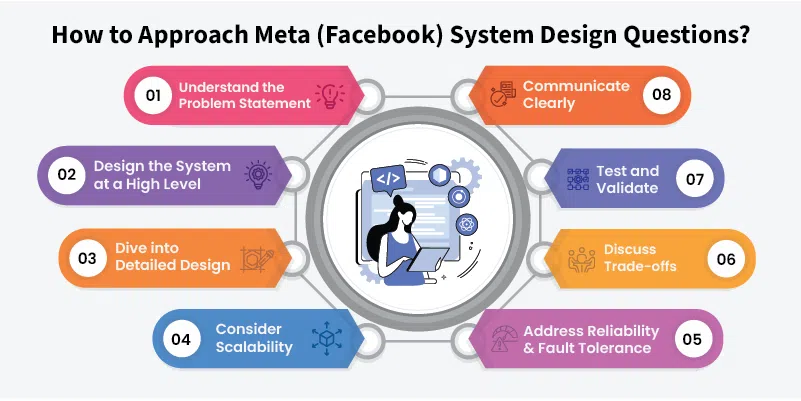
When tackling system design questions in a Meta(Facebook) interview, follow a structured approach to demonstrate your ability to design scalable, reliable, and efficient systems. Here’s a step-by-step guide:
Redundancy: Plan for redundancy to ensure system availability in case of component failures. Consider strategies like replication and failover.
Monitoring and Alerts: Implement monitoring to detect and respond to issues. Set up alerts for critical failures or performance degradations.
Step 6. Discuss Trade-offs
Trade-offs: Be prepared to discuss trade-offs between different design choices. For example, choosing between consistency and availability in a distributed system.
Cost Considerations: Address potential cost implications of your design decisions, including infrastructure and maintenance costs.
Step 7. Test and Validate
Simulate Usage: Discuss how you would test the system under different scenarios. Describe methods for load testing and stress testing.
Validation: Ensure that the design meets all requirements and can handle real-world usage effectively.
Step 8. Communicate Clearly
Explain Your Design: Clearly articulate your design choices and rationale. Use diagrams to illustrate your architecture.
Seek Feedback: Engage with the interviewer, asking for feedback or clarification on any points of your design.
Important Concepts to know for Meta(Facebook) System Design Interview Questions
Before diving into the system design interview questions listed below, it’s crucial to familiarize yourself with these key topics:
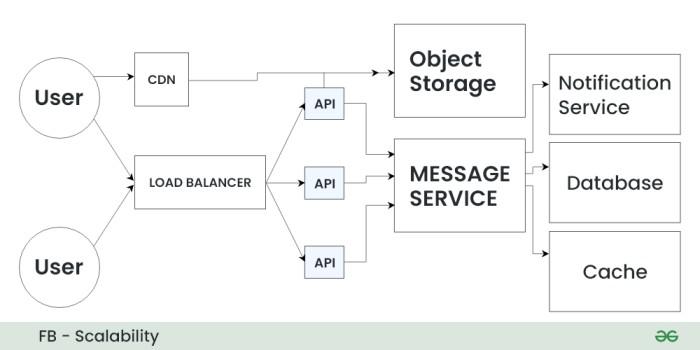
Scalability: Understanding how to design systems that can handle increasing loads by scaling vertically (upgrading existing hardware) or horizontally (adding more servers).
Load Balancing: Techniques for distributing incoming network traffic across multiple servers to ensure no single server becomes a bottleneck, improving availability and performance.
Distributed Systems: Design principles for systems where components are spread across multiple machines, focusing on fault tolerance, consistency, and data synchronization.
Caching: Methods for temporarily storing frequently accessed data to reduce latency and database load, including strategies like LRU (Least Recently Used) and TTL (Time-To-Live).
Database Design: Creating schemas and relationships for efficient data storage and retrieval, including normalization, indexing, and handling large volumes of data.
API Design: Principles for designing robust and scalable APIs, including RESTful and GraphQL approaches, focusing on clear endpoints, data formats, and versioning.
Concurrency and Synchronization: Techniques for managing multiple operations simultaneously, including locks, semaphores, and concurrent data structures, to prevent conflicts and ensure data integrity
Fault Tolerance: Designing systems to continue functioning despite hardware or software failures, using techniques like redundancy, failover, and replication.
Event-Driven Architecture: Designing systems that react to events or changes in state, including message queues and event streaming for decoupling components and handling asynchronous operations.
Security: Ensuring data protection and privacy through authentication, authorization, encryption, and secure communication practices.
Object-Oriented Principles: Understanding the core principles of OOAD, such as encapsulation, inheritance, and polymorphism, helps in designing modular and maintainable systems.
Design Patterns: Design patterns are reusable solutions to common software design problems that improve code flexibility, maintainability, and scalability.
These topics provide a foundational understanding of how to design and manage complex systems effectively.
In Meta(Facebook) system design interviews, candidates are assessed on their ability to create scalable, efficient systems. Expect to design features or complex services, focusing on scalability, data storage, and reliability, while articulating your design choices and trade-offs effectively.
Q1. Design Meta(Facebook) News Feed
The Meta(Facebook) News Feed is a central feature that showcases posts from friends, pages, and groups followed by users. The challenge lies in delivering a personalized, real-time feed for billions of users while maintaining high performance and engagement.
Functional Requirements:
Personalized Content: Users should receive tailored posts from friends and followed pages based on their interactions and preferences.
User Interaction: Users must be able to like, comment, and share posts seamlessly.
Rich Media Support: Posts can include various formats, such as text, images, and videos.
Real-Time Updates: The feed should refresh instantly to display new posts as they are created.
Non-Functional Requirements:
High Availability: The system must remain operational 24/7 to provide uninterrupted service.
Low Latency: Feed loading should occur in under 200 milliseconds for optimal user experience.
Scalability: The architecture must support billions of users and an extensive volume of posts.
Eventual Consistency: While critical updates require strong consistency, non-critical posts can follow an eventual consistency model.
Key Components:
Feed Generator: Creates and personalizes the news feed based on user interactions and preferences.
Database: Utilizes a distributed database like Cassandra for scalable storage of posts and associated metadata.
Caching Layer: Implements Redis to cache recent or popular posts, allowing for quick retrieval and reducing database load.
Message Queue: Employs Kafka to manage real-time updates, ensuring new posts are efficiently processed and delivered.
Ranking Algorithm: Analyzes user data to determine the order of posts in the feed, enhancing relevance and engagement.
Meta(Facebook) Messenger is a real-time chat application for one-to-one or group messaging. It must ensure real-time message delivery across billions of users while supporting rich media.
Functional Requirements:
Real-time messaging between users.
Support for sending and receiving text, images, and videos.
Message status indicators (delivered, read).
Sync across multiple devices.
Non-Functional Requirements:
Low-latency message delivery.
High scalability to support billions of messages per day.
Reliability with retries for undelivered messages.
The notification system is designed to alert users about interactions, such as likes, comments, and tags, ensuring real-time delivery with minimal delay. This system enhances user engagement by keeping them informed of relevant activities.
Functional Requirements:
Real-Time Notifications: Users must receive alerts for new likes, comments, and tags instantly.
Push Notifications: Support for push notifications on both mobile and web platforms.
Notification History: Users should be able to retrieve a history of their notifications for review.
Non-Functional Requirements:
High Scalability: The system must efficiently handle millions of notifications per second to accommodate a large user base.
Low Latency: Notifications should be delivered with minimal delay to ensure timely updates.
Reliability: Implement retries for failed notifications to ensure that users receive important alerts.
Key Components:
Message Queue: Utilizes Kafka or RabbitMQ to manage and process notification events efficiently.
Notification Delivery Service: Responsible for pushing notifications to users' devices across mobile and web platforms.
Database: Stores notification history, which can be implemented using MySQL or NoSQL databases like DynamoDB for scalability.
Cache: Employs Redis to cache frequently accessed notifications, enhancing retrieval speed and reducing database load.
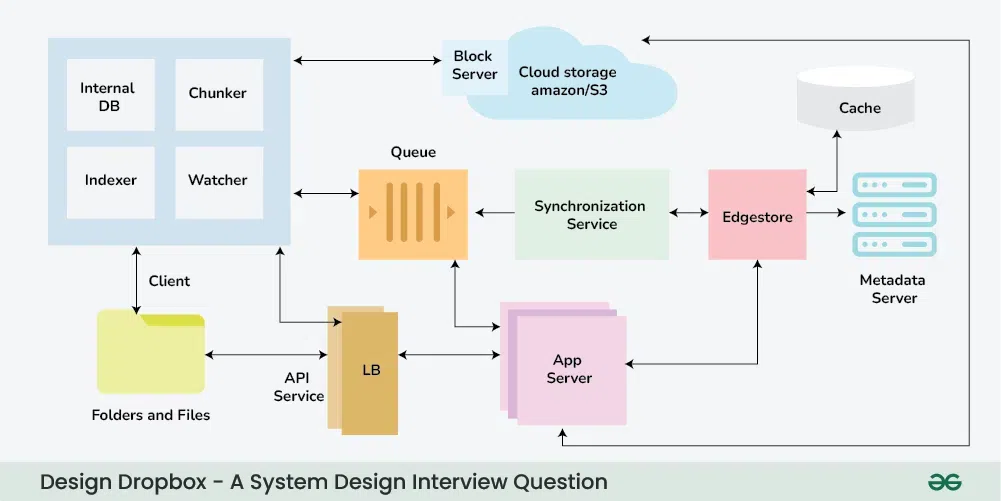
A distributed file storage system like Dropbox allows users to upload, share, and sync files across devices while maintaining security and availability.
Functional Requirements:
Users can upload, download, and share files.
Synchronize files across devices.
Maintain version control for files.
Non-Functional Requirements:
Scalability to handle billions of files and requests.
High durability and availability (data should never be lost).
Security for data access and sharing.
Key Components:
Watcher: Monitors file/folder changes and notifies the indexer and chunker.
Chunker: Splits files into chunks for efficient uploading, saving bandwidth by only uploading modified parts.
Indexer: Updates the internal database with chunk details and communicates with the synchronization service via a message queue.
Internal Database: Stores file and chunk information, versions, and locations.
Metadata Database: Maintains indexes for chunks, including names and versions, ensuring data consistency.
Message Queuing Service: Facilitates asynchronous communication between clients and the synchronization service with request and response queues.
A payment system is designed to securely manage transactions across various payment methods while ensuring transactional integrity and regulatory compliance. Its primary goal is to provide a reliable and safe environment for processing payments.
Functional Requirements:
Multiple Payment Methods: The system must support various payment options, including credit cards and digital wallets.
Secure Transactions: It should ensure that all transactions are processed securely to protect user data and prevent fraud.
Refunds and Reconciliation: The system must handle refunds, transaction retries, and ensure accurate financial reconciliation.
Non-Functional Requirements:
High Availability: The architecture must be robust enough to handle peak transaction loads without downtime.
Low Latency: Transactions should be processed quickly to enhance user experience and satisfaction.
Security and Compliance: The system must comply with Payment Card Industry Data Security Standard (PCI DSS) to safeguard sensitive payment information.
Key Components:
Payment Gateway Integration: Connects with external payment processors to facilitate transaction processing and validation.
Transaction Database: Maintains comprehensive records of transaction histories and logs for auditing and reconciliation purposes.
Fraud Detection System: Continuously monitors transactions for suspicious activity, helping to prevent fraud and ensure transaction integrity.
Retry Mechanism: Manages failed transactions, automatically retrying them to improve payment success rates.
Q8. Design Meta(Facebook)’s Recommendation System
The recommendation system delivers personalized content suggestions, including videos, ads, and friends, tailored to individual user preferences and behaviors. By analyzing user activity, it enhances engagement and improves user satisfaction.
Functional Requirements:
Content Recommendations: The system must recommend relevant content (videos, posts, ads) based on user interactions and preferences.
Adaptive Learning: It should continuously refine recommendations using user feedback to improve accuracy and relevance over time.
Non-Functional Requirements:
Scalability: The architecture must efficiently serve personalized content to millions of users without degradation in performance.
Low Latency: Recommendations should be delivered with minimal delay to enhance the user experience.
High Accuracy: The system needs to achieve high precision in matching content to users’ interests and preferences.
Key Components:
Recommendation Engine: Utilizes machine learning models to analyze user data and predict preferences, generating personalized content suggestions.
Data Pipeline: Collects and processes user activity data, facilitating model training and enhancing recommendation accuracy.
AI Models: Continuously train and improve algorithms to adapt to changing user preferences and optimize recommendations.
Caching Layer: Stores recent or frequently requested recommendations to speed up access and reduce latency for high-demand content.
Q9. Design a Real-Time Analytics System (e.g., for Ads)
A real-time analytics system is designed to process vast amounts of event data instantly, providing valuable insights into metrics such as ad performance and user behavior as they occur. This capability is crucial for businesses seeking to make data-driven decisions in real time.
Functional Requirements:
Real-Time Data Processing: The system must process incoming data streams in real time to generate timely insights.
Dynamic Dashboards: Support interactive dashboards that display real-time metrics related to ad performance and user engagement.
Non-Functional Requirements:
Low Latency: The system should ensure minimal delay in processing events to provide instantaneous insights.
High Scalability: It must handle millions of events per second efficiently to accommodate fluctuating data loads.
Fault Tolerance: The architecture should be resilient, ensuring that no data is lost during processing or system failures.
Key Components:
Stream Processing System: Utilizes tools like Kafka for data ingestion and Apache Flink for real-time data processing, enabling seamless event handling.
Data Storage: Employs platforms such as Hadoop or other big data storage solutions to retain historical data for analysis and reporting.
Analytics Engine: Responsible for computing real-time metrics and generating actionable insights from the processed data.
Dashboard System: Provides a user-friendly interface to display real-time data insights, allowing stakeholders to monitor performance effectively.
Q10. Design a Live Video Streaming Platform
A live video streaming platform like Meta(Facebook) Live must effectively manage millions of simultaneous viewers while enabling real-time interactions, such as comments. This requires a robust architecture that ensures seamless streaming and user engagement.
Functional Requirements:
Simultaneous Streaming: The platform must support live video streaming to millions of viewers at once.
Real-Time Comments: Viewers should be able to comment and interact in real-time during the broadcast.
Adaptive Video Quality: The system should automatically adjust video quality based on viewers' network conditions for optimal performance.
Non-Functional Requirements:
Low Latency: Video streaming should have minimal delay to enhance the viewer experience.
Scalability: The architecture must scale efficiently to accommodate millions of concurrent users without performance degradation.
High Availability: The system must ensure uninterrupted streaming, even during peak loads or system failures.
Key Components:
Video Encoder: This component converts the live video into various quality levels to enable adaptive streaming, catering to different viewer bandwidths.
Content Delivery Network (CDN): A CDN is essential for fast and reliable global video delivery, distributing content closer to viewers to reduce latency.
Real-Time Messaging: Utilizing WebSockets, this component allows for instantaneous communication, enabling viewers to comment and interact with the stream seamlessly.
Tips and Tricks for Tackling Amazon System Design Interview
Here are some essential tips and tricks for tackling system design questions in interviews:
Clarify Requirements: Ask questions to understand the problem's scope and requirements before diving into solutions.
Break Down the Problem: Divide the system into smaller components, focusing on major functionalities and interactions.
Consider Scalability: Design for scalability from the start, considering how the system will handle growth in users and data.
Choose Appropriate Technologies: Select technologies and tools that fit the problem’s needs, such as databases, caching mechanisms, and load balancers.
Use Design Patterns: Apply relevant design patterns to solve common problems efficiently, like using Singleton for global instances or Observer for event handling.
Think About Data Flow: Map out how data will flow through the system, including storage, retrieval, and processing.
Prioritize Trade-offs: Understand and discuss trade-offs between consistency, availability, and partition tolerance (CAP theorem) or other relevant concerns.
Plan for Failures: Incorporate fault tolerance and redundancy to ensure the system remains robust under failures.
Optimize Performance: Consider performance aspects, such as caching strategies, indexing, and load balancing, to enhance system efficiency.
Communicate Clearly: Articulate your design decisions and reasoning clearly, and be prepared to iterate based on feedback or new requirements.
By following these tips, you can approach system design questions methodically and demonstrate your problem-solving skills effectively.