|
VOOZH | about |
|
VOOZH | about |
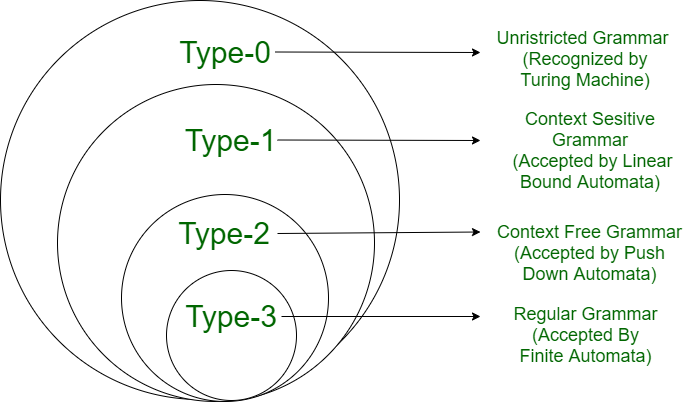
The Chomsky Hierarchy is a classification of formal languages into four types based on the restrictions of their grammars and the computational power required to recognize them. It covers all language types, from regular languages (Type 3) with the simplest grammar to recursively enumerable languages (Type 0) with the most complex grammar.
According to Chomsky hierarchy, grammar is divided into 4 types as follows:
Type 0: Unrestricted Grammar:
Type-0 grammars include all formal grammar. Type 0 grammar languages are recognized by turing machine. These languages are also known as the Recursively Enumerable languages.
Grammar Production in the form of where
 is ( V + T)* V ( V + T)*
V : Variables
T : Terminals.
is ( V + T )*. In type 0 there must be at least one variable on the Left side of production.
For example:
Sab --> ba
A --> S
Here, Variables are S, A, and Terminals a, b.
Type 1: Context-Sensitive Grammar
Type-1 grammars generate context-sensitive languages. The language generated by the grammar is recognized by the Linear Bound Automata
In Type 1
That is the count of symbol in is less than or equal to
Also ? ? (V + T)+
i.e. ? can not be ?
For Example:
S --> AB
AB --> abc
B --> b
Type 2: Context-Free Grammar: Type-2 grammars generate context-free languages. The language generated by the grammar is recognized by a Pushdown automata. In Type 2:
.
For example:
S --> AB
A --> a
B --> b
Type 3: Regular Grammar: Type-3 grammars generate regular languages. These languages are exactly all languages that can be accepted by a finite-state automaton. Type 3 is the most restricted form of grammar.
Type 3 should be in the given form only :
V --> VT / T  (left-regular grammar)
(or)
V --> TV /T (right-regular grammar)
For example:
S --> a
The above form is called strictly regular grammar.
There is another form of regular grammar called extended regular grammar. In this form:
V --> VT* / T*.  (extended left-regular grammar)
(or)
V --> T*V /T*  (extended right-regular grammar)
For example :
S --> ab.