VOOZH about

URL: https://www.geeksforgeeks.org/theory-of-computation/halting-problem-in-theory-of-computation/

⇱ Halting Problem in Theory of Computation - GeeksforGeeks


  • Courses
  • Tutorials
  • Interview Prep

Halting Problem in Theory of Computation

Last Updated : 13 Apr, 2026

The Halting Problem is a fundamental concept in the theory of computation. It deals with determining whether a computer program will halt (terminate) or run indefinitely when executed with a given input. A program is said to halt if it completes execution by accepting or rejecting the input, rather than entering an infinite loop.

  • The Halting Problem asks whether a program will terminate or run forever.
  • It considers a program and a specific input.
  • Halting means the program stops execution after producing an output.
  • There is no universal algorithm to determine halting for all programs.
  • The problem is undecidable, as proven by Alan Turing.
  • Applies to programs written in any programming language (C, C++, Java, etc.).

Concepts Related to the Halting Problem

To understand better the halting problem, we must know Decidability, Undecidability and Turing machine, decision problems and also a theory named as Computability theory and Computational complexity theory. Some important terms:

  • Computability Theory – It is a branch of the theory of computation that studies which problems can be solved using computational models. It focuses on determining whether a problem is solvable or not. Computational complexity refers to the amount of resources, such as time and space, required by an algorithm to solve a problem.
  • Decision Problems – A decision problem is one that gives only two outputs: yes or no. It is framed as a question about input values, such as whether a solution exists. These problems are defined over an infinite set of inputs.
  • Turing Machine – A Turing machine is a mathematical model of computation that represents a general-purpose computer. It performs co

Proof by Contradiction

Problem statement: Can we design a machine which if given a program can find out if that program will always halt or not halt on a particular input?

Solution:

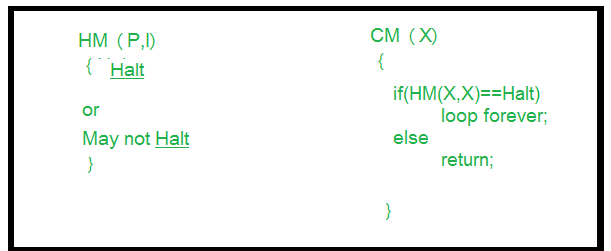
1. Assumption: Suppose we can design such a machine, called HM(P, I), where:

  • HM is the hypothetical machine/program.
  • P is the program.
  • I is the input.

When provided with these inputs, HM will determine whether program P halts or not.

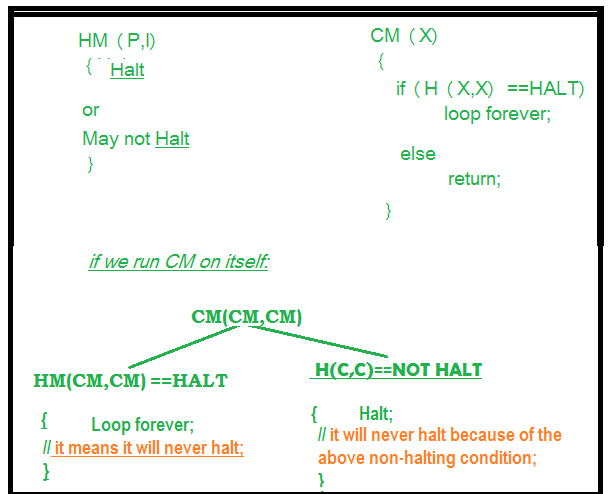
2. Constructing a Contradiction: Using HM, we can create another program, called CM(X), where X is any program passed as an argument as shown in figure.👁 Image

3. Behavior of CM(X): In CM(X), we call HM with inputs (X, X), meaning we pass program X both as the program and as its input. HM(X, X) will return either "Halt" or "Not Halt."

  • If HM(X, X) predicts that X halts, CM(X) will enter an infinite loop.
  • If HM(X, X) predicts that X does not halt, CM(X) will halt immediately.

4. The Contradiction: Now, consider what happens if we pass CM itself as an argument: CM(CM).

  • If HM predicts that CM(CM) halts, CM will loop indefinitely (contradicting HM's prediction).
  • If HM predicts that CM(CM) does not halt, CM will halt immediately (again contradicting HM).
👁 Image

In both scenarios, we face a contradiction. Therefore, our initial assumption that such a machine HM could exist must be false. Hence we can conclude that Halting Problem is undecidable. No general algorithm can determine whether every program will halt or not.

Comment
Article Tags:

Explore