|
VOOZH | about |
|
VOOZH | about |
Prerequisite - , ,
In this article, we will see some popular regular expressions and how we can convert them to finite automata (NFA and DFA). Let's discuss it one by one.
Overview :
Let a and b are input symbols and r is the regular expression. Now we have to design NFA as well as DFA for each regular expression.
Design finite automata from the regular expression :
Here, we will discuss the Design of finite automata from regular expression as follows.
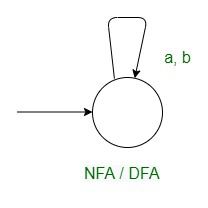
Case-1 :
When r = Φ, then FA will be as follows.
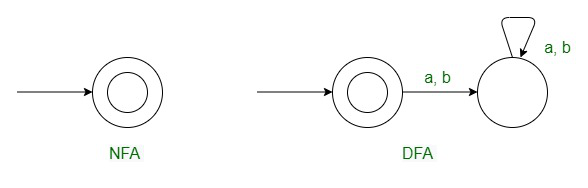
Case-2 :
When r = ε, then FA will be as follows.
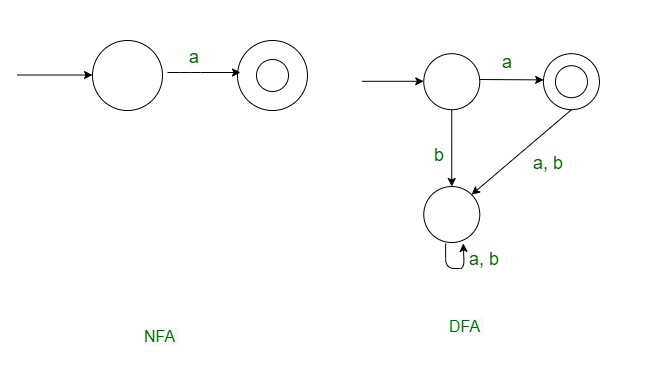
Case-3 :
When r = a, then FA will be as follows.
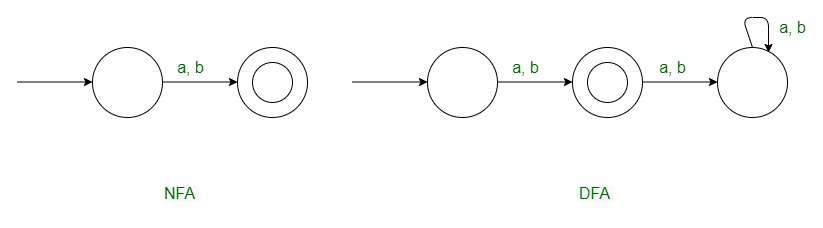
Case-4 :
When r = a+b , then FA will be as follows.
Case-5 :
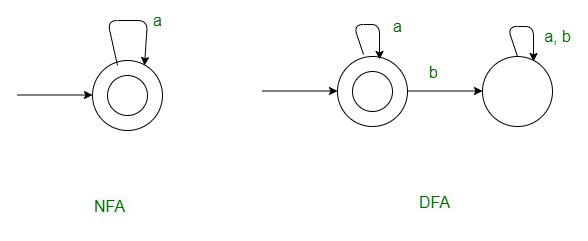
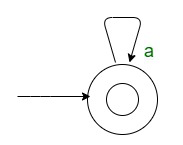
When r = r = a* , then FA will be as follows.
Case-6 :
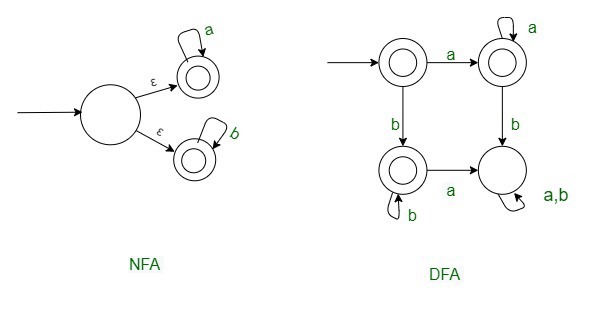
When r = a* + b*, then FA will be as follows.
Case-7 :
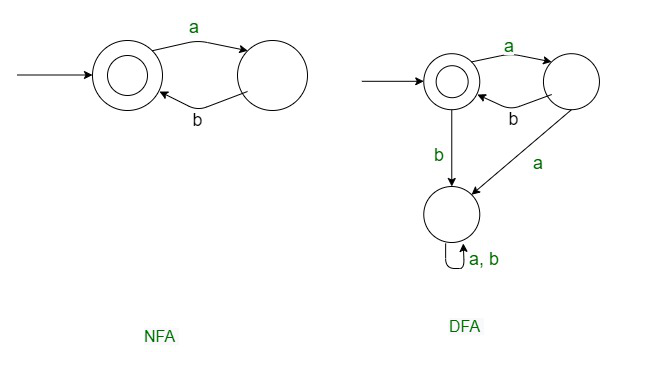
When r = (ab)*, then FA will be as follows.
Case-8 :
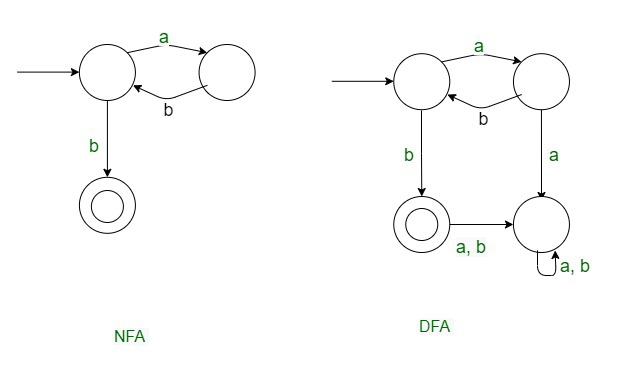
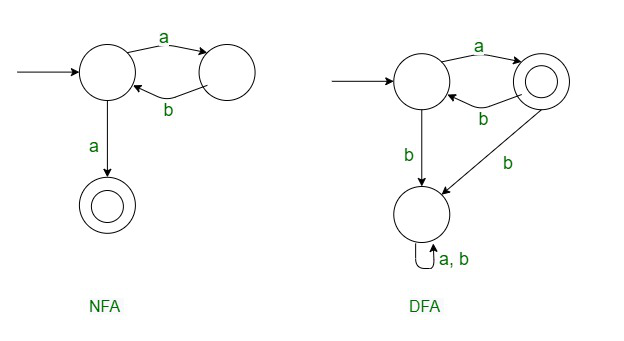
When r = (ab)*b, then FA will be as follows.
Case-9 :
When r = (ab)*a, then FA will be as follows.
Case-10 :
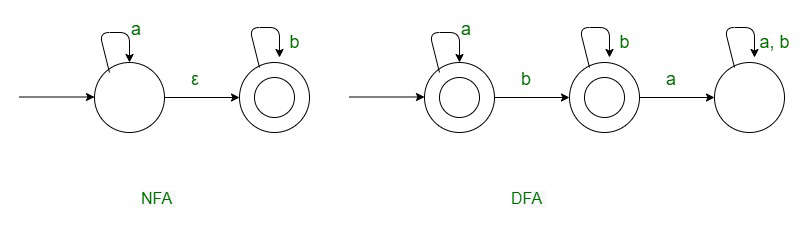
When r = a*b*, then FA will be as follows.
Case-11 :
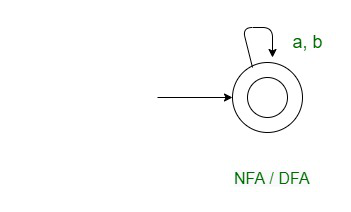
When r = (a+b)*, then FA will be as follows.
Unary Design :
Let a is the input symbol and r is the regular expression. For each regular expression, we will design finite automata.
Case-1 : r = a*
👁 ImageCase-2 : r = (aa)*
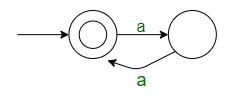
👁 ImageCase-3 : r = (aa)*a
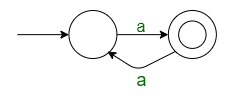
👁 ImageCase-4 : r = aaaa*
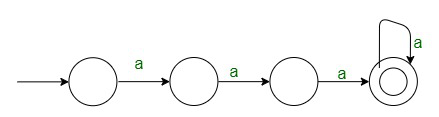
👁 ImageCase-5 : r= (aa + aaa)*
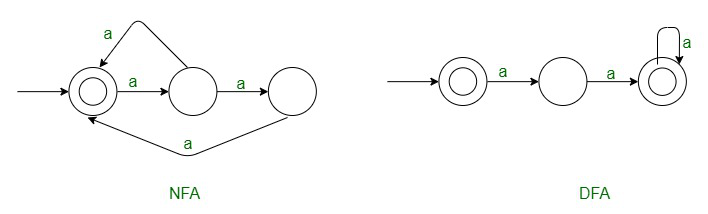
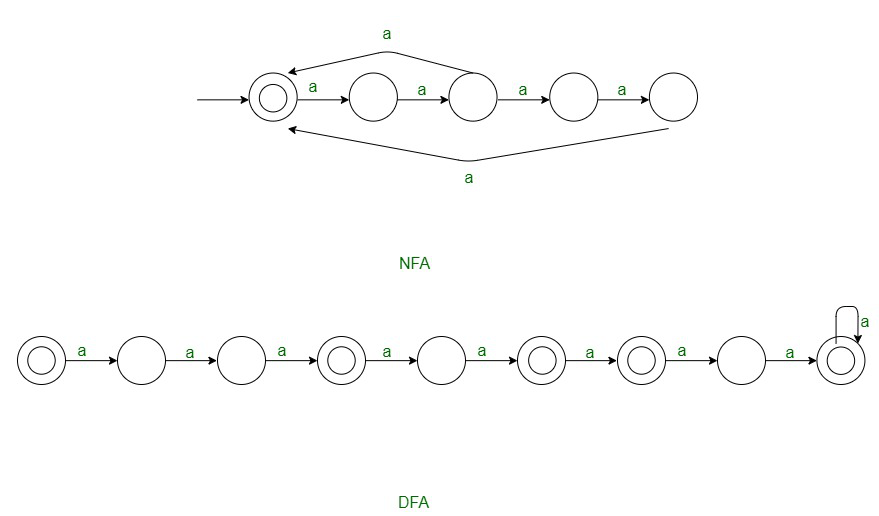
👁 ImageCase-6 : r=( aaa+aaaaa)*
👁 ImageCase-7 : r=(aa + aaaaaa)*
It is a multiple of 1 term i.e. aa, so it can be reduced to r=(aa)*.
L= {an | n = 7x+12, x € Z, x >=0 }👁 ImageGeneral Methods :
Here, we will discuss some general methods as follows.
Method-1 :
L = { aK1n+K2 ; n>=0 }If K1>K2, No. of states = K1
If K1<K2, No. of states = K2 +1
If K1=K2, No. of states = K1 +1 = k2 +1
Method-2 :
L = { aKn ; n>0 , K is a fixed integer } = { aKn ; n>=1. K is an integer}
No. of states = K +1
Method-3 :
L = { aKn ; n>=0 , K is a fixed integer }Here, residue i.e. K2=0, K1>K2. Therefore, No. of states = K