|
VOOZH | about |
|
VOOZH | about |
Grammar is a formal system that defines a set of rules for generating valid strings within a language. It serves as a blueprint for constructing syntactically correct sentences or meaningful sequences in a formal language. Grammar refers to a formal system that defines how strings in a language are constructed. It plays a crucial role in determining the syntactic correctness of languages and forms the foundation for parsing and interpreting programming languages, natural languages, and other formal systems.
👁 Grammar in Theory of Computation - GeeksforGeeksAny Grammar can be represented by 4 tuples - <N, T, P, S>
A production or production rule in computer science is a rewrite rule specifying a symbol substitution that can be recursively performed to generate new symbol sequences. It is of the form α-> β where α is a Non-Terminal Symbol which can be replaced by β which is a string of Terminal Symbols or Non-Terminal Symbols.
Consider Grammar G1 = <N, T, P, S>
T = {a,b} #Set of terminal symbols
1 2 3 4 5
P = { A -> Aa, A -> Ab, A -> a ,A -> b, A -> 𝜺} #Set of all production rules
S = {A} #Start Symbol
As the start symbol S is equivalent to A then we can produce Aa, Ab, a, b, 𝜺 strings. These strings can further produce strings where A can be replaced by the strings mentioned in the production rules. Hence this grammar can be used to produce strings of the form (a+b)*.
Derivation of Strings
A->a #using production rule 3
OR
A->Aa #using production rule 1
Aa->ba #using production rule 4
OR
A->Aa #using production rule 1
Aa->AAa #using production rule 1
AAa->bAa #using production rule 4
bAa->ba #using production rule 5
Consider Grammar G2 = <N, T, P, S>
N = {A} #Set of non-terminals Symbols
T = {a} #Set of terminal symbols1 2 3 4
P = {A -> Aa, A -> AAa, A -> a, A -> 𝜀} #Set of all production rules
S = {A} #Start Symbol
As the start symbol is S then we can produce Aa, AAa, a, which can further produce strings where A can be replaced by the Strings mentioned in the production rules and hence this grammar can be used to produce strings of form (a)*.
Derivation of Strings
A->a #using production rule 3
OR
A->Aa #using production rule 1
Aa->aa #using production rule 3
OR
A->Aa #using production rule 1
Aa->AAa #using production rule 1
AAa->Aa #using production rule 4
Aa->aa #using production rule 3
Two grammars are said to be equivalent if they generate the same language. For instance, if Grammar 1 and Grammar 2 both generate strings of the form (𝑎+𝑏)∗, they are considered equivalent.
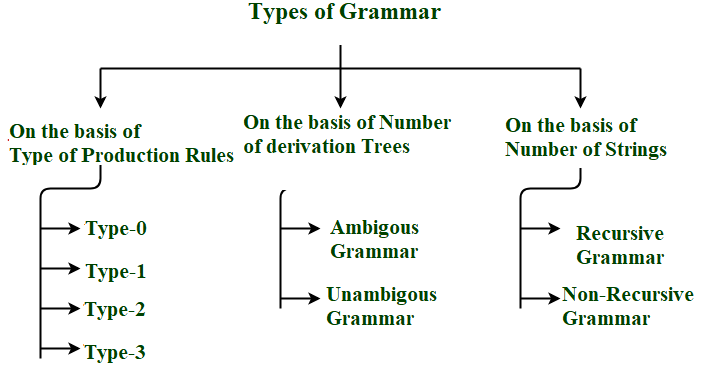
There are several types of Grammar. We classify them on the basis mentioned below.