|
VOOZH | about |
|
VOOZH | about |
A DFA is represented as {Q, Σ, q, F, δ}. In DFA, for each input symbol, the machine transitions to one and only one state. DFA does not allow any null transitions, meaning every state must have a transition defined for every input symbol. NFA is similar to DFA but includes the following features:
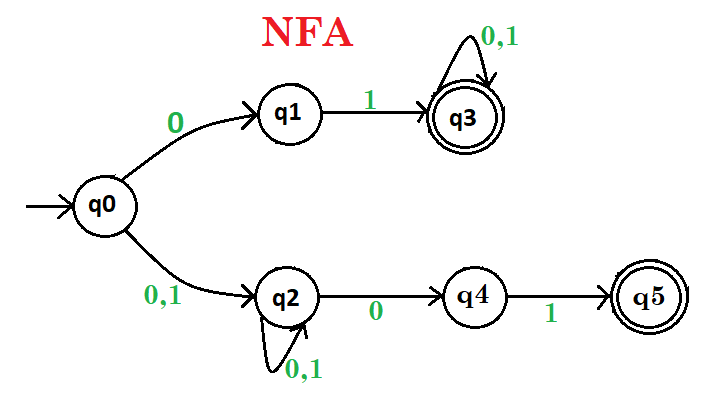
DFA and NFA of same language whose strings only reach to the final state containing either 01 at start or at the end. If anything else is come then come out to the final state then it does not accept. NFA of the given string is as follows:
Example: 0110,110001,111101,0100000,11010101,0111111...
👁 Image
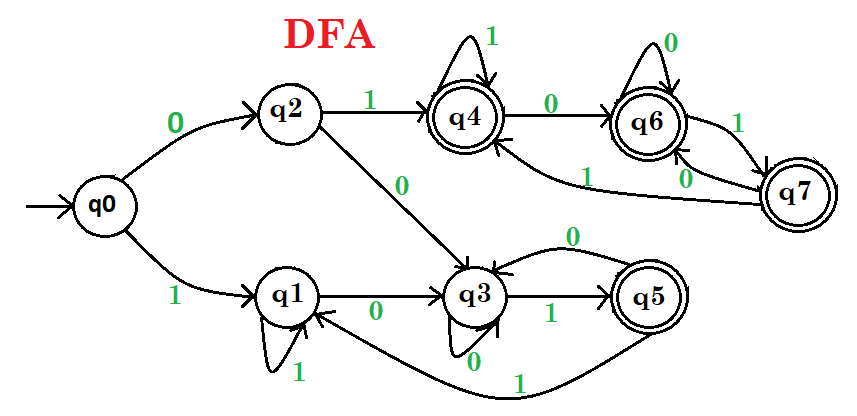
DFA of the same given string is as follows by converting the given NFA to DFA :👁 Image
Here, q0 shows the initial state, q1, q2 are the transition states, and q3, q4, q5, q6, q7 are the transition and final states.
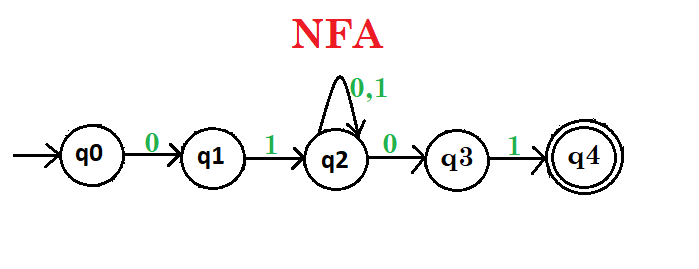
NFA of same language whose strings only reach to the final state containing 01 at start and at the end. If anything else is come then come out to the final state then it does not accept. NFA of the given string is as follows: 👁 Image
Here, q0 shows the initial state, q1, q2, q3 are the transition states, and q4 is the final state.
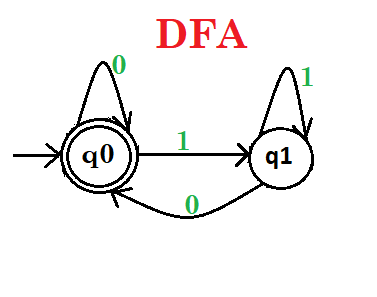
Draw a DFA whose strings only reach to the final state containing 0 at the end that means number is multiple of 2. If anything else is come then come out to the final state then it does not accept. DFA of the given string is as follows:
Example:00,100,10010,10100,0100010...
👁 Image
Here, q0 shows the initial and final state, q1 is the transition states.
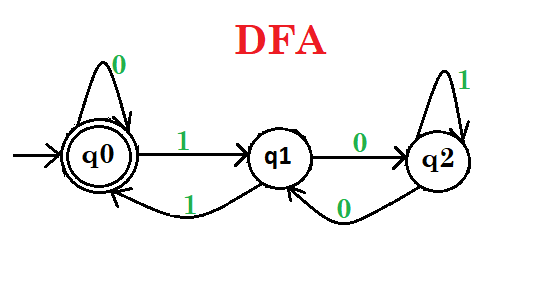
Draw a DFA whose string only reach to the final state containing binary number is multiple of 3. If anything else is come then come out to the final state then it does not accept. DFA of the given string is as follows:
Example :011,0011,01001,1001...
👁 Image
Here, q0 shows the initial and final state, q1, q2 are the transition states.
For more practice on DFA you can refer to Practice problems on finite automata.