|
VOOZH | about |
|
VOOZH | about |
Standard Meta Language (SML) is a type-safe programming language that encapsulates numerous innovative ideas in programming language plan or design. It is a statically composed language, with an extensible type framework. It supports polymorphic type inference, which eliminates the burden of specifying types of variables and significantly encourages code re-use. It provides a productive programmed capacity for data structures and functions. It is a general-purpose, particular, functional programming language with compile-type checking and type inference. It is mainstream among compiler scholars and programming language analysts, as well as in the improvement of proving theorems. It is an advanced version of ML, the programming language utilized in the Logic for Computable Functions (LCF) hypothesis-demonstrating project. It is particular among generally utilized languages that have a proper specification, given as typing rules and operational semantics which was fully developed in 1997.
1. Expression: An expression is represented using the operands and operators. In this, Infix expression is required for the evaluation of expressions.
Example:
- 10 + 20
val it = 30 : int
2. Variables: Here, the variables can be defined using the val keyword.
Example:
- val a = 2;
- val b = 3;
- val c = a + b;
val c = 5 : int
-val negvar=~3; (* negative value in SML *)
val negvar = ~3
3. Print: The print command is used to display the output in SML.
Example:
- print ("Hello this is my first program in SML ");
Hello this is my first program in SML val it = () : unit
4. Conditional Statements: The condition can be specified using if-else keywords.
Example:
- if 10 > 20 then print ("Yes") else print ("No");
No val it = () : unit
5. Functions or Procedure: The operator fun is used to define the functions.
Example:
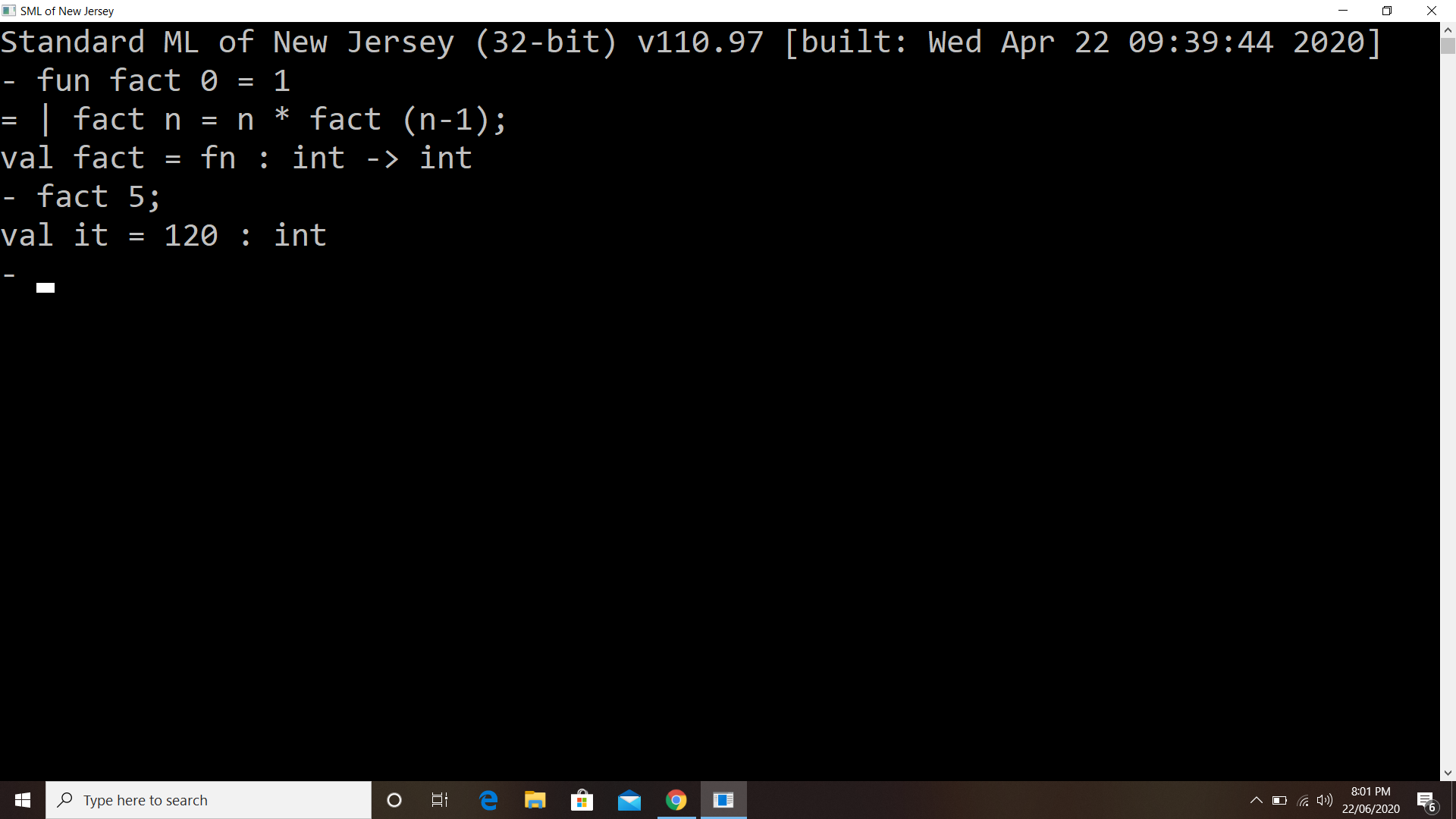
- fun fact 0 = 1
6. Recursion: A recursion is an approach in which function calls itself within an argument and upon reaching the termination condition the control returns to the calling function. There are two properties that a recursive function must have:
Example of recursion in a factorial program developed in SML
7. List manipulation and List processing in SML: List is represented as:
Example:
- [10, 20, 30, 40];
val it = [10, 20, 30, 40] : int list
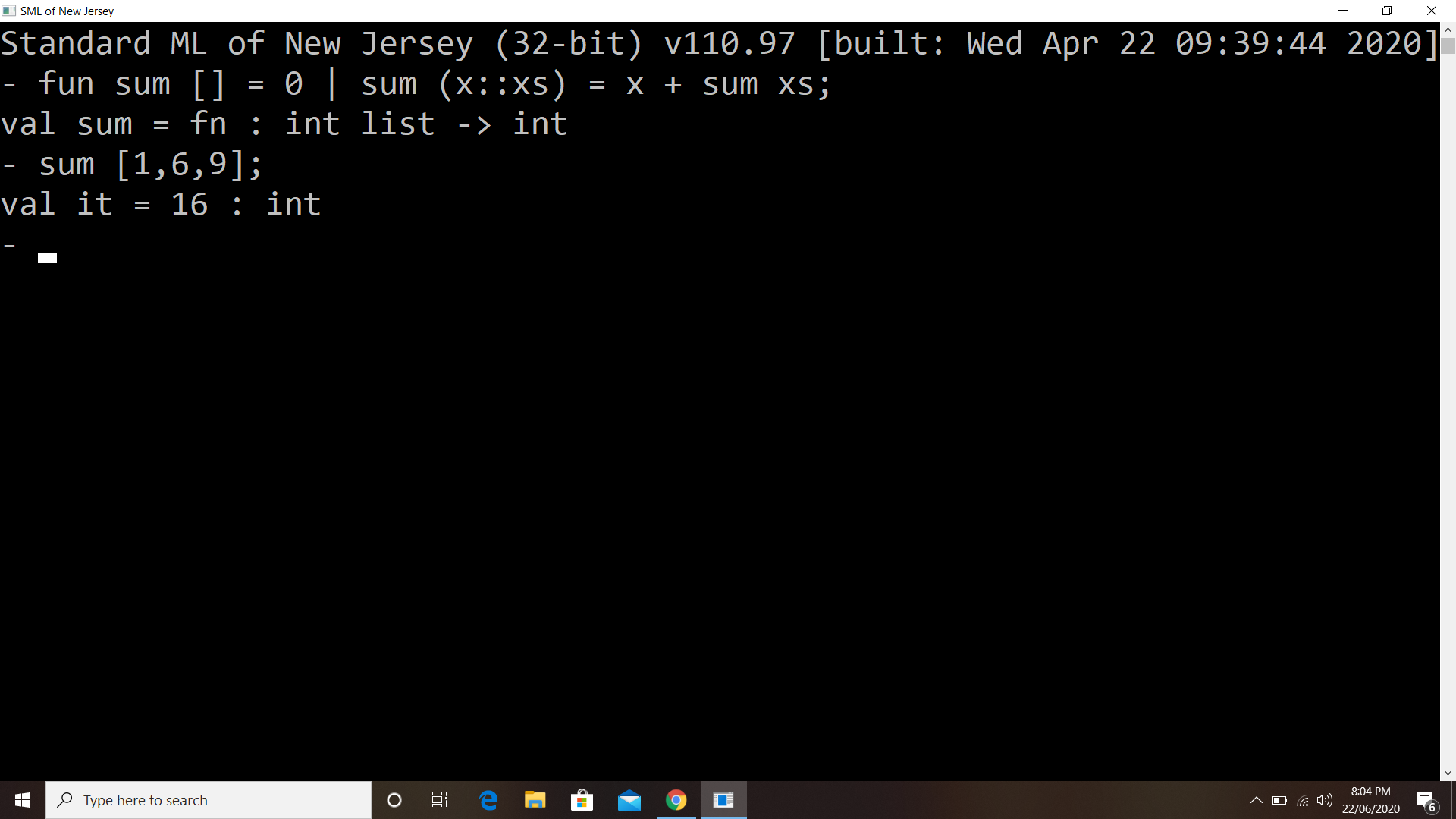
Example#1: To find the sum of all the elements of a list.
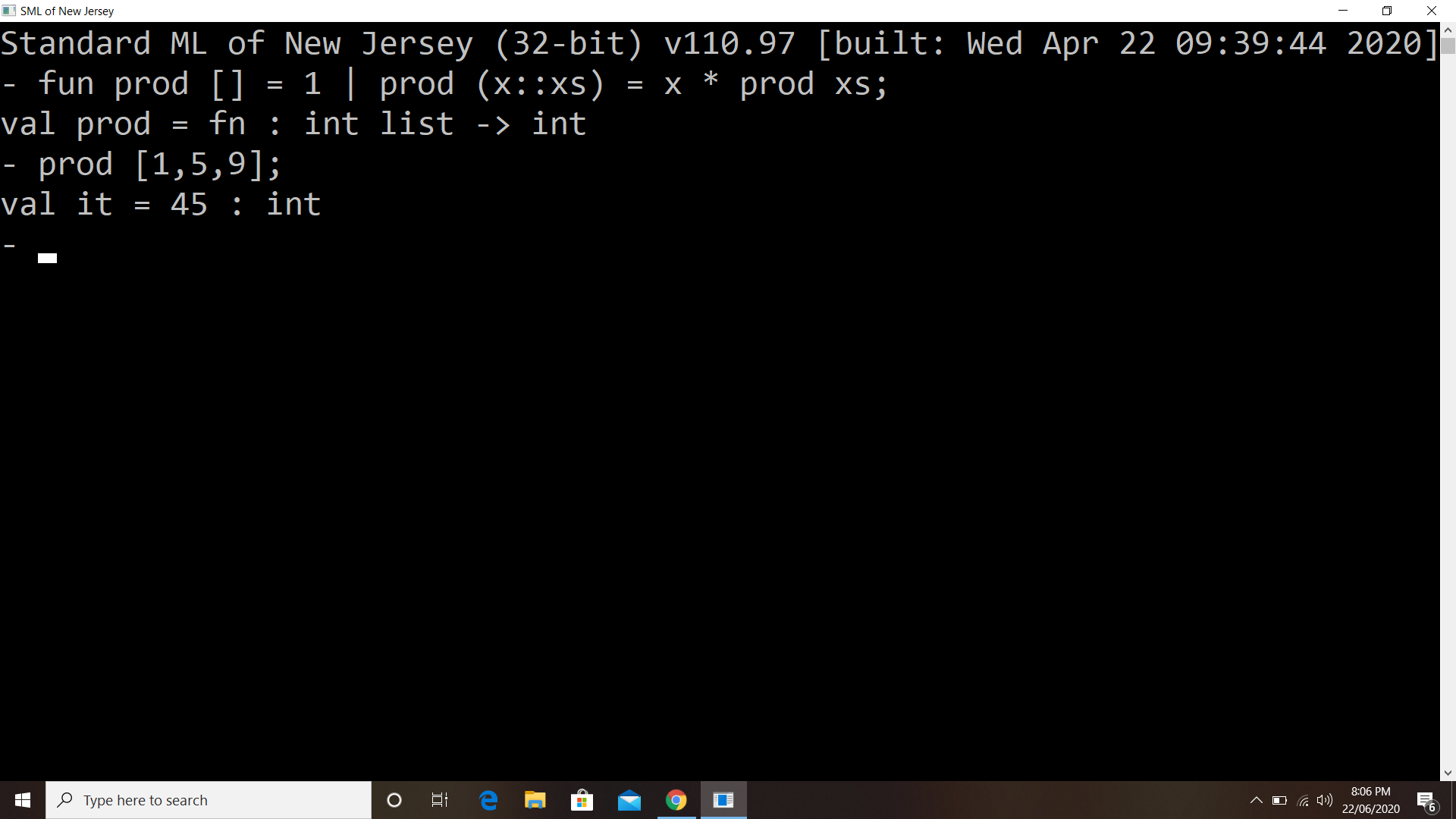
Example#2: To find the product of all the elements of a list.
👁 Product of all elements of list
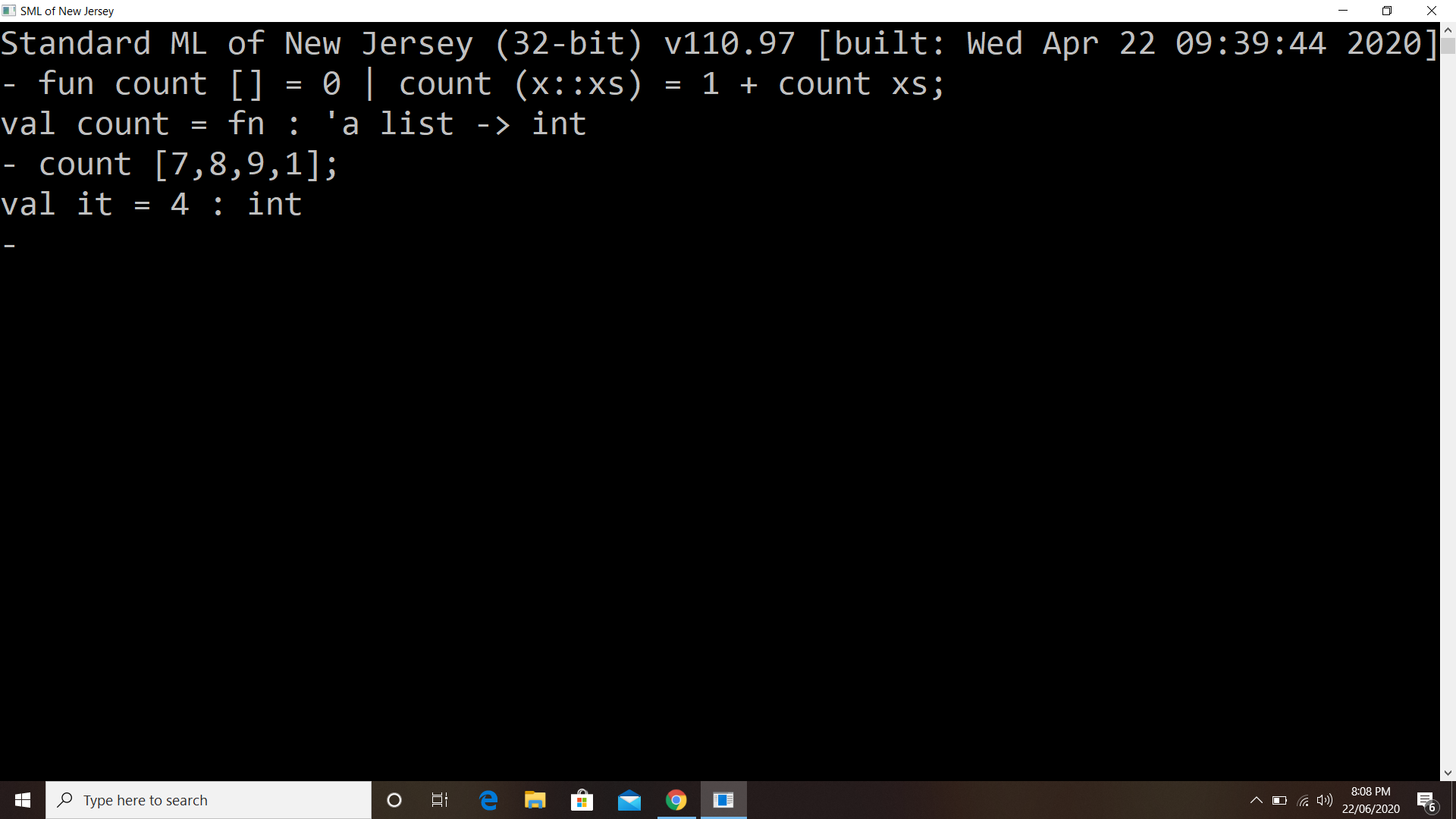
Example#3: To find the length of a list without using length keyword.
(* this function correct only for y >= 0 *)
fun pow (x:int, y:int) =
 if y=0
 then 1
 else x * pow(x,y-1)
fun cube (x:int) =
 pow(x,3)
val sixtyfour = cube(4)
(* Functions taking or producing lists *)
fun sum_list (xs : int list) =
 if null xs
 then 0
 else hd(xs) + sum_list(tl(xs))
fun countdown (x : int) =
 if x=0
 then []
 else x :: countdown(x-1)
fun append (xs : int list, ys : int list) = (* part of the course logo :) *)
 if null xs
 then ys
 else hd(xs) :: append(tl(xs), ys)
(* More functions over lists, here lists of pairs of ints *)
fun sum_pair_list (xs : (int * int) list) =
 if null xs
 then 0
 else #1 (hd(xs)) + #2 (hd(xs)) + sum_pair_list(tl(xs))
fun firsts (xs : (int * int) list) =
 if null xs
 then []
 else (#1 (hd xs))::(firsts(tl xs))
fun seconds (xs : (int * int) list) =
 if null xs
 then []
 else (#2 (hd xs))::(seconds(tl xs))
fun sum_pair_list2 (xs : (int * int) list) =
 (sum_list (firsts xs)) + (sum_list (seconds xs))
(* badly named: evaluates to 0 on empty list *)
fun bad_max (xs : int list) =
 if null xs
 then 0
 else if null (tl xs)
 then hd xs
 else if hd xs > bad_max(tl xs)
 then hd xs
 else bad_max(tl xs)
(* badly named: evaluates to 0 on empty list *)
fun good_max (xs : int list) =
 if null xs
 then 0
 else if null (tl xs)
 then hd xs
 else
(* for style, could also use a let-binding for (hd xs) *)
let val tl_ans = good_max(tl xs)
in
 if hd xs > tl_ans
 then hd xs
 else tl_ans
end
fun countup(from : int, to : int) =
 if from=to
 then to::[]
 else from :: countup(from+1,to)
fun countdown(from : int, to : int) =
 if from=to
 then to::[]
 else from :: countdown(from-1,to)