|
VOOZH | about |
|
VOOZH | about |
14 min
read
What is Glide? Learn how Glide works, its features, pricing, limits, and how to build powerful no-code apps from beginner to pro level.
By
Jesus Vargas
Updated on
May 29, 2026
.
Reviewed by
Thinh Dinh
Senior Developer
Real-World Experience with No-Code Tools: With over 320 apps built, we know firsthand what works—and what doesn't—when using no-code platforms like Glide, Bubble, FlutterFlow and Webflow.
Expert Team with 40+ Years of Combined Experience: Our team has deep technical knowledge, with experts who use no-code tools to solve real-world problems for clients every day, ensuring our advice is actionable and reliable.
Detailed Guides Based on Actual Projects: We don’t just talk about no-code; we use it daily to solve real business problems for our clients, from MVPs to complex automations.
Take a deeper look at our editorial guidelines
If you have heard of Glide but are not sure exactly what it does or whether it fits your project, this guide gives you a complete picture. From what Glide is at its core, through what you can build with it, to where it falls short and when something else makes more sense.
Glide App Development
Turn Sheets Into Apps
As the largest Glide agency, we help businesses transform spreadsheets into powerful internal tools, CRMs, and mobile apps
Glide is a no-code app builder that turns spreadsheets and databases into fully functional web apps. You build using a visual drag-and-drop interface, and your app publishes instantly as a Progressive Web App that works on mobile, tablet, and desktop without writing any code.
For a structured breakdown of its strengths and tradeoffs, see our full analysis of Glide advantages and disadvantages.
Glide is best suited for internal business tools, CRMs, client portals, inventory systems, dashboards, and MVPs. It is a practical platform for any data-driven business app where the primary users are your team or a controlled external audience.
Glide uses a data-first architecture. You connect a data source, create relationships between tables, use visual components to display and interact with that data, add workflow logic, and publish instantly. No backend configuration, server management, or deployment pipeline required.
Glide's popularity comes from the combination of its visual builder speed, prebuilt component library, role-based access control, native automation, broad integration support, and increasingly capable AI features. It covers most business app requirements without requiring a developer.
You can see these capabilities applied in real projects inside Glide AI features in action.
Glide is designed for non-technical founders, operations managers, and business teams who need to build or replace internal tools quickly, without hiring developers or waiting months for custom software.
Explore these Glide use cases to understand what can be built with Glide.
Glide is not suitable for complex enterprise ERP systems, real-time high-performance applications, apps requiring deep native mobile hardware access, projects needing full custom code flexibility, or very large data-intensive systems without careful optimization.
Glide leads on speed of development and data-to-app simplicity for business tools. Bubble leads on logic depth and SaaS capability.
Adalo and FlutterFlow lead on native mobile publishing. Webflow leads on marketing site design. The right choice depends entirely on what you are building.
If Glide does not align with your architecture needs, explore realistic Glide alternatives.
Glide offers a free plan for personal projects and testing, paid plans starting around $49/month for small teams, and Enterprise pricing for organizations needing advanced integrations, Big Tables, and SSO. Costs scale based on user count, data volume, and feature requirements.
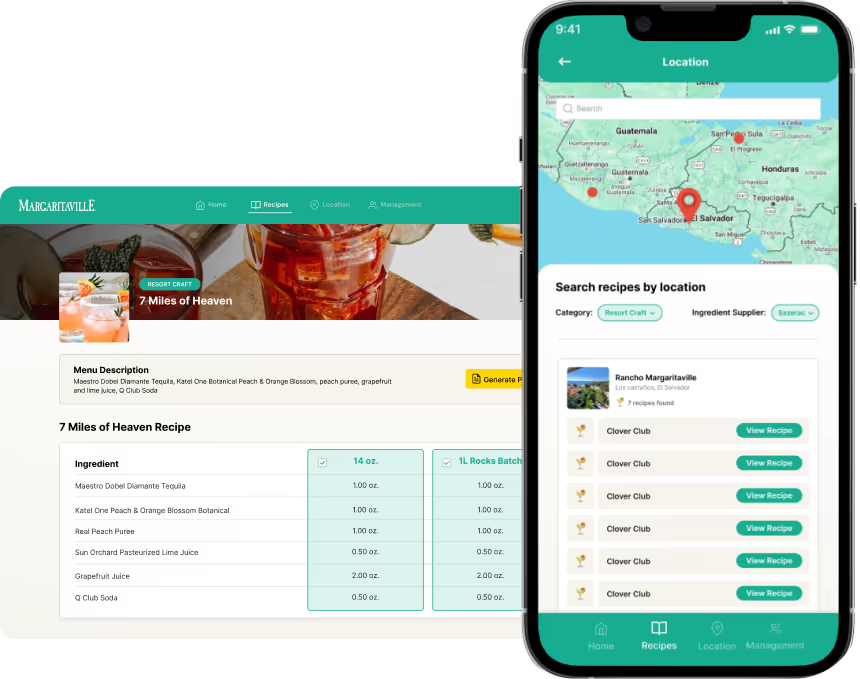
Real Glide apps in production include internal operations dashboards, inventory tracking systems, field service apps, event coordination portals, and CRMs built on spreadsheet data. These are not prototypes but working tools used daily by business teams.
Browse production-ready Glide app examples to see how businesses structure their data-driven apps.
The most important Glide limitations to understand before building are row limits and performance constraints, restricted custom logic depth, dependence on automation tools for complex integrations, scaling considerations for large apps, and the critical importance of data structure quality.
For a deeper look at growth constraints, review our full guide on Glide scalability.
Choose Glide for fast, data-driven business apps where speed of launch and ease of use matter more than maximum technical flexibility. Avoid it for projects requiring heavy custom engineering, consumer-scale traffic, or deep native mobile capabilities.
Work with a specialist product team when your project involves complex integrations, revenue-generating SaaS requirements, long-term scalability planning, deeply embedded AI workflows, or when you want a structured product approach rather than iterating alone.
At LowCode Agency, we work with teams building everything from fast internal tools in Glide to multi-platform SaaS products with custom backends.
The starting point is always the same: understand what you are actually building, who will use it, and what success looks like before recommending a platform or writing a workflow.
Glide App Development
Turn Sheets Into Apps
As the largest Glide agency, we help businesses transform spreadsheets into powerful internal tools, CRMs, and mobile apps
Most Glide apps break not because of Glide.
They break because no one planned for growth.
At LowCode Agency, we build scalable Glide apps that handle real usage, structured data, and long-term expansion. Not quick MVPs that collapse when users increase.
We are not here to ship a quick Glide app.
We build structured, scalable systems that support real operations and evolve as your business grows.
If you’re serious about building a Glide app that won’t hit a wall in six months, let’s build it properly.
Last updated on
May 29, 2026
.
Jesus Vargas
-
Founder
Jesus is a visionary entrepreneur and tech expert. After nearly a decade working in web development, he founded LowCode Agency to help businesses optimize their operations through custom software solutions.
Custom Automation Solutions
Save Hours Every Week
We automate your daily operations, save you 100+ hours a month, and position your business to scale effortlessly.
Our AI — trained on 300+ shipped products — tells you what to build, what to skip, and what it'll actually cost. No fluff.
Assess My Idea"Working with LowCode Agency was the best decision I made in 2025"
Franklin Frith
CEO at HRM
Yes. Glide requires no programming knowledge to build, deploy, and maintain apps. You configure everything through the visual editor using point-and-click and drag-and-drop interactions. Understanding relational data concepts helps you build better apps, but no coding is required.
Yes. Glide produces Progressive Web Apps that work on iOS and Android, can be installed to the home screen, and run in full-screen mode. They are not native App Store apps. For App Store publishing, you need a third-party wrapper service or a different platform like FlutterFlow.
Glide has a free plan suitable for personal projects and testing. It includes Glide branding, limited rows, and restricted features. For any production business app, a paid plan starting around $49/month is required to access custom domains, remove branding, and support a real team.
Glide is used by small and mid-size businesses, operations teams at larger companies, non-technical founders, consultancies, and agencies. Common industries include logistics, field services, retail, professional services, healthcare administration, and event management, essentially any business that runs on structured data and needs apps to manage it.
Glide can support tens of thousands of registered users. User count is rarely the performance bottleneck. The real constraints are data volume per user session, monthly update limits, and row count limits. A well-architected Glide app with Row Owners and Glide Tables performs well at large user counts.
It depends entirely on your use case. Glide is faster to build with, easier to maintain, and better suited for internal tools and data-driven business apps. Bubble offers deeper logic, more complex relational database capabilities, and better architecture for SaaS products and marketplaces.
Glide
Glide Review: Our Honest Opinion After Building 330+ Apps
With Glide, you can build easy-to-use web and mobile apps quickly and efficiently. But does it live up to the hype? Read our full review to find out!
Glide
Can Glide Build iPhone Apps? (Glide iOS App Guide)
Can Glide build iPhone apps? Learn how Glide works on iOS, App Store limits, key features, and when Glide is the right tool for mobile app development.
Glide
How to Translate a Glide App to Any Language (Complete Guide)
Learn how to translate a Glide app into any language using tables, computed columns, AI, and best practices for multi-language app setup and scaling.
Glide
18+ Best Glide App Templates to Build Faster (2026 Picks)
Discover 18+ best Glide app templates to build faster in 2026. Explore ready-made Glide templates for MVPs, internal tools, and scalable business apps.
Comparison
Glide
Glide vs Softr | 10 Factors Compared (2026)
Glide vs Softr compared across 10 key factors including ease of use, scalability, integrations, pricing, and flexibility. Discover which no-code platform fits your 2026 app goals.
Glide
13 Best Glide Alternatives (Compared for Real Use Cases)
Explore 13 best Glide alternatives compared for real use cases. See features, pricing, scalability, and when to choose each no-code platform in 2026.