VOOZH about

URL: https://www.lowcode.agency/blog/how-to-choose-a-bubble-agency

โ‡ฑ How to Choose a Bubble Agency (What to Check Before Hiring)


Blog
 ยป 

Bubble

 ยป 
How to Choose a Bubble Agency (What to Check Before Hiring)

How to Choose a Bubble Agency (What to Check Before Hiring)

18 min

 read

Learn how to choose a Bubble agency, what skills to check, common red flags, pricing factors, and how to avoid costly mistakes before hiring.

By 

Jesus Vargas

Updated on

May 29, 2026

.

Reviewed by 

Douglas Noldor

Bubble Developer

Why Trust Our Content

Real-World Experience with No-Code Tools: With over 320 apps built, we know firsthand what worksโ€”and what doesn'tโ€”when using no-code platforms like Glide, Bubble, FlutterFlow and Webflow.
โ€
Expert Team with 40+ Years of Combined Experience: Our team has deep technical knowledge, with experts who use no-code tools to solve real-world problems for clients every day, ensuring our advice is actionable and reliable.
โ€
Detailed Guides Based on Actual Projects: We donโ€™t just talk about no-code; we use it daily to solve real business problems for our clients, from MVPs to complex automations.

Take a deeper look at our editorial guidelines

TL;DR: How to Choose the Right Bubble Agency

  • This is a product decision, not a vendor choice
    The Bubble agency you choose decides how your app is structured, how it scales, and how painful or smooth future changes will be.
  • Real Bubble experience matters more than badges
    Look for agencies with live, production apps and clear explanations of workflows, data design, and performance, not just certifications or demos.
  • If there is no discovery phase, walk away
    Agencies that skip discovery usually build fast but create fragile apps that need rewrites later.
  • Process and communication reduce risk
    You should see clear scoping, structured sprints, regular demos, and direct access to the people building your app.
  • Avoid promises that sound too good
    Unrealistic timelines or very low prices often lead to missed launches, slow apps, or projects stuck for months without progress.
  • Think beyond the MVP
    Choose teams that plan for scaling, maintenance, and post-launch support, not just a first release.
  • Fit and honesty beat hype
    The best Bubble agencies say no to the wrong projects and focus on long-term outcomes, not short-term delivery.

โ€

Bubble App Development

Bubble Experts You Need

Hire a Bubble team thatโ€™s done it allโ€”CRMs, marketplaces, internal tools, and more

๐Ÿ‘ Image

โ€

โ€

What Is a Bubble Agency?

A Bubble agency is not just a team that knows how to use the Bubble.io. Agencies differ widely in how they think, build, and support products over time.

Some focus only on assembling features, while others operate like full product teams. Understanding these tiers early helps you set the right expectations and avoid costly mistakes later.

  • Not all Bubble agencies solve the same problem
    Some agencies act as Bubble builders who focus on screens and workflows only. Others work as product partners who think about architecture, scalability, and long-term use before building anything.
  • Bubble builders vs Bubble product teams
    Builders execute tasks you define and usually stop at delivery. Product teams help shape the product, challenge weak assumptions, design clean systems, and plan for growth beyond the first release.
  • Choosing the wrong tier creates product debt
    When agencies skip planning and structure, apps become slow, hard to maintain, and expensive to fix. This technical and product debt often costs more than building it right the first time.

Choosing a Bubble agency is really about choosing how your product will evolve. The right tier helps you build a stable system, not just launch something that breaks under real usage.

โ€

Read more | Types of apps you can build with Bubble.io

โ€

Bubble Agency Tiers and What They Actually Mean

Bubble agency tiers are assigned by Bubble and reviewed quarterly. They are based on real platform impact, not marketing claims.

The main signals Bubble uses are how much revenue the agency generates inside the Bubble ecosystem, how many apps they have transitioned to production, and the experience level of their team.

Higher tiers usually indicate broader exposure to real-world complexity.

  • Bronze-tier Bubble agencies ($1 to $9,999 annualized value)
    Bronze agencies typically have at least one year of Bubble experience and certified developers. They usually work on early-stage MVPs or smaller apps. These teams are still building production experience and may not have handled high-scale or long-running products yet.
  • Silver-tier Bubble agencies ($10,000 to $49,999 annualized value)
    Silver agencies have multiple live apps, a growing team of Bubble-certified developers, and at least 2 years of platform experience. They are familiar with real client workflows, integrations, and post-launch issues that appear only after users start relying on the app.
  • Gold-tier Bubble agencies ($50,000+ annualized value)
    Gold agencies have several years of Bubble experience, many production apps, and a proven track record across complex projects, often including enterprise clients. Reaching this tier usually means the bubble agency has transitioned 15 or more apps and understands scalability, performance, and long-term maintenance deeply.

Bubble tiers do not guarantee quality, but they strongly indicate volume, complexity, and exposure. Higher-tier agencies have simply seen more things break, scale, and evolve, which directly reduces risk for serious products.

โ€

Read more | Bubble vs FlutterFlow for AI App Development

โ€

Clarify Your Product Before You Evaluate Any Bubble Agency

Before comparing Bubble agencies, you need clarity on your own product. Many bad bubble agency decisions happen because the product is still vague.

When goals, scope, and constraints are unclear, even a strong Bubble agency will struggle. Clear inputs lead to better architecture, realistic timelines, and fewer rebuilds later.

  • Define exactly what you are building
    Be clear if this is an MVP, a SaaS product, an internal tool, or a marketplace. Each requires different data models, workflows, permissions, and scaling strategies in Bubble.
  • Set realistic complexity, timeline, and budget expectations
    A simple MVP and a production-ready SaaS are very different. Knowing feature depth, launch deadlines, and budget limits helps agencies propose the right technical approach.
  • Understand when Bubble is the right choice
    Bubble works best for web-based products that need logic, workflows, dashboards, user accounts, and fast iteration. It is ideal when speed and flexibility matter.
  • Be honest about when Bubble is not the right choice
    Products needing heavy real-time processing, low-level system control, or extreme performance constraints may be better served with traditional code.

Clear product definition protects you more than any bubble agency checklist. When you know what you are building and why, choosing the right Bubble agency becomes a much safer decision.

โ€

Read more | How we build an AI-powered app with Bubble

โ€

Core Criteria to Evaluate a Bubble Agency

Choosing a Bubble agency should be a structured decision, not a gut feeling. The right Bubble agency is not the one with the best website, but the one that can design, build, and evolve a product that works under real usage.

These criteria help you separate surface-level builders from teams that can handle long-term product responsibility.

1. Bubble-Specific Technical Expertise

Bubble expertise is not the same as general no-code knowledge. Strong agencies understand how Bubble behaves under load, how workflows affect performance, and how data decisions today impact scaling later.

  • Real Bubble experience, not generic no-code claims
    Look for teams that focus deeply on Bubble, not agencies that list many tools but lack platform depth. Bubble has its own limits, patterns, and best practices.
  • Workflow design and database architecture
    Clean workflows and well-structured data types prevent slow performance and fragile logic. This is one of the most important technical signals to evaluate.
  • API integrations and external systems
    Serious products rely on payments, auth providers, analytics, and internal tools. Agencies should be comfortable designing API-driven workflows inside Bubble.
  • Performance and scalability planning
    Ask how they handle growing datasets, heavier usage, and background processing. Good agencies plan for scale before problems appear.

Strong Bubble technical skills reduce future rewrites. Weak technical foundations create silent debt that surfaces only after users arrive.

โ€

Read more | How to hire Bubble developers

โ€

2. Product Thinking and UX Capability

A strong Bubble agency does more than build what you ask for. It helps shape the product so users can actually use it, understand it, and come back to it. This is where many technically capable teams still fail.

  • Ability to translate business goals into workflows
    The Bubble agency should understand your business model and convert it into clear user flows, permissions, and actions inside Bubble, not just disconnected features.
  • UX and usability focus for real users
    Good agencies design screens around how users think and behave. Clean navigation, clear states, and simple interactions matter more than visual polish.
  • Feature prioritization, not feature dumping
    Product-focused teams help you decide what to delay or remove. This keeps the app focused, easier to maintain, and faster to improve after launch.

Strong product thinking prevents bloated apps. It ensures your Bubble product solves real problems instead of becoming hard to use over time.

โ€

Read more | Can I Build a Mobile App with Bubble?

โ€

3. Relevant Portfolio and Case Studies

The Bubble agencyโ€™s portfolio should reduce your risk, not impress you visually. The goal is to see whether they have handled problems similar to yours and learned from them.

  • Projects similar in complexity, not just visuals
    Look for apps with comparable logic, user roles, integrations, or scale. Landing pages and simple CRUD apps do not prove deep capability.
  • Evidence of problem-solving, not templates
    Case studies should explain challenges, decisions, and trade-offs. This shows the Bubble agency understands why things were built, not just how.
  • Outcomes achieved, not just screenshots
    Strong agencies talk about results like time saved, processes improved, or systems stabilized, not only that the app went live.

Relevant experience matters more than volume. Agencies that have solved similar problems are better prepared to build a product that lasts.

โ€

Read more | Bubble.io Capabilities and Limitations

โ€

How the Agency Actually Works (Process Matters)

A Bubble agencyโ€™s process matters as much as its technical skill. Many projects fail not because Bubble cannot handle the product, but because the Bubble agency runs without structure, clarity, or accountability.

Understanding how the Bubble agency works day to day helps you reduce execution risk before any code is written.

  • Discovery and scoping approach
    Strong agencies start with discovery, not screens. They take time to understand workflows, users, constraints, and success metrics before locking scope. This prevents rushed builds and constant rework later.
  • How requirements are refined
    Requirements should be shaped through discussion and validation, not copied from a document. Good agencies ask questions, challenge assumptions, and turn rough ideas into clear, buildable workflows.
  • Sprint structure and delivery rhythm
    Look for structured sprints with clear goals, defined deliverables, and regular checkpoints. Predictable delivery helps you track progress and spot issues early.
  • Communication cadence and transparency
    Weekly updates, demos, and clear status reports matter. You should always know what is done, what is next, and where risks exist.
  • Who you work with day to day
    Clarify whether you work directly with Bubble developers, a product manager, or an account layer. Direct access to the people building your app reduces delays and misalignment.

A clear process protects your product. Agencies with strong execution habits create calmer builds, fewer surprises, and products that actually reach launch in good shape.

โ€

Read more | Bubble Alternatives

โ€

Team Structure and Continuity

Team structure is an often ignored risk when choosing a Bubble agency. Many projects fail or slow down not because of Bubble itself, but because knowledge sits with one person.

Understanding who builds, manages, and maintains your product helps you avoid fragile setups that break when people change.

  • Solo developer versus full product team
    A single developer can move fast early but becomes a risk as complexity grows. Full teams reduce dependency on one person and keep progress stable during busy phases.
  • Clear role ownership across the project
    Strong agencies define roles like project manager, designer, Bubble developer, and QA. Each role focuses on a specific responsibility, which improves quality and reduces missed details.
  • Knowledge transfer and documentation
    Workflows, data models, and decisions should be documented. This ensures the product can be understood, improved, or handed over without starting from scratch.
  • What happens if someone leaves the project
    Ask how continuity is handled. Agencies with shared knowledge and internal handover processes protect your product from sudden disruptions.

At LowCode Agency, we assign a dedicated project manager to every Bubble project. This creates a single point of ownership, keeps communication clear, and ensures the product continues smoothly even as the team evolves.

โ€

Read more | Bubble Pricing Plans

โ€

Pricing Models and What They Really Mean

Bubble agency pricing looks straightforward at first, but the model you choose affects speed, flexibility, and long-term cost. Understanding real price ranges helps you judge proposals realistically and avoid false savings that turn expensive later.

  • Fixed price, time-based, and retainer models
    Hourly rates usually range from $100 to $200 per hour, depending on experience and region. Fixed-price projects often fall between $10,000 and $40,000 for MVPs and production-ready apps. Retainers are common for ongoing iteration and support after launch.
  • What is usually included and excluded
    Most quotes cover core build work only. UX improvements, performance tuning, advanced testing, documentation, and post-launch fixes may be excluded unless clearly defined upfront.
  • Why the cheapest Bubble agency is often the most expensive later
    Very low pricing often means skipped planning and weak architecture. Fixing performance issues or rebuilding workflows later can easily exceed the original project cost.
  • How to evaluate value instead of price
    Compare clarity of scope, experience with similar apps, process maturity, and long-term support. A higher upfront cost often reduces total spend over the productโ€™s lifetime.

Pricing should reflect product seriousness. Paying for the right structure early usually saves time, money, and stress later.

โ€

Read more | Bubble App Examples

โ€

Contracts, Ownership, and Long-Term Control

Contracts are not just legal paperwork. They decide who really controls your product after launch. Many founders face problems later because ownership, access, or exit terms were unclear at the start.

A good Bubble agency will be transparent about these points and comfortable putting them in writing.

  • App ownership and IP rights
    You should own the Bubble app, data, logic, and all custom work created for your product. The contract must clearly state that intellectual property transfers to you after payment.
  • Access to Bubble account and assets
    Your app should live in your Bubble account, not the agencyโ€™s. You should have admin access to the app, plugins, APIs, domains, and any connected services from day one.
  • Handover and documentation expectations
    Proper handover includes documentation of workflows, data models, integrations, and key decisions. This makes future updates easier and reduces dependency on the original Bubble agency.
  • Exit clauses and transition support
    The contract should explain how either side can exit and how support continues during transition. This protects you if priorities change or you switch teams later.

Clear ownership and exit terms protect your product long-term. A confident Bubble agency will never hesitate to give you full control.

โ€

Read more | Bubble Scalability

โ€

Post-Launch Support and Scalability Planning

Launching a Bubble app is only the beginning. Real challenges appear after users start using the product, workflows run at scale, and new requirements emerge.

Post-launch support and scalability planning decide whether your app improves smoothly or becomes hard to manage over time.

  • Bug fixes versus feature evolution
    Early support should focus on stabilizing the app and fixing real usage issues. Over time, priorities shift toward improving workflows and adding features based on user behavior, not assumptions.
  • Performance optimization over time
    As data grows, searches, workflows, and page loads need tuning. Good agencies monitor performance, refactor heavy logic, and prevent slowdowns before users feel them.
  • Scaling users, data, and workflows
    Growth means more users, more records, and more automation. Planning for this includes better database structure, backend workflows, and selective use of external services when needed.
  • Ongoing partnership versus one-off build
    One-off builds often stop at delivery. Long-term partners stay involved, understand your business, and help the product evolve as operations and goals change.

Scalable Bubble products are built with the future in mind. Post-launch support turns an app into a system that grows with your business instead of holding it back.

โ€

Read more | Best Backends for Bubble

โ€

Red Flags When Choosing a Bubble Agency

Red flags are usually visible early if you know what to look for. Many failed Bubble projects did not fail because of the platform, but because warning signs were ignored at the Bubble agency selection stage.

Paying attention to these signals helps you avoid wasted time, missed launches, and expensive rebuilds.

  • Vague answers about architecture or performance
    If the Bubble agency cannot clearly explain how they structure workflows, data, or performance optimization, it often means they are building without a real plan.
  • No discovery or scoping phase
    Agencies that jump straight into building screens usually skip understanding workflows and constraints. This almost always leads to rework and unstable apps.
  • Over-promising timelines or costs
    Promises like delivering a full product in four months but failing to launch even a first version after a year are common warning signs. Real timelines include planning, iteration, and testing.
  • No discussion about scalability or maintenance
    If the Bubble agency talks only about launch and never about growth, performance, or post-launch support, they are not thinking long term.
  • No clear process or ownership model
    Lack of clarity on who owns the app, how work is delivered, or how changes are handled creates risk and dependency later.
  • Agencies distracted by product-based revenue
    Agencies that focus mainly on Bubble plugins or product businesses often prioritize recurring revenue from these plugins or templates over client services. This can lead to reduced attention and quality for service projects.
  • No ongoing support offering
    Not all agencies provide post-launch support. If support ends at delivery, you may struggle with fixes, updates, or scaling once users arrive.
  • Lack of AI or automation expertise
    Modern Bubble apps often need automation or AI integrations. Agencies without experience in these areas may limit your productโ€™s future potential.

Red flags are about patterns, not single mistakes. Bubble agencies that avoid these issues are far more likely to deliver a stable product that actually reaches and survives real usage.

โ€

Read more | Bubble Pros and Cons

โ€

Why Founders Choose LowCode Agency for Bubble Development

LowCode Agency approaches Bubble development as product building, not task execution. We work as a product team alongside you, focused on clarity, real usage, and long-term control.

This approach helps founders avoid rushed builds, fragile workflows, and apps that struggle once real users arrive.

  • Product-team mindset, not a dev shop
    We think through workflows, permissions, edge cases, and growth before building. This reduces rework and keeps the product usable as it evolves.
  • Discovery-first approach
    Every Bubble project starts with discovery. We map users, workflows, constraints, and success metrics before touching the editor, so the build solves the right problem.
  • Built for clarity, scalability, and real usage
    We design clean data models, readable workflows, and simple UX. Our Bubble apps are built to scale with users, data, and automation over time.
  • Silver-tier Bubble agency, focused on quality delivery
    We are a Silver-tier Bubble agency, growing by delivering production-ready Bubble apps that scale after launch. This tier reflects real platform experience and consistent client outcomes.
  • Long-term partnership and honest boundaries
    Most clients continue with us post-launch for iteration, performance work, automation, and AI layers. We also say a clear no to projects we cannot deliver well, because quality matters more than volume.
  • Flexibility beyond Bubble when needed
    When products outgrow Bubble or require custom infrastructure, we help teams transition parts or the full system to custom code, without locking you in.
  • Types of Bubble products we build
    We have built 350+ apps across SaaS platforms, internal tools, CRMs, dashboards, marketplaces, and AI-powered business systems. Our team includes Bubble-certified developers, AI experts, and automation specialists, with a strong focus on client services, not plugins or side products.

If you want a Bubble partner that plans carefully, builds for scale, and stays honest about fit, letโ€™s discuss your product and see if we are the right match.

โ€

Bubble App Development

Bubble Experts You Need

Hire a Bubble team thatโ€™s done it allโ€”CRMs, marketplaces, internal tools, and more

๐Ÿ‘ Image

โ€

โ€

Bubble Apps Built by LowCode Agency

LowCode Agency has built production-ready Bubble apps across SaaS, marketplaces, internal tools, and AI-powered platforms.

These are real systems used daily by teams and customers, not demo builds. Below are examples that show the depth, complexity, and outcomes of our Bubble work.

  • AI-powered learning and assessment platforms
    BarEssay is an AI-driven Bubble app that helps law students prepare for the California Bar Exam through essay analysis and targeted feedback. The platform reduced study time by 30 percent while improving focus on weak areas.
    Read more about the BarEssay Bubble case study
  • Internal business systems and workflow automation
    GL Hunt uses a custom Bubble app for project management, contractor scheduling, and ServiceTitan API integration. The system increased operational efficiency by 40 percent and reduced late documentation by 80 percent.
    Read more about the GL Hunt Bubble case study
  • Marketplaces and multi-user platforms
    TEN is a Bubble marketplace that connects event producers with technicians through automated hiring and payment workflows. The platform reduced admin work by 40 percent and cut hiring time in half.
    Read more about the TEN Bubble case study
  • Customer portals and operational dashboards
    CareerNerds replaced hundreds of spreadsheets with a Bubble-based client management platform. The app reduced admin work by 75 percent and increased coaching productivity by 40 percent.
    Read more about the CareerNerds Bubble case study
  • Scalable SaaS and investment platforms
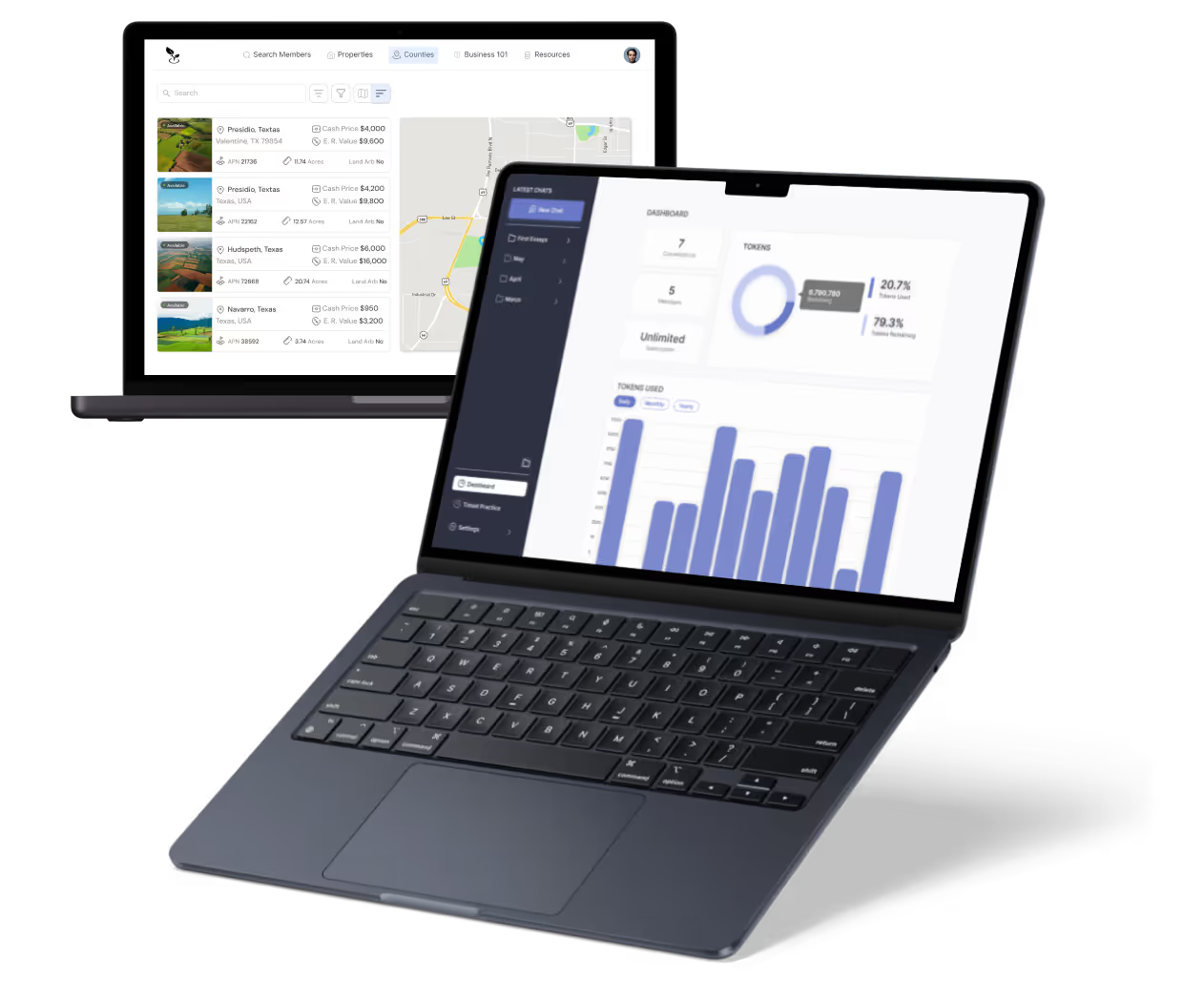
    Copious.Land is a Bubble marketplace for land investors featuring location-based search and data-driven insights. The platform increased successful transactions by 40 percent and improved user engagement shortly after launch.
    Read more about the Copious.Land Bubble case study

These projects reflect how LowCode Agency builds Bubble apps for real-world use, with clean architecture, scalable workflows, and long-term product thinking at the core.

โ€

Strategic Technology Partner

We Help You Win Long-Term

We donโ€™t just deliver softwareโ€”we help you build a business that lasts.

๐Ÿ‘ Image

โ€

โ€

Conclusion

Choosing a Bubble agency is not just a hiring decision; it is a product decision. The Bubble agency you choose shapes how your system is designed, how it scales, and how easy it is to improve later. Hype, badges, or promises matter less than real fit, process, and experience.

When you think beyond the MVP and focus on building a real system, the right Bubble agency becomes a long-term partner, not just a short-term builder.

If you have learned how to choose the best Bubble development agency, feel free to check out our list of the best Bubble agencies for 2026.

Last updated on 

May 29, 2026

.

Jesus Vargas

 - 

Founder

Jesus is a visionary entrepreneur and tech expert. After nearly a decade working in web development, he founded LowCode Agency to help businesses optimize their operations through custom software solutions. 

Custom Automation Solutions

Save Hours Every Week

We automate your daily operations, save you 100+ hours a month, and position your business to scale effortlessly.

๐Ÿ‘ Image
LOW / CODE Agency

Get an Honest MVP Assessment in 5 Minutes

Our AI โ€” trained on 300+ shipped products โ€” tells you what to build, what to skip, and what it'll actually cost. No fluff.

Assess My Idea

"Working with LowCode Agency was the best decision I made in 2025"

Franklin Frith

CEO at HRM

Summarize with AI

FAQs

How do I know if a Bubble agency is right for my project?

A Bubble agency is right for your project if it understands your product goals, asks strong discovery questions, explains workflows clearly, and shows experience with similar complexity. The right agency focuses on long-term use, not just fast delivery.

Should I always choose a Gold agency over a Silver agency?

Not always. Gold agencies usually have broader experience, but a strong Silver agency can be a better fit for many products. What matters more is relevant experience, clear process, honest timelines, and whether the agency understands your specific product needs.

How much does it cost to hire a Bubble agency?

Bubble agency costs usually range from $100 to $200 per hour or $10,000 to $40,000 for fixed-price projects. Pricing depends on app complexity, integrations, timelines, and whether post-launch support is included.

Is it better to hire a freelancer or a Bubble agency?

Freelancers work well for small features or simple tools. A Bubble agency is better for serious products with multiple users, payments, or long-term goals. Agencies offer structure, QA, continuity, and lower risk as complexity grows.

Can a Bubble agency help after launch?

Yes, many Bubble agencies provide post-launch support. This includes bug fixes, performance optimization, feature updates, automation, and scaling support. Ongoing partnership is important if your app will evolve with users and business needs.

How long does it take to build an app with a Bubble agency?

Most Bubble agencies build MVPs in 6 to 10 weeks. More complex SaaS products or internal systems often take 10 to 16 weeks. Timelines depend on clarity, scope, integrations, and how quickly decisions are made.

Related Articles

Mobile App Development

No-code/Low-code

11 Best No-code Mobile App Builders | Donโ€™t Miss Out!

Discover the 11 best no-code mobile app builders to create iOS & Android apps without coding. Compare features & pick the right tool for your needs

Bubble

How to Build a Construction Project Management App with Bubble

Build a construction project management app with Bubble. Track milestones, manage subcontractors, and control budgets โ€” no code, no compromise.

Bubble

How to Build a Subcontractor Management App with Bubble

Build a subcontractor management app with Bubble no code required. Track contracts, tasks, and payments step-by-step with this no-code tutorial.

No-code/Low-code

How to Hire the Best Web App Developers

Learn how to hire the best web app developers for your project. Compare skills, pricing, and platforms to find the perfect fit faster

AI

Bubble

Best Bubble Agency for AI App Development in 2026 (6 Top Picks)

Looking for the best Bubble agency for AI app development? Here are 6 vetted agencies that build production-ready, AI-powered apps on Bubble.io in 2026.

Bubble

How to Build a KPI Dashboard App with Bubble

Build a KPI dashboard with Bubble. Pull live data, visualize metrics, and track goals in real time โ€” a custom dashboard without a BI tool budget.

๐Ÿ‘ Image
Thank you! Your submission has been received!
Oops! Something went wrong while submitting the form.

Why customers trust us for no-code development

๐Ÿ‘ Image
Expertise
Weโ€™ve built 330+ amazing projects with no-code.
๐Ÿ‘ Image
Process
Our process-oriented approach ensures a stress-free experience.
๐Ÿ‘ Image
Support
With a 30+ strong team, weโ€™ll support your business growth.