|
VOOZH | about |
|
VOOZH | about |
11 min
read
Learn the complete MVP development process to launch faster, save costs, and validate your startup idea with real user feedback before scaling
By
Jesus Vargas
Updated on
May 29, 2026
.
Reviewed by
Real-World Experience with No-Code Tools: With over 320 apps built, we know firsthand what works—and what doesn't—when using no-code platforms like Glide, Bubble, FlutterFlow and Webflow.
Expert Team with 40+ Years of Combined Experience: Our team has deep technical knowledge, with experts who use no-code tools to solve real-world problems for clients every day, ensuring our advice is actionable and reliable.
Detailed Guides Based on Actual Projects: We don’t just talk about no-code; we use it daily to solve real business problems for our clients, from MVPs to complex automations.
Take a deeper look at our editorial guidelines
A Minimum Viable Product (MVP) is the simplest version of your app or product that delivers core features to solve a problem for early users. It’s not about building everything at once but focusing on the essentials that prove your idea works.
Startups build MVPs before creating full products because it reduces risk and validates assumptions. Instead of spending months or years on a complex build, an MVP allows founders to launch quickly, test demand, and learn from real user behavior.
The benefits of an MVP include:
By starting small, businesses can grow smarter and faster.
MVP Development Services
Validate Before You Scale
We help you turn concepts into working MVPs ready for user feedback and investor pitches—in weeks, not months.
The foundation of any MVP lies in proper planning and research. Before writing a single line of code or using no-code tools, you need clarity on the problem, users, and goals.
The first step is identifying the pain point you are solving. What problem exists that is significant enough for people to want a solution? Once you know the problem, define your target users.
By understanding your audience deeply, you make sure your MVP is relevant and valuable. A clear target user profile guides decisions in design, functionality, and positioning.
Read more | Healthcare MVP guide
Before committing resources, test your idea in the real world. Use surveys, landing pages, or even pre-orders to measure early interest. Talking to potential users is essential because these conversations reveal what they like, dislike, or expect from a solution.
Social media polls or lightweight prototypes can also gauge demand. The goal is to confirm that people truly want your solution before investing time and money. Validation reduces risk and ensures your MVP solves a real problem.
Read more | Mobile app MVP development guide
Turn your idea into a short, focused statement that explains the problem and how your MVP addresses it.
For example: “Busy freelancers struggle to track invoices. Our app simplifies invoicing in one click.” Then form a solution hypothesis: “If we build X, users will do Y.” This frames your expectations and sets measurable outcomes.
Writing this down forces clarity, keeps the team aligned, and provides a reference for testing later. Without a clear problem statement and hypothesis, it is easy to drift into feature overload.
Read more | MVP case studies
Understanding the market and competition helps you position your MVP effectively. Research existing solutions. What features do they offer, and where do they fall short? Read reviews, study pricing, and analyze user complaints. Gaps in current products are opportunities for differentiation.
Competitor analysis does not mean copying. It means spotting unmet needs and delivering better. This step also shows stakeholders that you know the landscape and can explain why your product deserves attention. A clear analysis ensures your MVP has a unique angle.
Read more | Bubble MVP app development
Your value proposition answers the question: “Why should users choose your product?” Focus on what makes your MVP unique or better than current alternatives.
A strong value proposition highlights how your solution helps users achieve their goals. Keep it simple and user-focused so your audience understands it quickly. This clarity not only helps with adoption but also strengthens investor pitches and marketing campaigns.
Read more | SaaS MVP development guide
Finally, define how you will measure success. Your MVP needs tangible goals such as user signups, demo bookings, or time spent on the app.
These metrics reveal whether your solution resonates with users. For example, if your goal is 500 signups in the first month, you will know if demand exists. Clear goals keep the team aligned and motivated.
Success metrics should reflect both business outcomes and user engagement. This helps you decide whether to pivot, iterate, or scale. Without defined goals, it is difficult to measure progress.
Once you have validated your idea, the next step is deciding what features to include and what type of MVP best suits your goals. This stage is about strategy and focus.
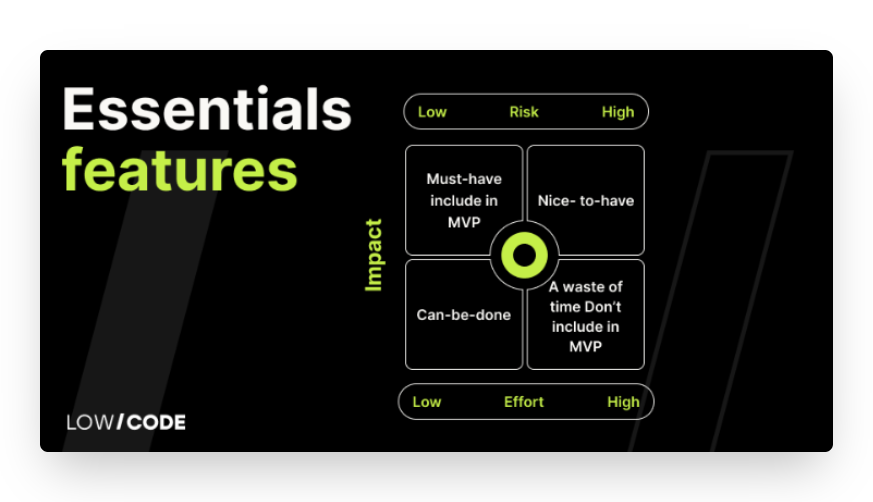
When building an MVP, it is easy to get carried away by feature ideas. The goal, however, is not to build everything at once, but to launch with the essentials. Frameworks like the
Your first release should only include must-have features that directly solve the core user problem. For example, a food delivery MVP only needs menu browsing, ordering, and payments.
Advanced features like loyalty programs or reviews can wait. By keeping the scope lean, you launch faster, save costs, and learn from real users before investing in extras.
Read more | Web MVP development
Not every MVP looks the same. Choosing the right approach depends on your resources and validation goals.
Each method reduces risk while gathering feedback. Picking the right MVP type ensures you test your idea efficiently without overspending on development.
Read more | Best MVP development agencies
Once your strategy is ready, it is time to build. The success of your MVP depends on choosing the right platform and the right people to bring it to life.
The platform you choose shapes the speed, cost, and scalability of your MVP. Each option has its strengths:
Make sure the platform supports integrations, APIs, and scalability. Choosing incorrectly can force costly rebuilds, so align the tool with your app’s vision and long-term growth plans.
Read more | How to Build AI HR App
Even with no-code, experience matters. Working with a no-code agency helps you with:
Agencies like LowCode Agency bring proven frameworks from past MVP launches, which means faster, safer results. If you are a solo founder, partnering with experts fills gaps in design and technical knowledge. With the right guidance, your MVP moves from idea to reality in weeks, not months.
Once the MVP is built, the next step is making sure it works as expected and then introducing it to real users. Testing and launch are critical for gathering insights and driving adoption.
Read more | How to Build an AI App for Customer Service
Start by running internal tests with your team to catch obvious bugs, usability issues, and workflow gaps. Next, release the MVP to a small group of beta users who represent your target audience.
Observe how they interact with the app, where they get stuck, and which features they find most valuable. Collect feedback through surveys, interviews, or built-in analytics to understand real user behavior.
This testing stage ensures your MVP delivers value before a broader launch. Fixing bugs early and improving the user journey increases your chances of market success.
Read more | How to Build AI Ecommerce platform
After beta testing, move to your MVP launch. This could be a soft launch with a limited audience or a public release to a wider market. Keep marketing simple by using cost-effective channels such as landing pages, email campaigns, social media, or product listing sites like Product Hunt.
A smaller launch allows you to monitor performance closely and make quick adjustments. Focus on gathering data about signups, engagement, and retention. The goal of this stage is not perfection but learning fast from real users so you can refine and prepare for growth.
Read more | How to Build an AI Nutritionist App
An MVP is not the end product. It is the beginning of a cycle of feedback, learning, and improvement. This stage ensures your app continues to evolve in ways that match user needs and market demand.
Once your MVP is live, collect as much feedback as possible. Look at usage data, heatmaps, and analytics to see how people interact with the app. Combine this with surveys, interviews, and direct user feedback to uncover what is working and what is not.
The goal is to identify patterns, highlight popular features, and expose problem areas. A clear picture of user behavior allows you to make informed decisions instead of guessing what to change.
Read more | AI fitness app development guide
Adopt the Build-Measure-Learn loop, a proven framework from Lean Startup methodology. Build a feature or improvement, measure how users respond, and learn from the results. Keep feedback cycles short to avoid wasting time on features nobody wants.
The faster you test and improve, the closer your product moves toward product-market fit. Iteration is not about adding endless features, but refining the core experience users care about most.
Read more | How to hire AI app developers
Not every MVP will succeed in its original form. The key is knowing when to pivot or persevere. If metrics show weak engagement, low retention, or feedback that points to a misaligned solution, it may be time to pivot toward a new direction.
On the other hand, if usage grows and users clearly value your product, double down on what is working. Making this decision with data, rather than gut feeling, ensures your resources go toward building a product that can succeed long term.
Read more | AI business process automation guide
Building and launching an MVP is only the first step. The real journey begins once you start improving, scaling, and turning your prototype into a complete product.
After launch, focus on adding features that users truly want. Avoid guessing; instead, use feedback and analytics to guide decisions. Improvements may include faster performance, smoother user experience, or better workflows.
Small but targeted updates can create a stronger product-market fit. Do not overload your app with unnecessary features. Instead, prioritize enhancements that directly address user pain points and make the app more valuable.
Understanding realistic timelines helps you plan resources and set appropriate expectations with stakeholders, investors, and early users.
Post-launch iteration cycles should be much faster—typically 1-2 weeks for minor improvements and 4-6 weeks for significant feature additions. This accelerated pace lets you respond quickly to user feedback and market changes.
Remember, these are estimates for working with experienced teams. Solo development or working with inexperienced developers can extend timelines significantly.
Read more | Best no-code AI app builders
Many startups fail by building too much too early. Instead of focusing on essentials, they add unnecessary features that slow down launch. Skipping validation is another common mistake, leading to wasted effort on products nobody wants.
Finally, ignoring user feedback can be fatal. An MVP’s purpose is to learn, so disregarding insights removes the advantage of testing. Avoiding these mistakes saves time and money.
Read more | MVP development challenges and mistakes
Strategic Technology Partner
We Help You Win Long-Term
We don’t just deliver software—we help you build a business that lasts.
Scaling requires knowing when to rebuild and when to expand. If your MVP was built on a platform that limits performance, consider rebuilding with a scalable backend. Add advanced features only after validating demand.
These may include automation, integrations, or premium tiers. The focus should shift from quick testing to building a reliable product that supports growth, larger user bases, and long-term revenue.
Ready to transform your startup idea into reality? Don't let your innovative concept remain just an idea while competitors capture your market. At LowCode Agency, we've helped over 330 founders turn their visions into MVPs.
Book a free discovery call with our team and discover how we can accelerate your startup journey while avoiding the costly mistakes that derail most first-time founders.
Last updated on
May 29, 2026
.
Jesus Vargas
-
Founder
Jesus is a visionary entrepreneur and tech expert. After nearly a decade working in web development, he founded LowCode Agency to help businesses optimize their operations through custom software solutions.
Custom Automation Solutions
Save Hours Every Week
We automate your daily operations, save you 100+ hours a month, and position your business to scale effortlessly.
Our AI — trained on 300+ shipped products — tells you what to build, what to skip, and what it'll actually cost. No fluff.
Assess My Idea"Working with LowCode Agency was the best decision I made in 2025"
Franklin Frith
CEO at HRM
An MVP (Minimum Viable Product) is the simplest version of your product that solves your customers core problem and can be released to real users. Unlike prototypes or beta versions, an MVP is a functional product that people can use and provide feedback on. It contains only essential features needed to validate your business concept and test market demand before investing in full development.
MVP development typically takes 6-12 weeks when working with experienced no-code development teams. The timeline depends on complexity: simple apps with basic functionality can be completed in 6-8 weeks, while sophisticated platforms with multiple user types and complex workflows may require 10-12 weeks. This includes planning, design, development, testing, and launch preparation phases.
The MVP process involves five main phases: Planning and Research (defining problems, validating ideas, analyzing competition), Design and Prototyping (creating user flows and mockups), Building (developing using no-code platforms), Testing and Launch (quality assurance and deployment), and Learn and Iterate (collecting feedback and making improvements). Each phase builds upon insights from the previous stage.
Professional MVP development typically costs $30,000-$50,000 depending on complexity and platform choice. While DIY development might seem cheaper, it often leads to poor architecture, extensive rebuilds, and missed market opportunities. Working with experienced agencies provides faster time-to-market, better user experience, and scalable foundations that support future growth without costly technical debt.
Post-launch validation combines quantitative metrics (user engagement, retention rates, feature usage) with qualitative feedback (user interviews, surveys, support conversations). Track leading indicators like onboarding completion and time-to-first-value alongside lagging indicators like monthly retention. Use tools like Google Analytics, Hotjar, and direct user feedback to understand what's working and what needs improvement.
Yes, many successful companies scale directly from their MVP using no-code platforms without rebuilding. The decision to rebuild should be economic; when platform limitations prevent growth or essential features. Often, optimizing existing workflows and upgrading platform plans delivers better results than starting over. Consider rebuilding only when current limitations clearly cost more than development investment.
MVP
7 MVP Case Studies: How We Helped Founders Validate Ideas with No-code
Want to launch fast? These 7 MVP case studies show how we helped founders validate ideas with no-code and build products in just 5 weeks. Learn more
Mobile App Development
MVP
MVP Mobile App Cost and Scope (Real Budget & Planning Guide)
MVP mobile app cost explained for founders. See real budgets, feature scope, timelines, and how to plan version 1 without overspending or overbuilding.
MVP
Top 10 MVP Development Agencies (2026) | Top Rated
Find the best MVP agency for your startup. Our 2026 list features fast, trusted teams that help you launch and grow without breaking the bank
Bubble
MVP
Bubble MVP App Development: Guide for Startups and Founders
Build your MVP faster with Bubble. Learn how startups use Bubble to launch scalable MVP apps without coding
MVP
No-code/Low-code
No-code MVP Development (How to Build, Validate, and Scale)
Learn how to build a no-code MVP step by step, validate your idea, reduce costs, and scale your product with the right strategy in 2026.
MVP
MVP Cost in 2026: Low-code vs Custom Development
Compare MVP costs in 2026 between low-code and custom development. Understand pricing, timelines, and trade-offs to choose the right build path.