VOOZH about

URL: https://www.mindat.org/min-3063.html

⇱ Painite: Mineral information, data and localities.


👁 Image
Now Featuring: The Bruce Carter Collection at Heritage Auctions, Live May 16th
Log InRegister
AboutSupport UsPhotosDiscussionsSearchLearnMore

Painite

A valid IMA mineral species - grandfathered
This page is currently not sponsored. Click here to sponsor this page.

About PainiteHide

This section is currently hidden. Click the show button to view.
Formula:
CaZrAl9(BO3)O15
Colour:
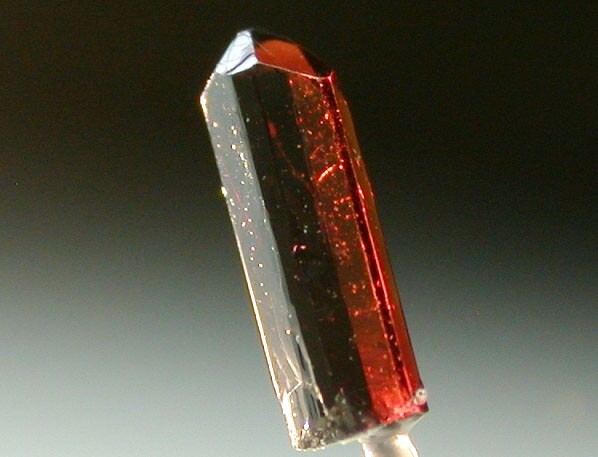
Red, brownish, orange-red
Hardness:
8
Specific Gravity:
4.01 - 4.03
Crystal System:
Hexagonal
Name:
Named in honor of Arthur Charles Davy Pain (23rd June 1901, Exmouth, England, UK - 27th August 1971, Exmouth, England, UK), mineralogist and gemmologist who first noted it as an interesting crystal.
Painite is an extremely rare borate mineral containing calcium, zirconium, boron, aluminium, and oxygen, with trace amounts of vanadium and chromium often contributing to its reddish-brown to orange-red coloration.

First discovered in Myanmar in the 1950s by British gemmologist Arthur C.D. Pain, after whom it is named, painite was for decades known from only a handful of specimens and was listed for many years as the world's rarest gemstone.

The Guinness Book of Records listed painite as the rarest gem between around 1981 and 2005. New finds in the early 2000s brought a relatively large amount of new painite specimens to the market.

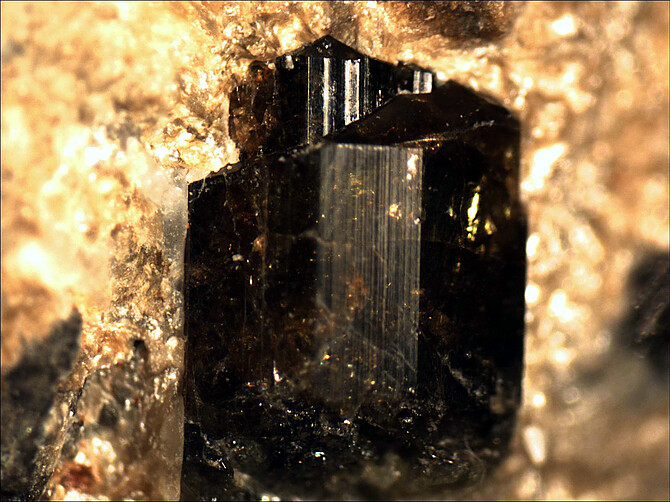
It crystallises in the hexagonal system, typically forming prismatic or short, stubby crystals, and may show strong pleochroism from brownish-red to orangish-red hues. Transparent gem-quality crystals are highly prized by collectors, while most material is opaque to translucent. Its scarcity, complex chemistry, and limited geographic occurrence make painite a notable species in both mineralogical and gemmological circles.

Painite is only found from Myanmar - reports online of painite from Sri Lanka, Madagascar, Mozambique and other places are incorrect. Material sold as painite from these places is either Myanmar painite being sold with a deceptive origin to avoid potential sanctions or, usually, another stone entirely (e.g. garnet.)


Unique IdentifiersHide

This section is currently hidden. Click the show button to view.
Mindat ID:
3063
Long-form identifier:
mindat:1:1:3063:8

Similar NamesHide

This section is currently hidden. Click the show button to view.
Hainite-(Y)A valid IMA mineral species - grandfatheredNa2Ca4(Y,REE)Ti(Si2O7)2OF3
KainiteA valid IMA mineral species - grandfatheredKMg(SO4)Cl · 3H2O
Pinite
PinnoiteA valid IMA mineral species - grandfatheredMg[B2O(OH)6]
PoniteA variety of Rhodochrosite(Mn,Fe)CO3

IMA Classification of PainiteHide

This section is currently hidden. Click the show button to view.
Approved, 'Grandfathered' (first described prior to 1959)
IMA Formula:
CaZrAl9O15(BO3)

Classification of PainiteHide

This section is currently hidden. Click the show button to view.
6.AB.85

6 : BORATES
A : Monoborates
B : BO3, with additional anions; 1(D) + OH, etc.
7.5.2.1

7 : MULTIPLE OXIDES
5 : (AB)2X3
7.10.3

7 : Oxides and Hydroxides
10 : Oxides of Zr and Th

Mineral SymbolsHide

This section is currently hidden. Click the show button to view.
As of 2021 there are now IMA–CNMNC approved mineral symbols (abbreviations) for each mineral species, useful for tables and diagrams.

SymbolSourceReference for Standard
PaiIMA–CNMNCWarr, L.N. (2021). IMA–CNMNC approved mineral symbols. Mineralogical Magazine, 85(3), 291-320. doi:10.1180/mgm.2021.43

Physical Properties of PainiteHide

This section is currently hidden. Click the show button to view.
Colour:
Red, brownish, orange-red
Hardness:
Density:
4.01 - 4.03 g/cm3 (Measured)    4.01 g/cm3 (Calculated)
Comment:
D(calc.) = 3.996–4.020

Optical Data of PainiteHide

This section is currently hidden. Click the show button to view.
Type:
Uniaxial (-)
RI values:
nω = 1.8159 nε = 1.7875
Max. Birefringence:
δ = 0.028
Based on recorded range of RI values above.

Interference Colours:
The colours simulate birefringence patterns seen in thin section under crossed polars. They do not take into account mineral colouration or opacity.

Michel-Levy Bar The default colours simulate the birefringence range for a 30 µm thin-section thickness. Adjust the slider to simulate a different thickness.

Grain Simulation You can rotate the grain simulation to show how this range might look as you rotated a sample under crossed polars.

Surface Relief:
Moderate
Pleochroism:
Strong
Comments:
Ruby-red // to [0001]; pale brownish orange or pale red-orange perpendicular to [0001].

Chemistry of PainiteHide

This section is currently hidden. Click the show button to view.
Mindat Formula:
CaZrAl9(BO3)O15
Element Weights:
Element% weight
O42.796 %
Al36.086 %
Zr13.556 %
Ca5.956 %
B1.607 %

Calculated from ideal end-member formula.

Crystallography of PainiteHide

This section is currently hidden. Click the show button to view.
Crystal System:
Hexagonal
Class (H-M):
6/m - Dipyramidal
Space Group:
P63/m
Cell Parameters:
a = 8.724(1) Å, c = 8.464(2) Å
Ratio:
a:c = 1 : 0.97
Unit Cell V:
557.88 ų (Calculated from Unit Cell)
Morphology:
Elongate crystals.
Comment:
Data from Armbruster et al. (2004); previously assumed to have space group P63.

Crystal StructureHide

This section is currently hidden. Click the show button to view.
Load
Unit Cell | Unit Cell Packed
2x2x2 | 3x3x3 | 4x4x4
Show
Big Balls | Small Balls | Just Balls | Spacefill
Polyhedra Off | Si Polyhedra | All Polyhedra
Remove metal-metal sticks
Display Options
Black Background | White Background
Perspective On | Perspective Off
2D | Stereo | Red-Blue | Red-Cyan
View
CIF File    Best | x | y | z | a | b | c
Rotation
Stop | Start
Labels
Console Off | On | Grey | Yellow
Data courtesy of the American Mineralogist Crystal Structure Database. Click on an AMCSD ID to view structure
IDSpeciesReferenceLinkYearLocalityPressure (GPa)Temp (K)
0003470PainiteArmbruster T, Dobelin N, Peretti A, Gunther D, Reusser E, Grobety B (2004) The crystal structure of painite CaZrB[Al9O18] revisited American Mineralogist 89 610-613👁 Image
2004Mogok0293
0000495PainiteMoore P B, Araki T (1976) Painite, CaZrB[Al9O18]: Its crystal structure and relation to jeremejevite, B5[X3Al6(OH)3O15], and fluoborite, B3[Mg9(F,OH)9O9] American Mineralogist 61 88-94👁 Image
19760293
CIF Raw Data - click here to close

X-Ray Powder DiffractionHide

This section is currently hidden. Click the show button to view.
Powder Diffraction Data:
d-spacingIntensity
5.76 Å(vs)
3.70 Å(s)
2.520 Å(vs)
2.370 Å(s)
2.008 Å(s)
1.726 Å(ms)
1.423 Å(ms)

Geological EnvironmentHide

This section is currently hidden. Click the show button to view.
Paragenetic Mode(s):

Type Occurrence of PainiteHide

This section is currently hidden. Click the show button to view.
General Appearance of Type Material:
Single crystal.
Place of Conservation of Type Material:
Natural History Museum, London, United Kingdom, number BM 1954,192 (holotype).
National Museum of Natural History, Washington, D.C., USA, number 142506 (holotype).
Geological Setting of Type Material:
Gem gravels.
Associated Minerals at Type Locality:

Other Language Names for PainiteHide

This section is currently hidden. Click the show button to view.
Dutch:Painiet
German:Painit
Russian:Пейнит
Simplified Chinese:铝硼锆钙石
Spanish:Painita

Common AssociatesHide

This section is currently hidden. Click the show button to view.
Associations Based on Photo Data:
39 photos of Painite associated with 'Ruby'Al2O3
7 photos of Painite associated with CorundumAl2O3
5 photos of Painite associated with CalciteCaCO3
2 photos of Painite associated with PhlogopiteKMg3(AlSi3O10)(OH)2
1 photo of Painite associated with 'Sapphire'Al2O3
1 photo of Painite associated with SpinelMgAl2O4

Related Minerals - Strunz-mindat GroupingHide

This section is currently hidden. Click the show button to view.
6.AB.ChubaroviteKZn2(BO3)Cl2Trig. 32 : R32
6.AB.Rhabdoborite-(Mo)Mg12Mo6+1.33O6(BO3)6F2Hex. 6 : P63
6.AB.05HambergiteBe2(BO3)(OH)Orth. mmm(2/m2/m2/m) : Pbca
6.AB.10BerboriteBe2(BO3)(OH) · H2OTrig.
6.AB.15JeremejeviteAl6(BO3)5(F,OH)3Hex. 6/m : P63/m
6.AB.20YuanfuliiteMg(Fe3+,Al)O(BO3)Orth. mmm(2/m2/m2/m) : Pnma
6.AB.20Warwickite(Mg,Ti,Fe,Al)2O(BO3)Orth. mmm(2/m2/m2/m) : Pnma
6.AB.25Karlite(Mg,Al)6.5(BO3)3(OH)4(◻,Cl)0.5Orth. 222 : P21212
6.AB.30MarinaiteCu2Fe3+O2(BO3)Mon. 2/m : P21/b
6.AB.30SavelievaiteMg2Cr3+O2(BO3)Orth. mmm(2/m2/m2/m) : Pbam
6.AB.30FredrikssoniteMg2(Mn3+,Fe3+)(BO3)O2Orth. mmm(2/m2/m2/m) : Pbam
6.AB.30VonseniteFe2+2Fe3+(BO3)O2Orth. mmm(2/m2/m2/m) : Pbam
6.AB.30LudwigiteMg2Fe3+(BO3)O2Orth. mmm(2/m2/m2/m) : Pbam
6.AB.30Azoproite(Mg,Fe2+)2(Fe3+,Ti,Mg)(BO3)O2Orth. mmm(2/m2/m2/m) : Pbam
6.AB.30BonaccorditeNi2Fe3+(BO3)O2Orth. mmm(2/m2/m2/m) : Pbam
6.AB.35FolvikiteSb5+Mn3+(Mg,Mn2+)10O8(BO3)4Mon. 2 : P2
6.AB.35Pinakiolite(Mg,Mn2+)2Mn3+(BO3)O2Mon. 2/m : B2/m
6.AB.40Takéuchiite(Mg,Mn2+)2(Mn3+,Fe3+)(BO3)O2Orth. mmm(2/m2/m2/m) : Pnnm
6.AB.40BlatteriteSb5+3(Mn3+,Fe3+)9(Mn2+,Mg)35(BO3)16O32Orth. mmm(2/m2/m2/m) : Pnnm
6.AB.40Orthopinakiolite(Mg,Mn2+)2Mn3+(BO3)O2Orth. mmm(2/m2/m2/m) : Pnnm
6.AB.40ChestermaniteMg2(Fe3+,Mn3+,Al,Sb3+)(BO3)O2Orth. mmm(2/m2/m2/m)
6.AB.45Aluminomagnesiohulsite(Mg,Fe2+)2(Al,Mg,Sn)(BO3)O2Mon. 2/m : P2/m
6.AB.45HulsiteFe2+2Fe3+O2(BO3)Mon. 2/m : P2/m
6.AB.45MagnesiohulsiteMg2Fe3+O2(BO3)Mon. 2/m : P2/m
6.AB.50FluoboriteMg3(BO3)(F,OH)3Hex. 6/m : P63/m
6.AB.50HydroxylboriteMg3(BO3)(OH)3Hex. 6/m : P63/m
6.AB.55ShabyniteMg5(BO3)(OH)5(Cl,OH)2 · 4H2OMon.
6.AB.55WightmaniteMg5(BO3)O(OH)5 · 2H2OMon. 2/m
6.AB.60GaudefroyiteCa4Mn3+2-3(BO3)3(CO3)(O,OH)3Hex.
6.AB.65SakhaiteCa48Mg16(BO3)32(CO3)16 · 2(H2O,HCl)Iso. m3m(4/m32/m) : Fd3m
6.AB.70HarkeriteCa48Mg16[AlSi4O15(OH)]4(BO3)16(CO3)16 · 2(H2O,HCl)Trig. 3m(32/m) : R3m
6.AB.75Pertsevite-(F)Mg2(BO3)(F,OH)Orth. mm2 : Pna21
6.AB.75Pertsevite-(OH)Mg2(BO3)(OH)Orth. mmm(2/m2/m2/m) : Pnma
6.AB.80JacquesdietrichiteCu2(H2BO3)(OH)3Orth. mmm(2/m2/m2/m) : Pmna
6.AB.85Rhabdoborite-(V)Mg12(V5+,Mo6+,W6+)1.5O6{[BO3]6-x[(P,As)O4]xF2-x} (x < 1)Hex. 6 : P63
6.AB.85Rhabdoborite-(W)Mg12(W6+,V5+)1.5O6{[BO3]6-x[(P,As)O4]xF2-x} Hex. 6 : P63
6.AB.90Mengxianminite(Ca,Na)2Sn2(Mg,Fe)3Al8[(BO3)(BeO4)O6]2Orth. mm2 : Fdd2

Other InformationHide

This section is currently hidden. Click the show button to view.
Notes:
Insoluble in acids and only slowly attacked by fusion with sodium carbonate or with sodium pyrosulphate.
Health Risks:
No information on health risks for this material has been entered into the database. You should always treat mineral specimens with care.

Internet Links for PainiteHide

This section is currently hidden. Click the show button to view.

References for PainiteHide

This section is currently hidden. Click the show button to view.

Localities for PainiteHide

This section is currently hidden. Click the show button to view.

Showing 11 localities.

This map shows a selection of localities that have latitude and longitude coordinates recorded. Click on the 👁 Image
symbol to view information about a locality. The 👁 Image
symbol next to localities in the list can be used to jump to that position on the map.

Locality ListHide

This section is currently hidden. Click the show button to view.
👁 Image
- This locality has map coordinates listed.
👁 Image
- This locality has estimated coordinates.
ⓘ - Click for references and further information on this occurrence. ? - Indicates mineral may be doubtful at this locality. 👁 Image
- Good crystals or important locality for species.
👁 Image
- World class for species or very significant.
(TL) - Type Locality for a valid mineral species. (FRL) - First Recorded Locality for everything else (eg varieties). Struck out - Mineral was erroneously reported from this locality. Faded * - Never found at this locality but inferred to have existed at some point in the past (e.g. from pseudomorphs).

All localities listed without proper references should be considered as questionable.
Myanmar
  • Kachin State
    • Mohnyin District
      • Hpakant Township (Hpakan; Phakant; Phakan)
Rossman GR et al. (2005) +2 other references
  • Mandalay Region
    • Pyin-Oo-Lwin District
      • Mogok Township
        • Kyatpyin Central
Kyaw Thu (2007)
Themelis (2008)
Themelis (2008)
Jordi Fabre collection
          • Thurein-taung
Kyaw Thu (2007) +1 other reference
Themelis (2008)
Kyaw Thu (2007) +1 other reference
Pavel.M. Kartashov (n.d.)
        • Mogok Valley
Claringbull et al. (1957) +1 other reference
Kyaw Thu (2007)
Quick NavTopAbout PainiteUnique IdentifiersSimilar NamesIMA Classification Classification Mineral SymbolsPhysical Properties Optical Data Chemistry Crystallography Crystal StructureX-Ray Powder DiffractionGeological EnvironmentType Occurrence Other LanguagesCommon AssociatesStrunz-MindatOther InformationInternet Links References Localities Locality List
Mindat.org® is an outreach project of the Hudson Institute of Mineralogy, a 501(c)(3) not-for-profit organization. Mindat® and mindat.org® are registered trademarks of the Hudson Institute of Mineralogy.
Copyright © mindat.org and the Hudson Institute of Mineralogy 1993-2026, except where stated. Most political location boundaries are © OpenStreetMap contributors. Mindat.org relies on the contributions of thousands of members and supporters. Founded in 2000 by Jolyon Ralph and Ida Chau.
To cite: Ralph, J., Von Bargen, D., Martynov, P., Zhang, J., Que, X., Prabhu, A., Morrison, S. M., Li, W., Chen, W., & Ma, X. (2025). Mindat.org: The open access mineralogy database to accelerate data-intensive geoscience research. American Mineralogist, 110(6), 833–844. doi:10.2138/am-2024-9486.
Privacy Policy - Terms & Conditions - Contact Us / DMCA issues - Report a bug/vulnerability Current server date and time: April 4, 2026 21:43:41 Page updated: April 4, 2026 16:11:30
Go to top of page